 Who was allowed to say genocideBare in 1969, when the victims were Israeli · 1948 to 2021
A word, and whose mouth it came out of
Who was allowed to say genocide
Raphael Lemkin coined the word in 1944. Four years later the United Nations wrote it into law, and in August 1948, while that debate was still going on, an American newspaper printed it about Palestine for the first time. It has been in American papers about Palestine ever since. The question worth asking is not whether it was said. It is who got to say it.
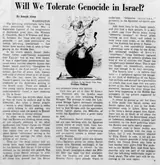
A syndicated column, 1969

The Sentinel, 14 November 1969 · Joseph Alsop
No quotation marks. No attribution. The paper’s own columnist, in the headline.
A local column, forty-five years later
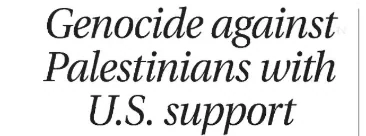
Lincoln Journal Star, 8 August 2014 · Ruth Raymond Thone
The first time in this collection that an American paper says it plainly, in its own voice, with Palestinians as the subject.
Every clipping here that uses the word, sorted by whose voice carries it. Counts are of 33 clippings found by searching for the word, so they describe this collection and not the American press.
A Palestinian, in 1980. The section above sorts the word by whose voice carries it, and this is the earliest instance in the collection where that voice is Palestinian and named. Mamoun el Sayyed, editor of the East Jerusalem paper El Fajar, quoted in a Florida daily on the settlers of Kiryat Arba: Rabbi Levinger is writing his own version of the Nuremberg laws. Kahane is inclined toward deportation and genocide.
On the same page Meir Kahane is quoted saying There is only one solution: The Arabs must leave Israel.
Twice it is the other way round. A Jewish weekly in 1948 calls what is happening to Jews in Arab countries “genocide,” in quotation marks, because the word was four years old. Alsop uses it about Israelis in 1969 with no quotation marks. And in 2014 two syndicated columnists put it in their headlines with no quotation marks in order to deny it: Genocide in Gaza is a lie worthy of Goebbels, and Facts disprove genocide charges hurled at Israel.
The word was never unavailable. It ran with no quotation marks around it, in mainstream papers, in their own voice, for decades — to warn about Israelis, and to rebut the charge. What took until 2014 was saying it plainly about Palestinians.
The ugliest clipping in this section is the one that has to stay. In August 2002 the Atlanta Constitution reported that white supremacists in Georgia were leafleting homes with the words “stop subsidizing Israeli genocide against Palestine.” The story is about Palestinian solidarity groups barring them from the pickets. Samir Moukaddam of the American-Arab Anti-Discrimination Committee describes how the approach goes: “At some point, they start saying, ‘Jews are this and Jews are that.’” Adam Levenstein, who is Jewish and a member of Atlanta Palestine Solidarity: “We want nothing to do with these people.”
Cropped to the leaflet it would say the opposite of what the page says, so it is held whole.
What the clipping records is a tactic. Organized white-supremacist groups attach themselves to Palestinian solidarity in order to move an audience from criticizing a state to a claim about Jewish people, which is antisemitism and is the thing the leafleting is for. The people actually doing the organizing in this story say so themselves and shut it down on the spot: Moukaddam describes the pivot, Levenstein refuses the association. The leaflet is not evidence about the movement it was aimed at. It is evidence about who tries to stand next to it.