Three hundred years of
American newspapers
What they called Palestinians, what they printed, and what they left out. 1724 to 6 October 2023.
Move across the years, or tap one, and read it below.
The bars count what this archive holds for each stretch of years, not how much the American press published. They move as the archive grows.
1700s1724–1799
News crossed the Atlantic by ship. Nobody in it had a nationality.
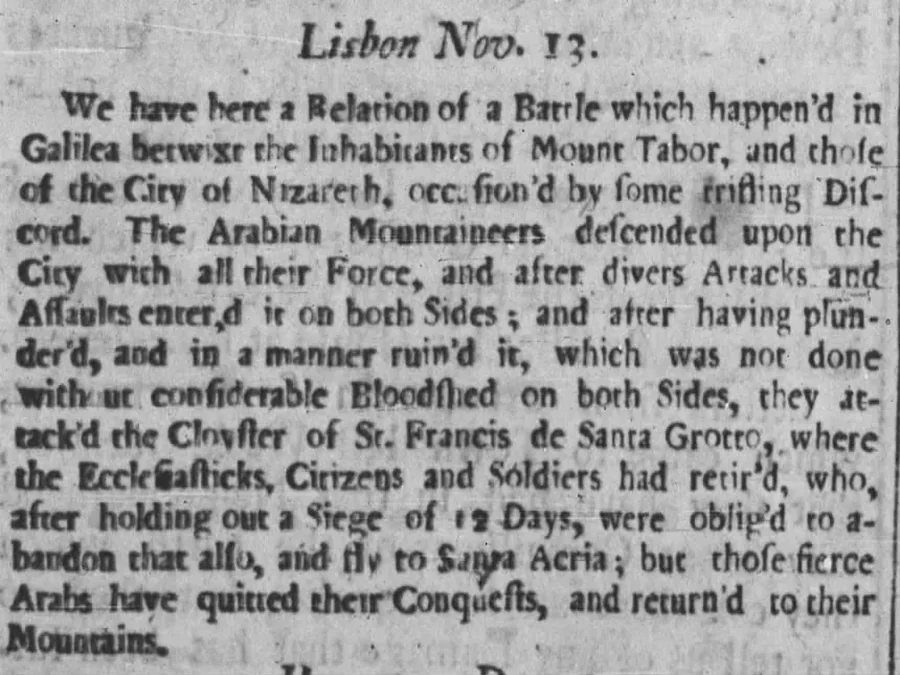
The oldest clipping here ran in a Philadelphia paper in 1724. It reports a battle between the people of Mount Tabor and the people of Nazareth, three months after it happened.
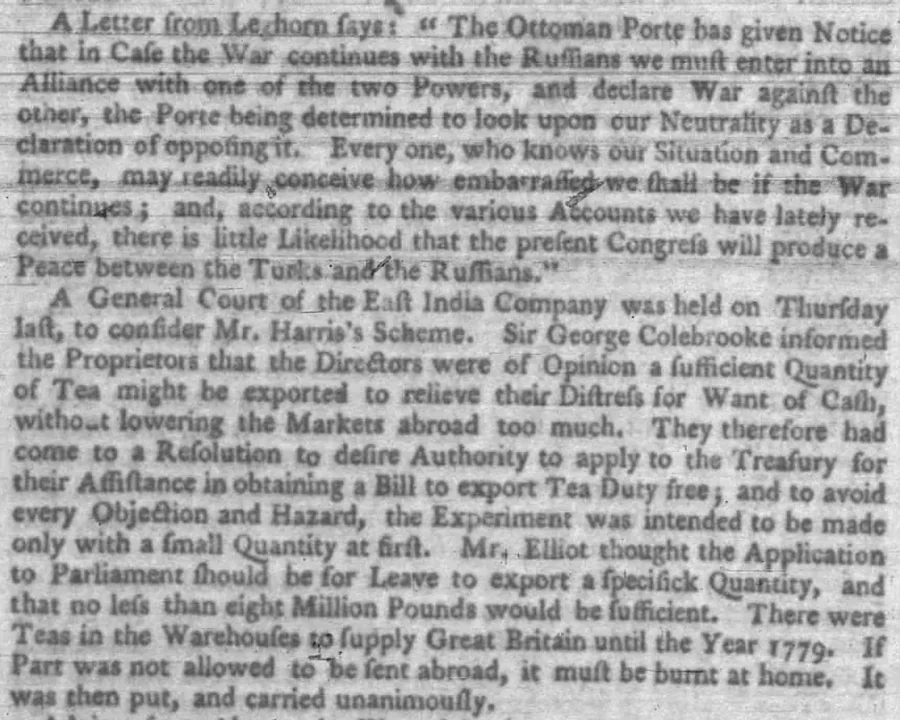
Palestine turns up in these years as distant news. The papers name towns and rulers. They don't name peoples. In 1773 a Virginia paper reports that Jaffa and Jerusalem have fallen to a ruler called Ali Bey, and leaves it there.
Everything that comes later is an argument about who the land belongs to. These pages are from before anyone was having it.
1800s1800–1899
Americans go, look at the farmers, and write home about them.
Americans start traveling to Palestine and publishing what they find. Bible sites, orange groves, rainfall, soil.
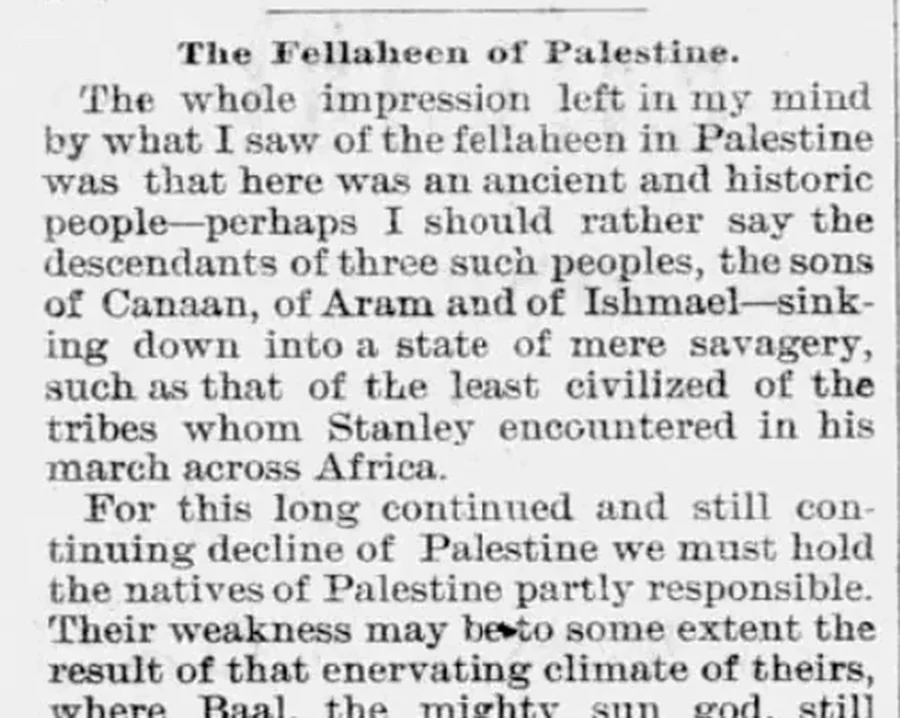
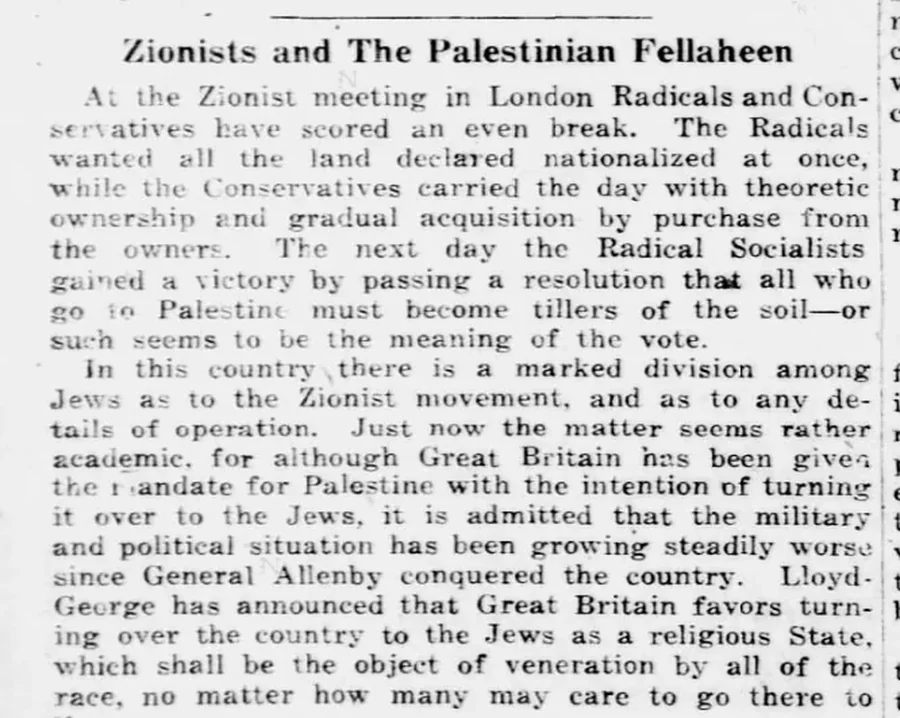
They write about the people working the land and use the Arabic word for them. In 1891 a paper called The Day runs a piece titled The Fellaheen of Palestine and calls them “an ancient and historic people.” Within forty years American papers will mostly stop describing these farmers at all.
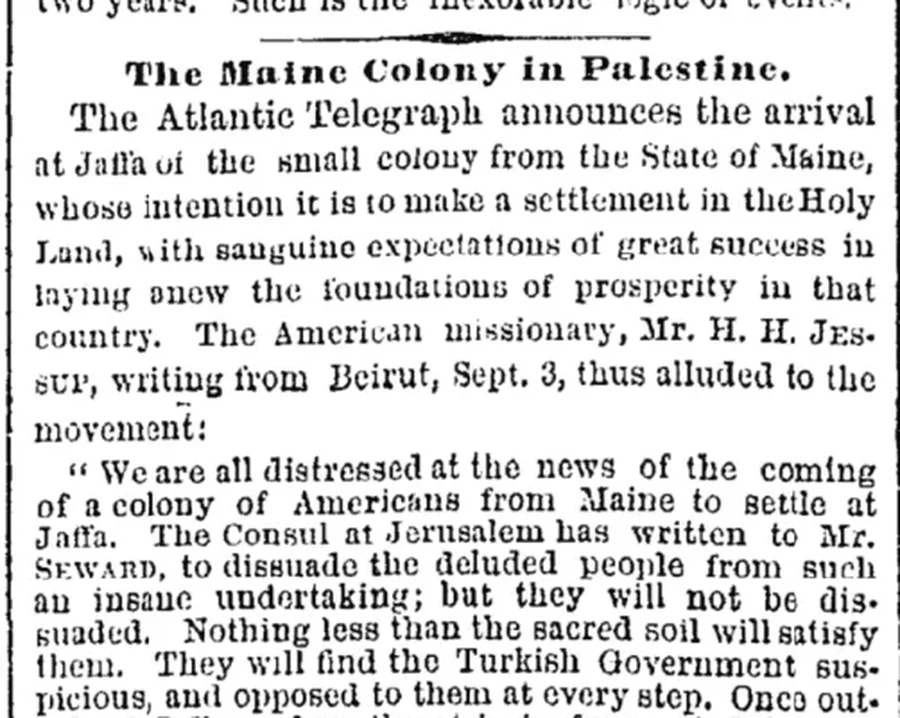
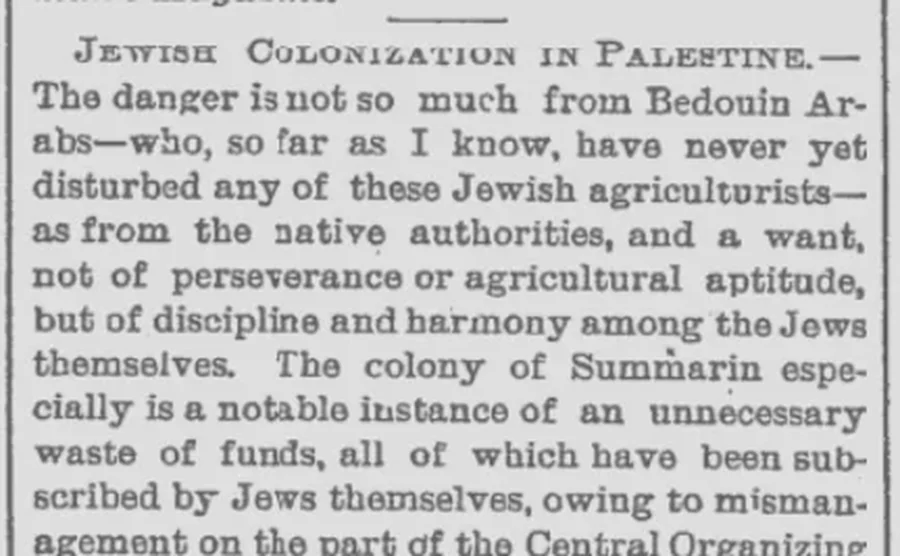
In 1866 the New York Times covers a group of Americans from Maine settling at Jaffa. In 1883 the same paper runs the headline Jewish Colonization in Palestine. Colonization is the ordinary word for settling land, and nobody's using it as an accusation yet.
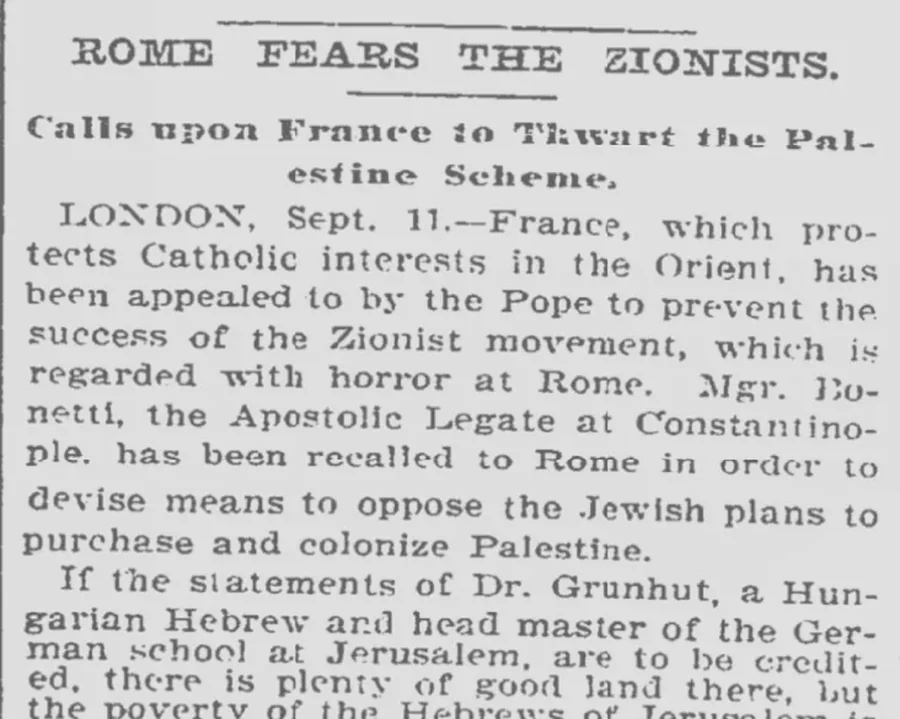
By 1897 the Times is reporting the first Zionist Congress in Basel.
1900s1900–1909
Zionism becomes the story, and Americans argue about it among themselves.
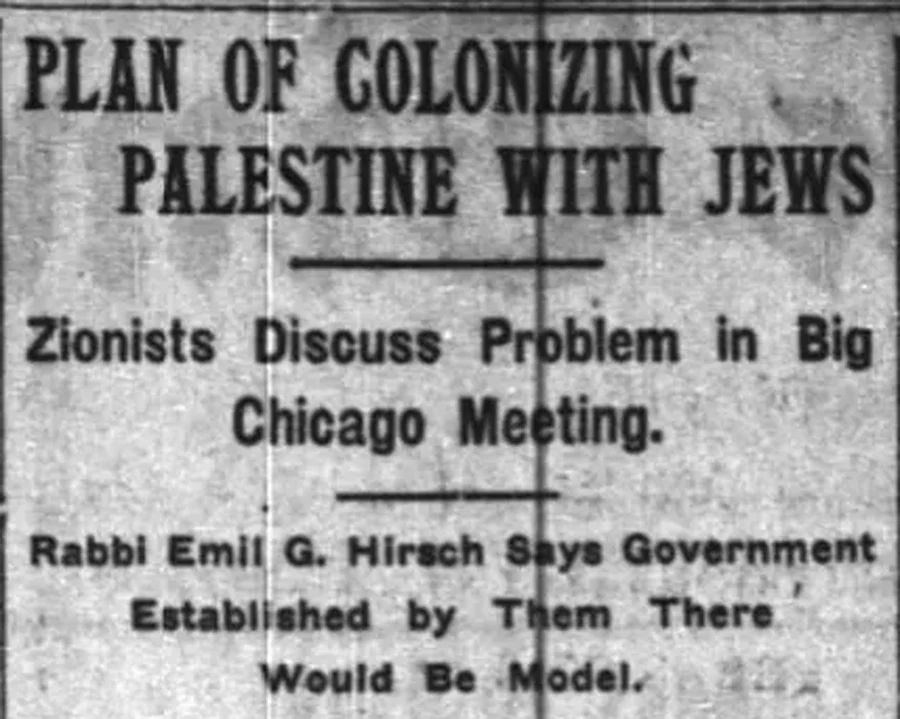
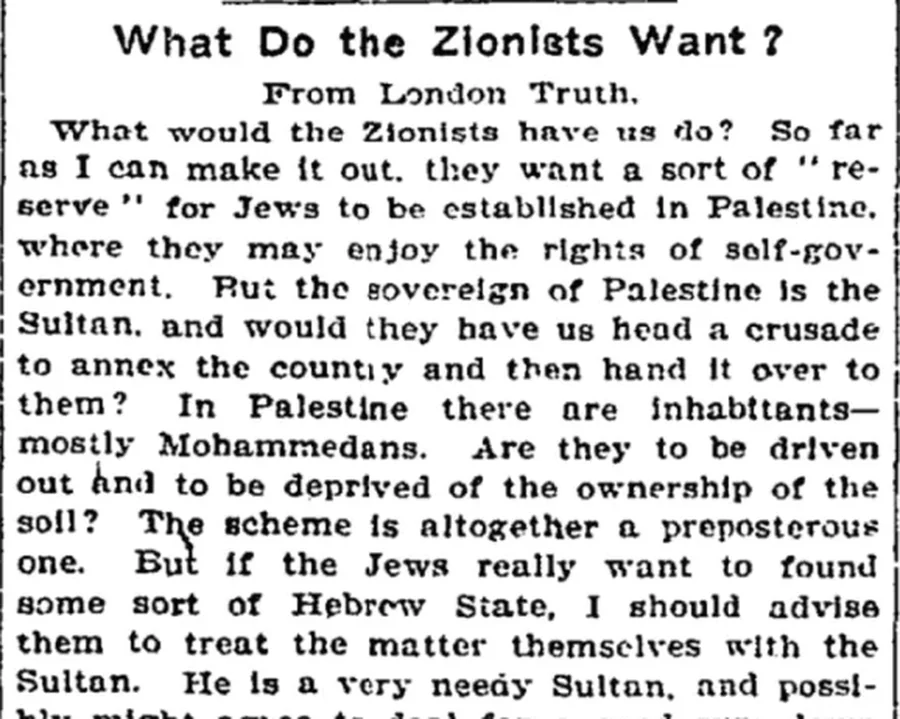
The argument in these pages runs between American rabbis, American editors and European congresses. The Times asks, flatly, What Do the Zionists Want? Another paper covers a rabbi attacking the movement from a New York pulpit.
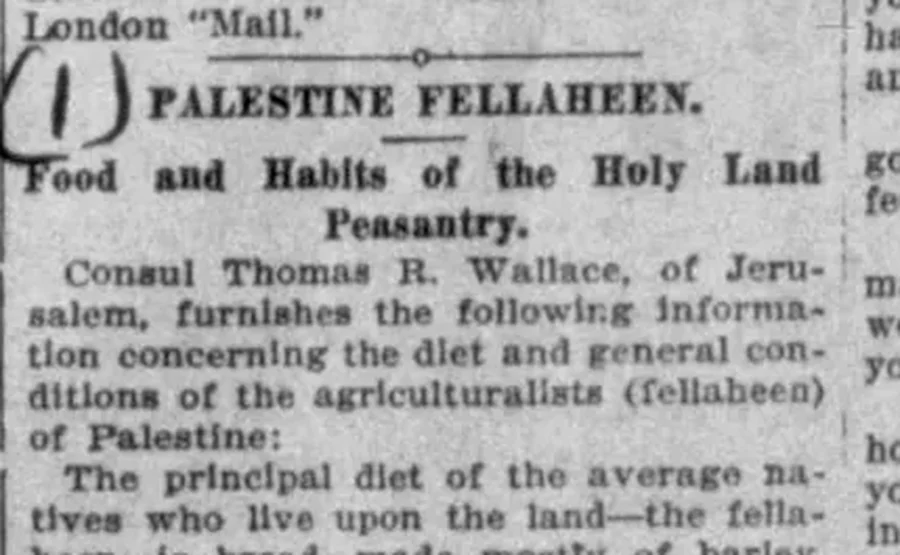
The people already living in Palestine appear mainly in a consular report about what the fellaheen eat. They're an agricultural condition to be described, not a party to the argument about their home.
1910s1910–1919
The land gets called empty. Its farmers are described in detail on the same pages.
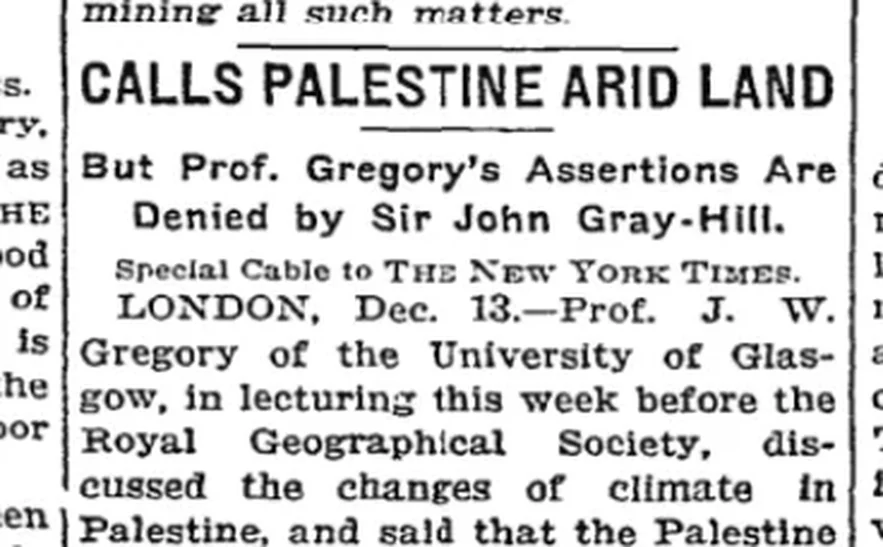
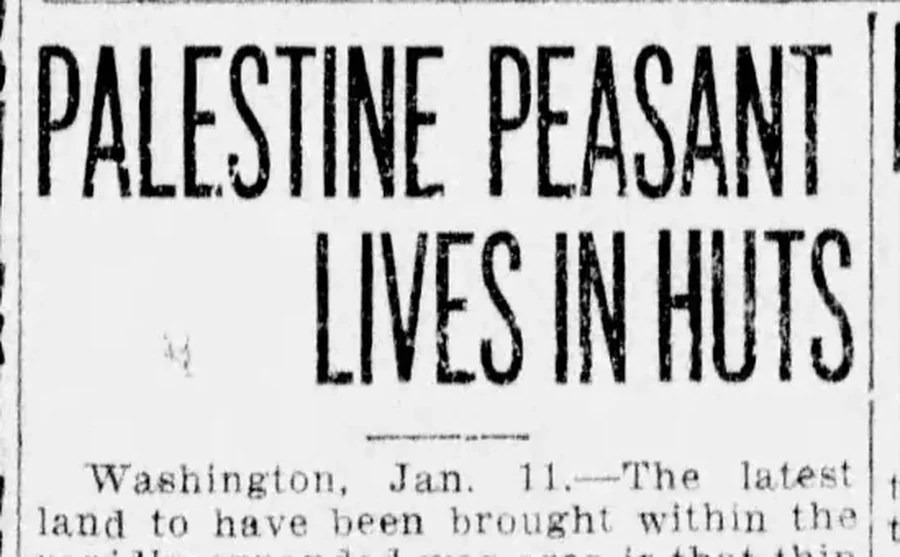
A professor tells the Royal Geographical Society that Palestine is arid, and the Times prints Calls Palestine Arid Land. Another paper runs Palestine In Waste. A third explains that the Palestine peasant lives in huts.
The same years carry close descriptions of the villages, the crops, the harvests. The papers can see the people. They don't treat them as people with a claim.
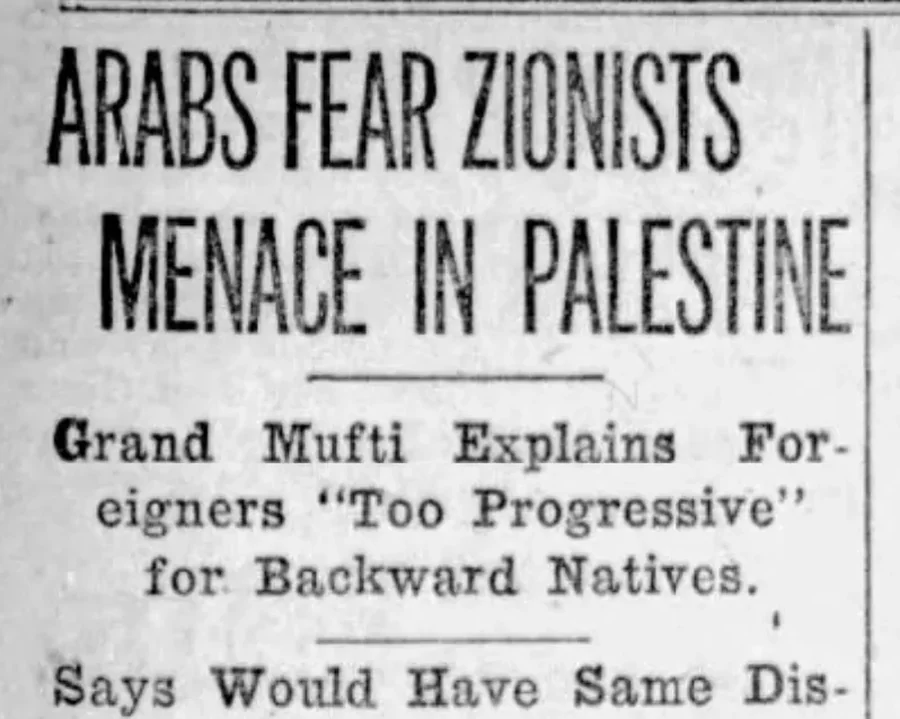
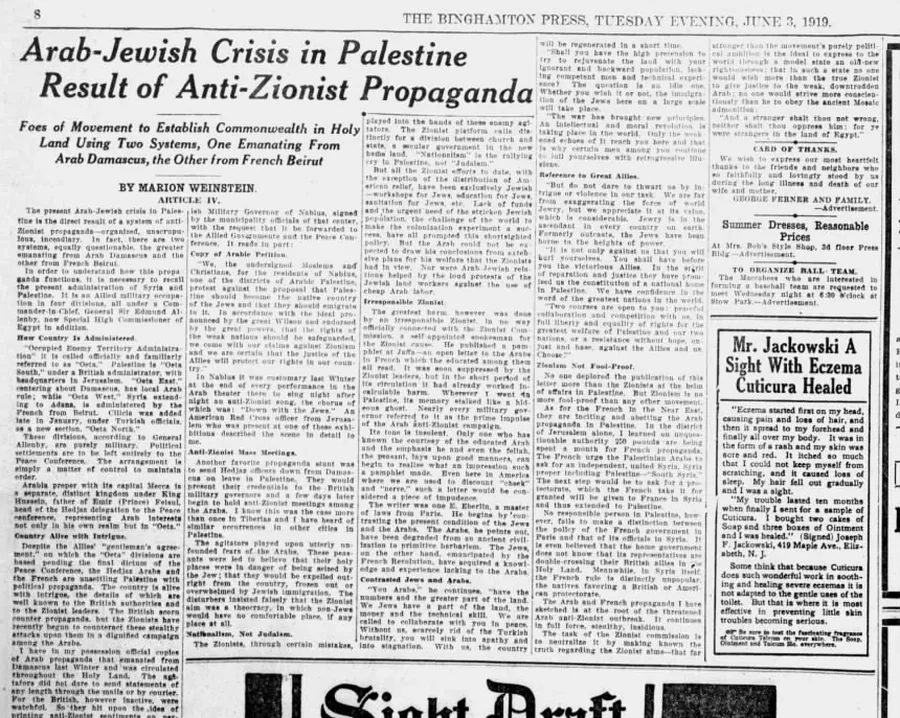
In 1919 a reporter named Marion Weinstein climbs the path at the foot of Mount Olivet to the house of the Grand Mufti of Jerusalem and prints about 1,500 words of him talking. “A land where the earth is the dust of our dead bones,” he says. “We have cultivated it for centuries.”
Eleven weeks later, in a different paper, the same reporter calls Arab objections to Zionism the product of propaganda that's “organized, unscrupulous, incendiary.” Same byline, same year.
1920s1920–1929
Arabs were calling themselves Palestinians long before 1948.
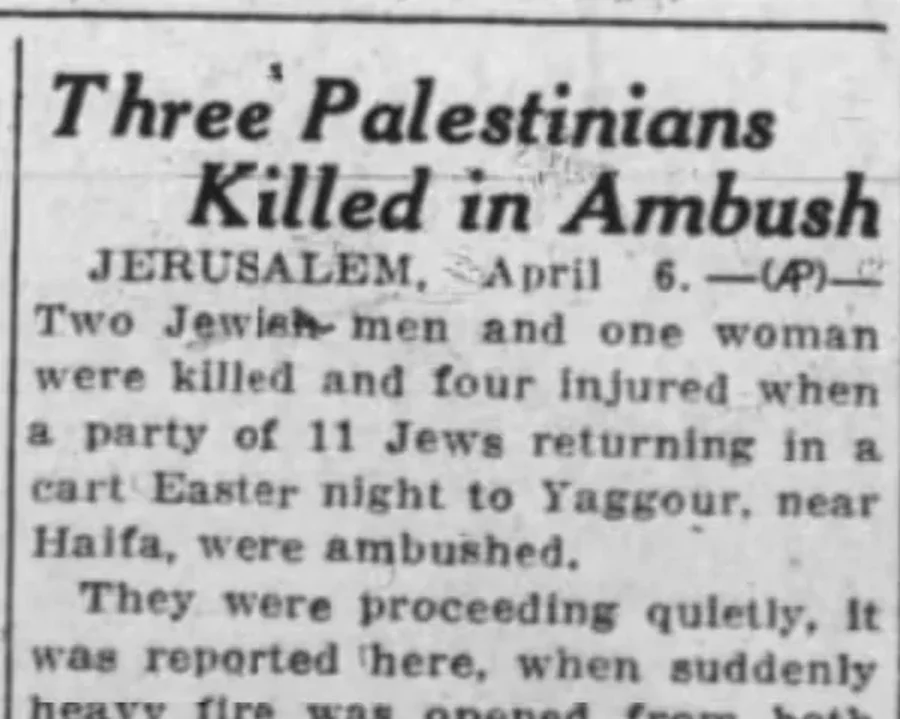
Before 1940 the word Palestinian turns up in these pages meaning several different things. Sometimes it means Jews. Often it's an adjective of place, like Palestinian citrus or the Palestinian government. And a good share of the time it means the Arab inhabitants.
When it means them, it's frequently inside a quotation from an Arab speaker. The Mufti. A street poster translated from Arabic and addressed “To the Palestinians.” The Arab National Party's published program. The word is often on the page because an Arab had just used it about himself.
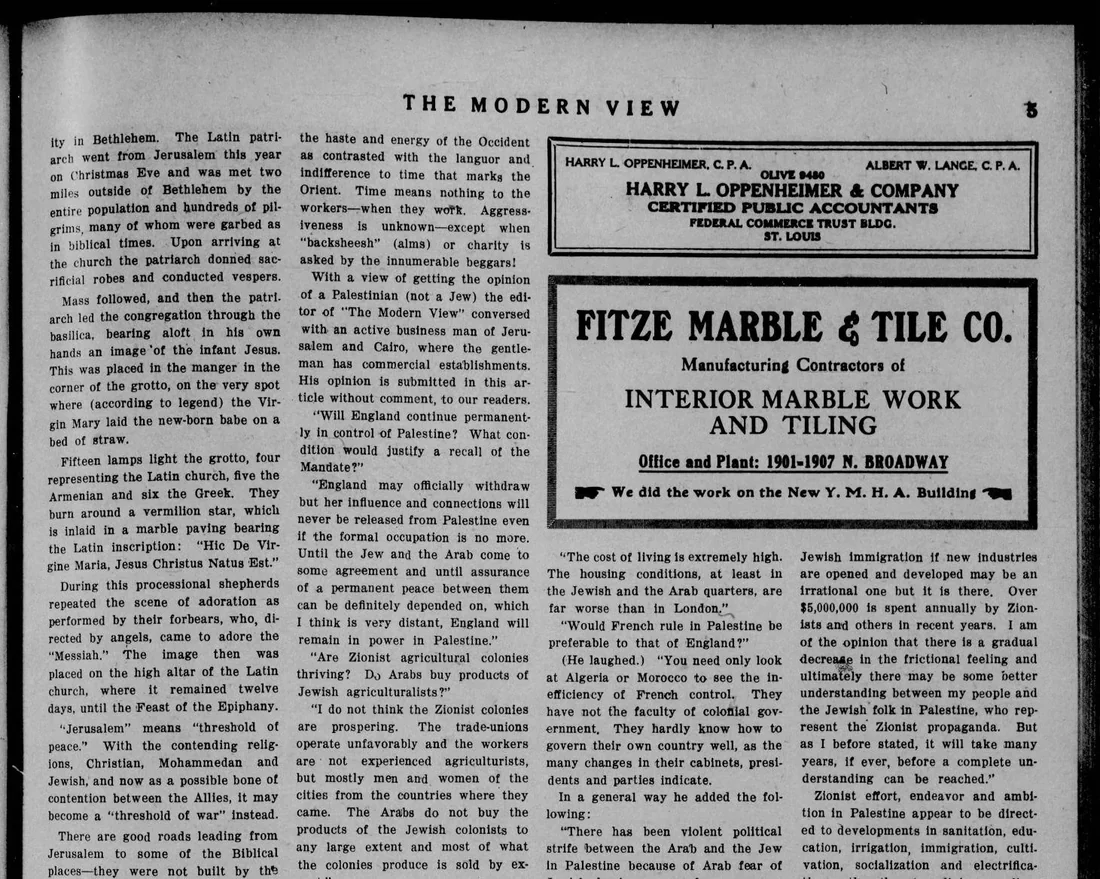
In 1927 a Jewish paper in St. Louis wanted to print an interview with an Arab businessman from Jerusalem, and had to tell its readers which kind of Palestinian it meant: “the opinion of a Palestinian (not a Jew).”
Anyone who says nobody was there in 1948 is arguing with these pages.
1930s1930–1939
The headline says terrorists. The reporter underneath wrote rebels.
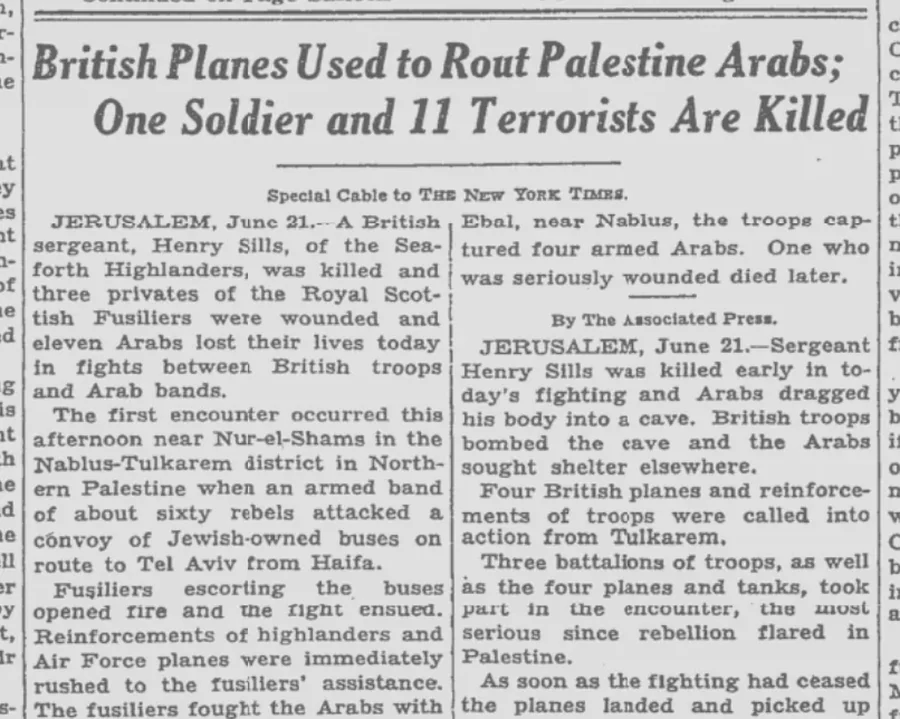
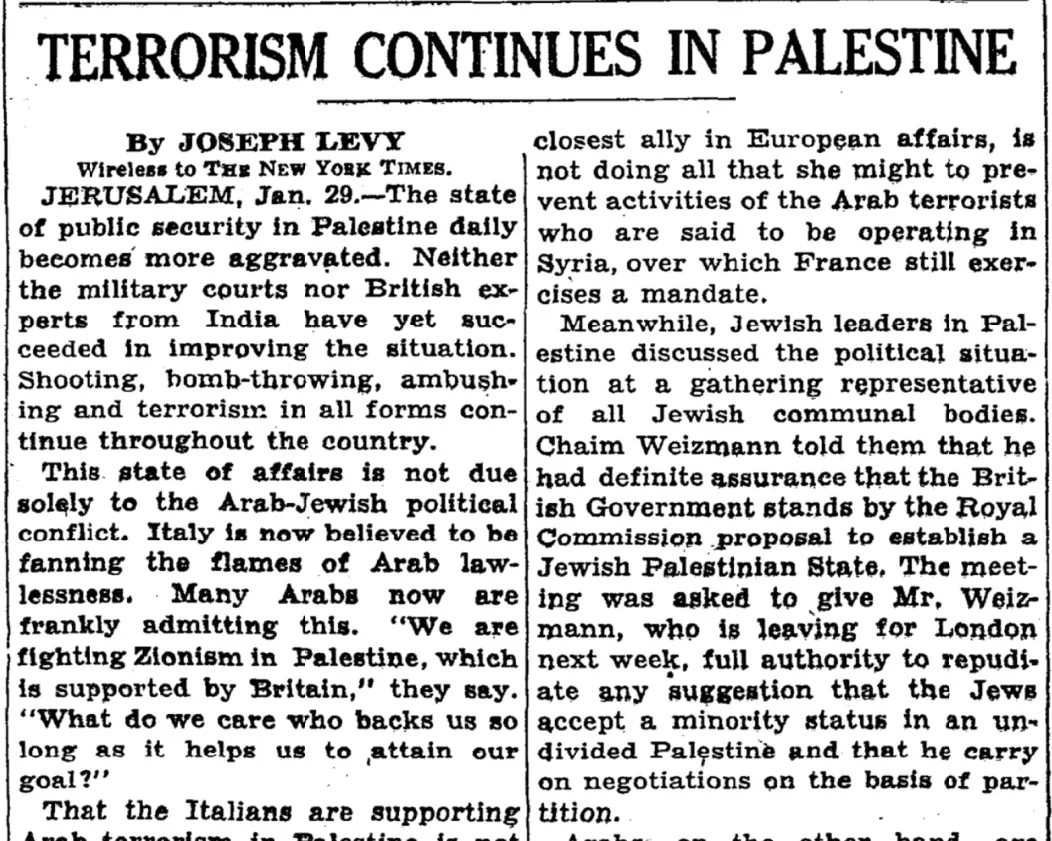
Palestine revolts against British rule in 1936. On 22 June the New York Times runs the headline One Soldier and 11 Terrorists Are Killed.
In the story below it, the word terror never appears. The correspondent in Jerusalem wrote “Arab bands,” “rebels,” and “eleven Arabs lost their lives.” Someone in New York picked the noun, and it wasn't the person who was there.
1940s1940–1949
For most of this decade, terrorist is what American papers call Jewish armed groups.
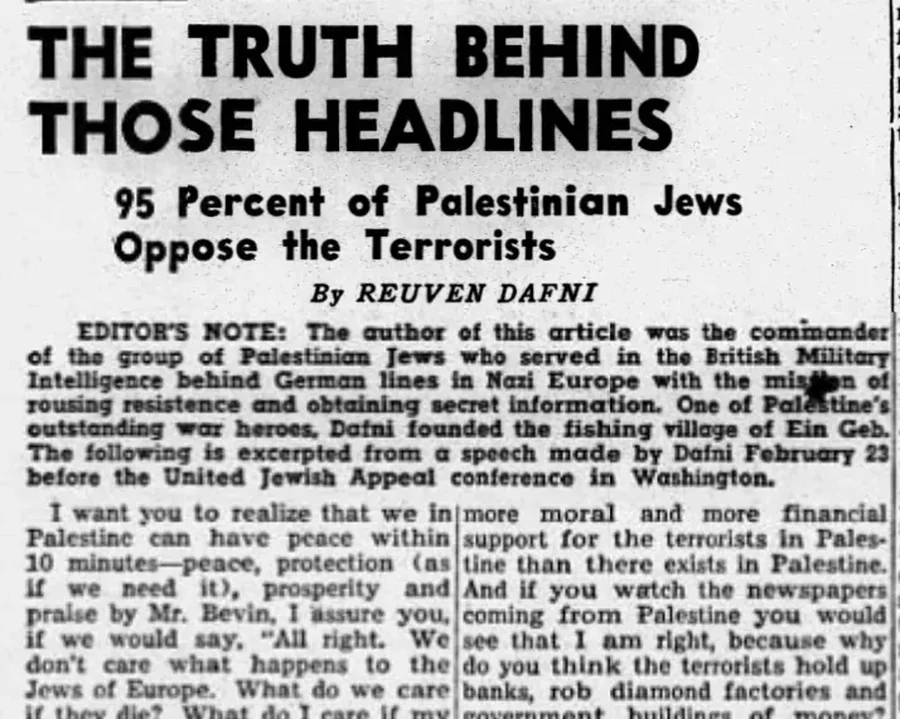
Between 1944 and 1948 the word belongs to Irgun and the Stern Gang. Not as a quoted insult from an Arab source. In the reporter's own voice, again and again, across more than a dozen papers and three news services. In those same years the papers use it for Arab fighters in their own voice once.
On the King David Hotel bombing, July 1946: “Terrorists today bombed and shattered part of the huge King David Hotel.” The New York Times in 1944: “TERRORISTS RENEW PALESTINE ATTACKS,” and the first line names “the notorious Jewish political extremist group.” A Jewish paper in St. Louis in 1947: “95 Percent of Palestinian Jews Oppose the Terrorists.”
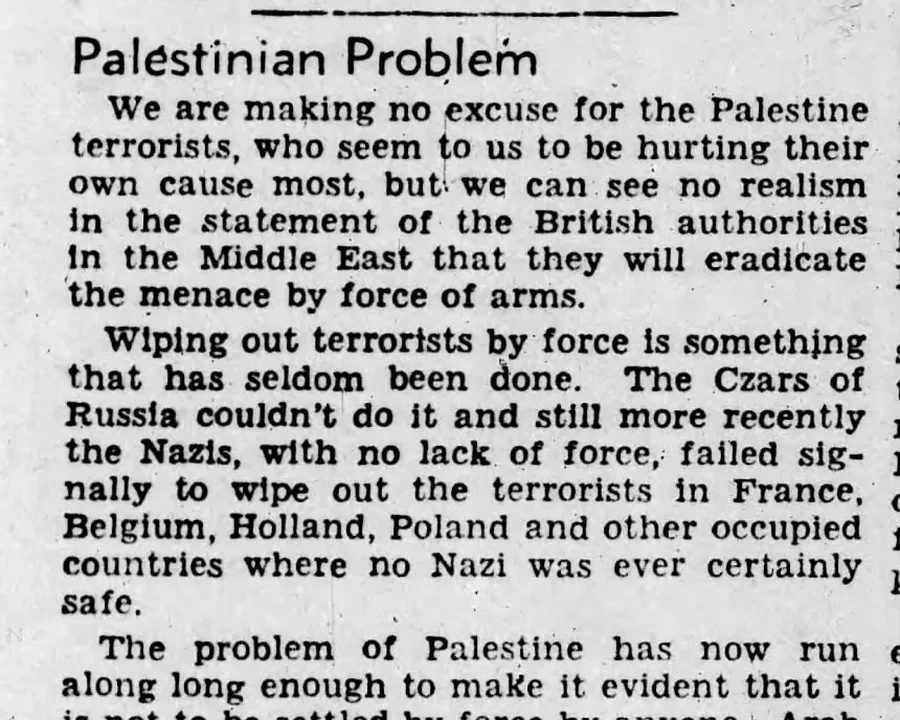
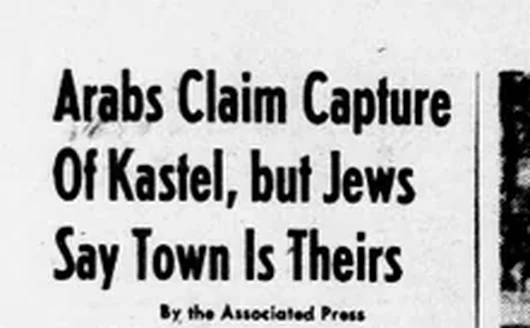
Then 1948. Almost every clipping that describes Palestinians leaving says they fled.
Here's what fled covered. On 12 April 1948 the Evening Star reported that Irgun and the Stern Gang held the village of Deir Yassin, that a Red Cross investigation found 254 Arab dead there with many women and children among them, and that Arabs and Jews alike were calling it “a horrible massacre.” Among the survivors the paper quotes is a twelve-year-old girl, Fahimeh Ali Moustafa Zeidan, who lost her mother, both grandparents, two brothers and a three-month-old sister. In every clipping from 1948 and 1949, she's the only Palestinian civilian who describes what happened to her in her own words.
1950s1950–1959
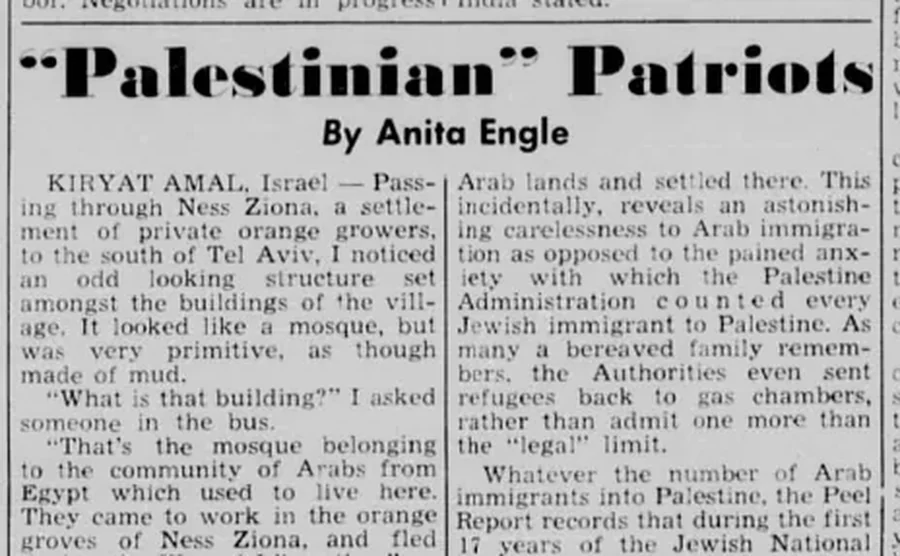
Ten years on, a paper finally writes that a million Palestinians were driven out.
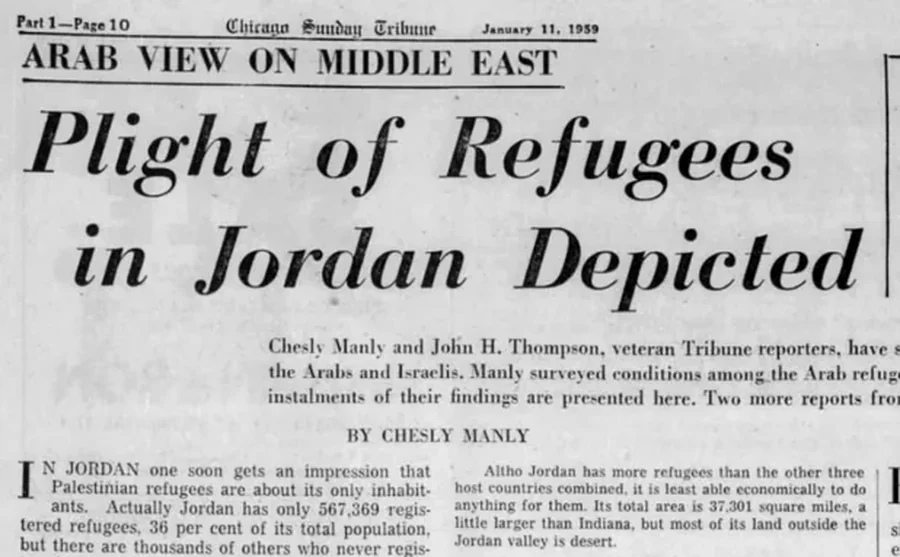
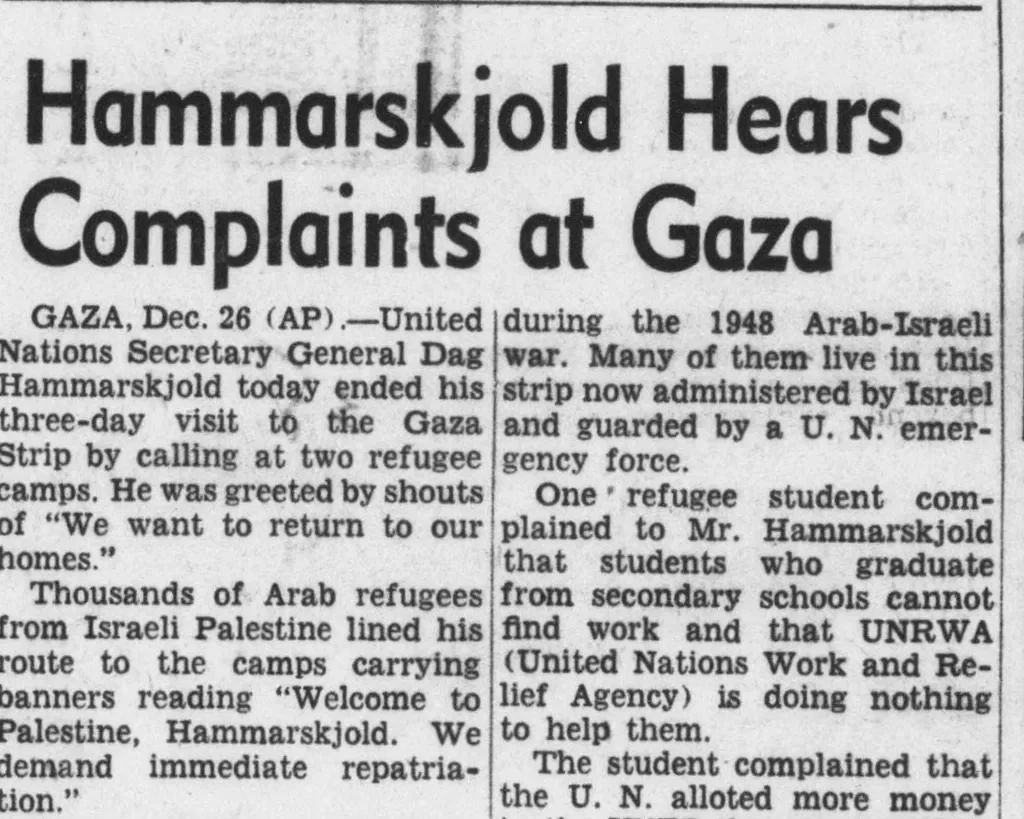
Palestinian refugees are the story now — the people expelled in 1948, living in camps in Gaza, Jordan, Lebanon and Syria.
For most of the decade the papers describe people who left without saying who made them leave. On 26 December 1958 the Associated Press puts it plainly: “About one million Palestinians were driven from their homes during the 1948 Arab-Israeli war.”
The other word hasn't moved yet. In January 1959 the Chicago Sunday Tribune describes “Menachem Begin, former commander of the Irgun Zvai Leumi, Jewish terrorist organization, and now a member of Israel's knesset.” Nothing in the sentence softens it.
1960s1960–1969
Occupied goes in the dateline. And terrorist changes sides.
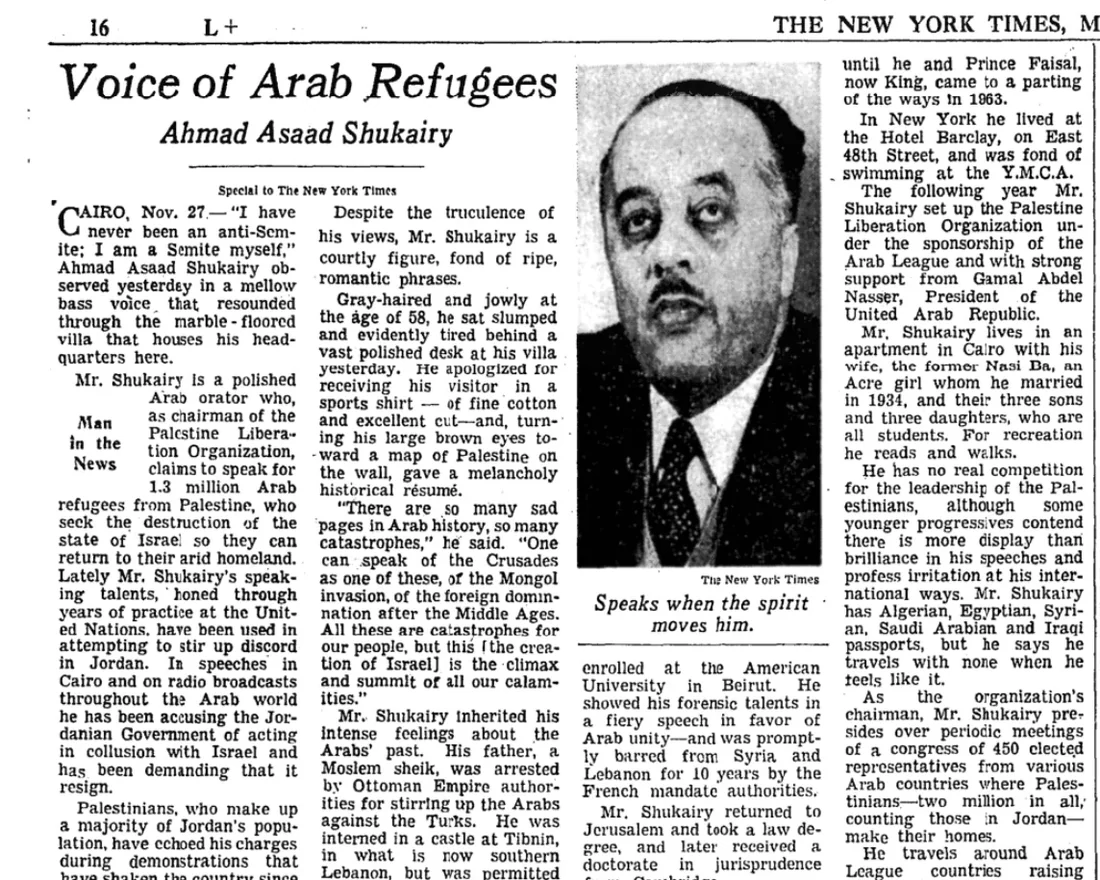
After 1967 these papers say occupied constantly, in the dateline, the line at the top of a story where a paper states plain fact. NABLUS, Israeli-Occupied Jordan. HEBRON, Israeli-occupied Jordan. RAMALLAH, Israeli-Occupied Jordan. Across the archive these papers reach for occupied more than twenty times as often as administered.
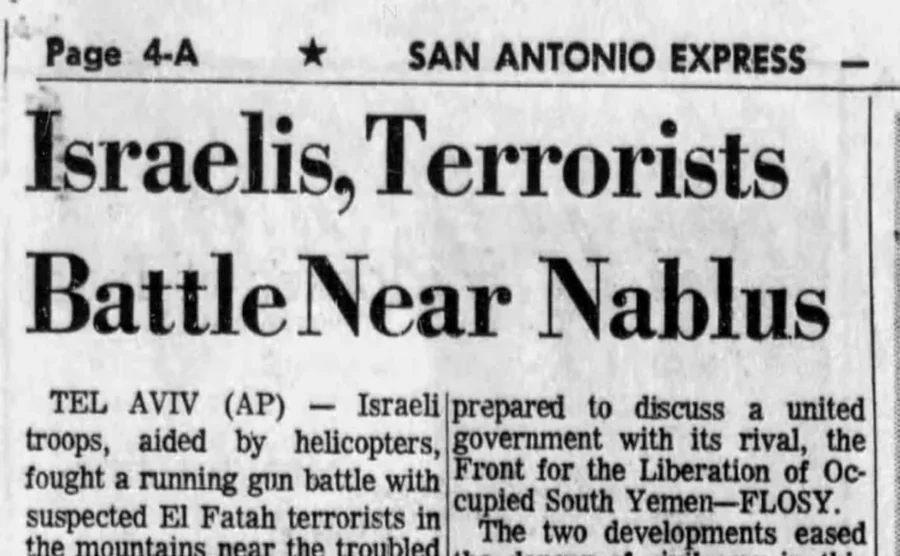
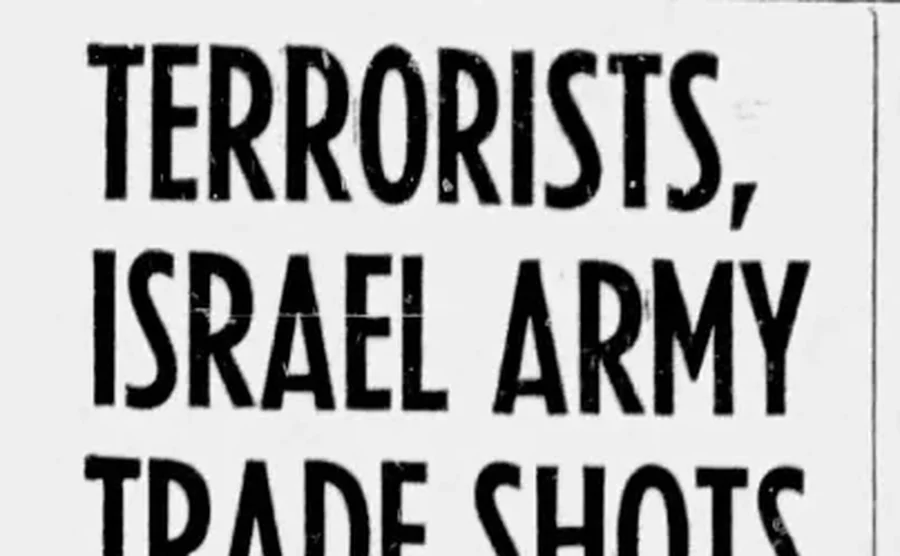
This is also when the other word turns around. By late 1966 the New York Times is using terrorist for Palestinians in its own voice. On 25 September 1967 it reaches a headline that ran in at least two papers: Israelis, Terrorists Battle Near Nablus. Inside the story, every sourced use of the word is attributed to the Israeli army. The headline needed no source at all.
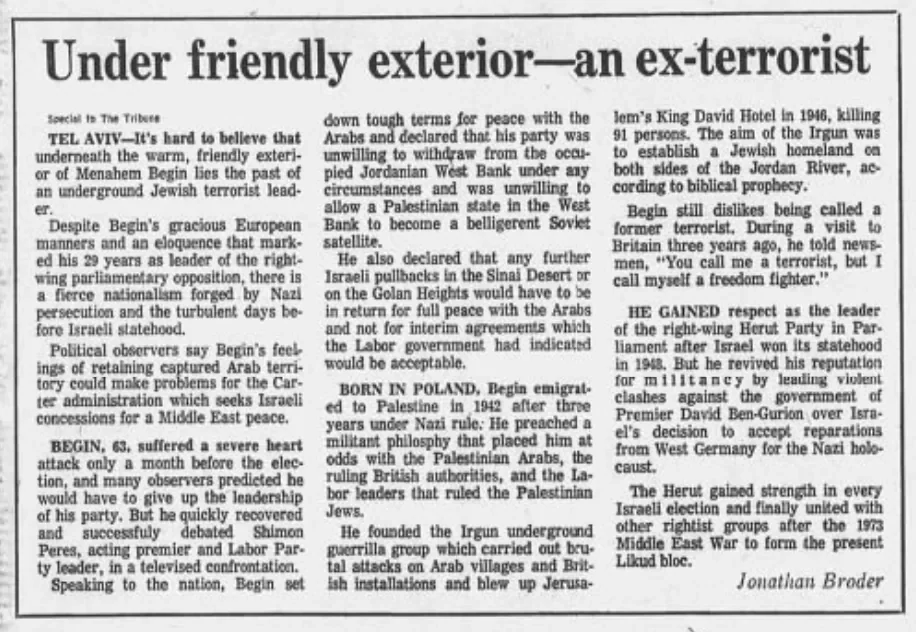
From here on, whenever a Jewish group gets called terrorist in these pages, it's in the past tense. Irgun. The Stern Gang. Begin's history.
1970s1970–1979
The same people get a new name every few years, and the name decides the story.
By the 1970s there's a Palestinian national movement with offices, spokesmen and, by 1974, a seat at the United Nations. American papers can't settle on what to call the people in it.
Guerrilla takes over, far more common now than it was a decade earlier. It comes out of Vietnam: its first use here, in 1966, is about Palestinians training with the Viet Cong. Fedayeen is always translated, and the translation does the arguing — “(the faithful)” in 1965, “[Arab terrorists]” in the New York Times's own brackets in 1967, “literally ‘those who sacrifice themselves’” in 1968, “men of conscience” in 1974.
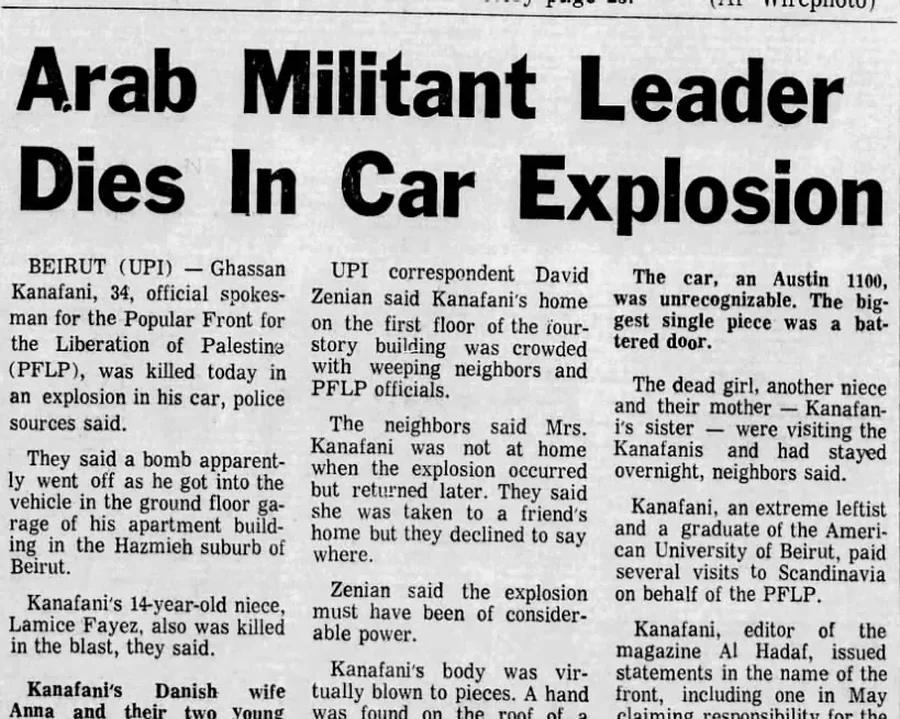
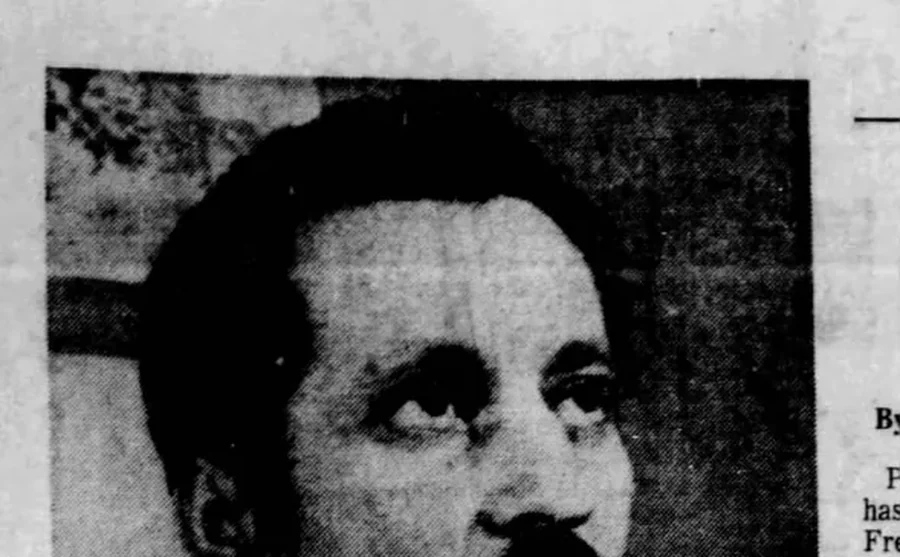
Ghassan Kanafani, a novelist and spokesman for the Popular Front for the Liberation of Palestine, was killed by a car bomb in Beirut on 8 July 1972. One news service story went out to American papers.
The Jacksonville Journal printed it as Arab Militant Leader Dies In Car Explosion. The Star-Ledger, next morning: Explosion kills leader of Arab terrorist group. On that same Star-Ledger page, the caption under the Associated Press photograph of him reads Palestinian guerrilla leader.
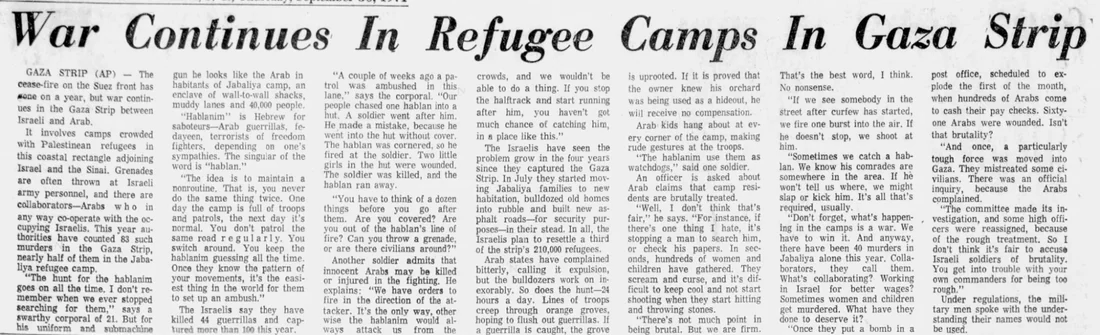
A reporter in Gaza had already written down how it worked, in 1971: “‘Hablanim’ is Hebrew for saboteurs — Arab guerrillas, fedayeen, terrorists or freedom fighters, depending on one's sympathies.”
1980s1980–1989
You can see the censor on the page, in square brackets.
August 1982, the New York Times, from Jerusalem: “[original dateline changed by censor].” Four lines later: “[18 words deleted here by censor].”
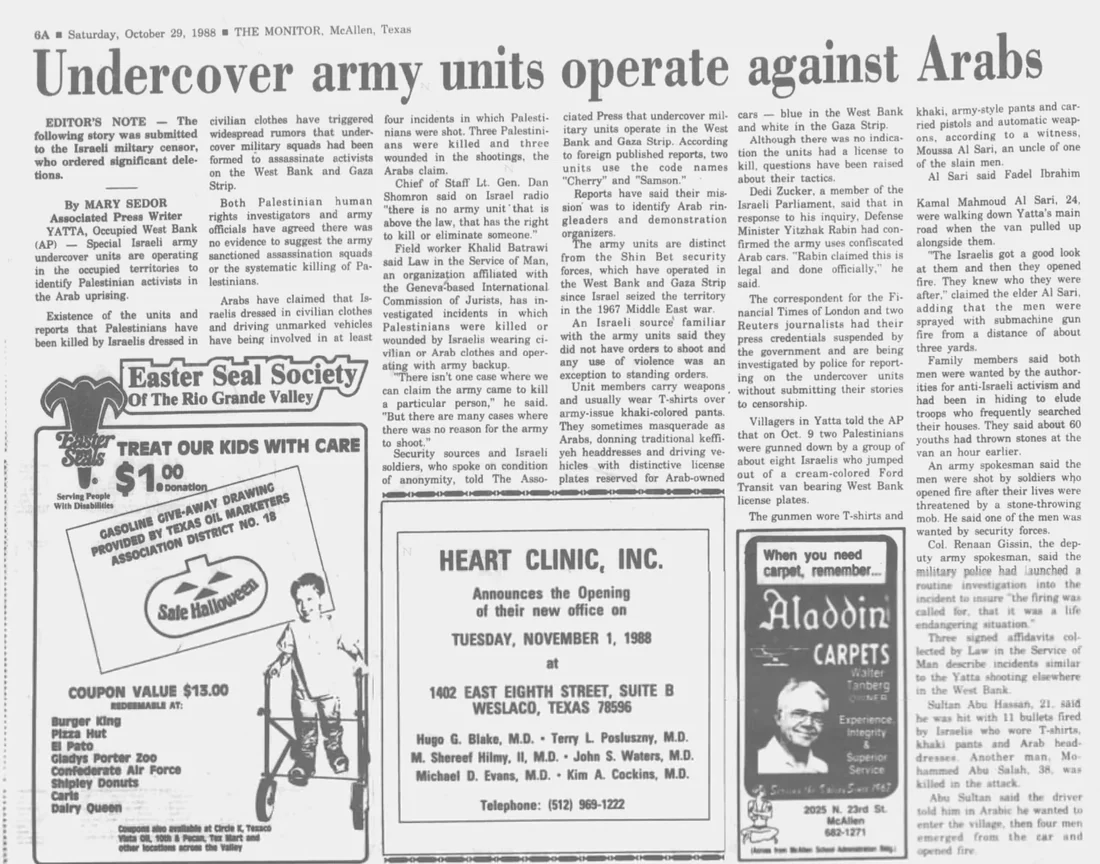
In 1988 an Associated Press reporter named Mary Sedor filed from the occupied West Bank about undercover Israeli army units. The copy went to the military censor and came back shorter. Three American papers ran it with a note at the top: “EDITOR'S NOTE — The following story was submitted to the Israeli military censor, who ordered significant deletions.”
Across the 1980s and 1990s, only a handful of clippings tell their readers the copy went through a censor, and most of those are that one story.
There's a quieter pattern underneath. When these stories open by naming a source, the Israeli army, police or radio comes first more than twice as often as a Palestinian source. The army says what happened. Hospitals say how many. One side explains, the other counts.
1990s1990–1999
Peace talks, settlements, and a word the papers keep stopping to translate.
From December 1987, when the revolt begins, the papers call it an uprising far more often than an intifada. The Arabic word doesn't appear at all until September 1988, nine months in, and when it does it usually comes with an explanation attached. The New York Times is still adding that explanation in October 1999.
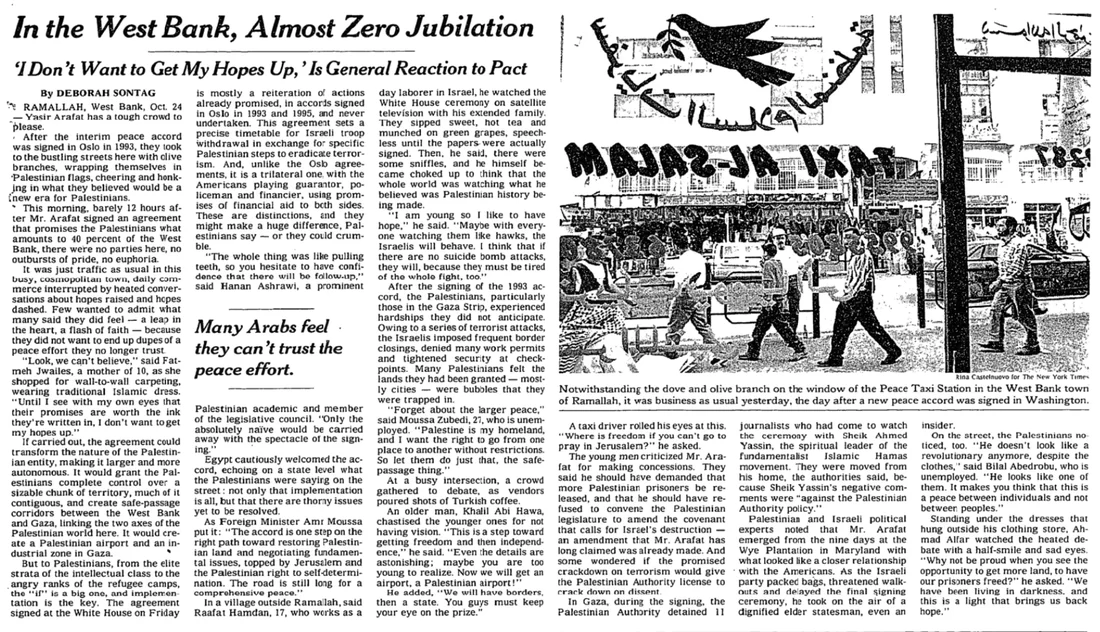
Oslo gets covered with more doubt than the memory of it suggests. In October 1998 the Times filed from Ramallah under the headline In the West Bank, Almost Zero Jubilation. After the 1993 signing people had filled the streets with olive branches and flags; this time, “there were no parties here, no outbursts of pride, no euphoria.”
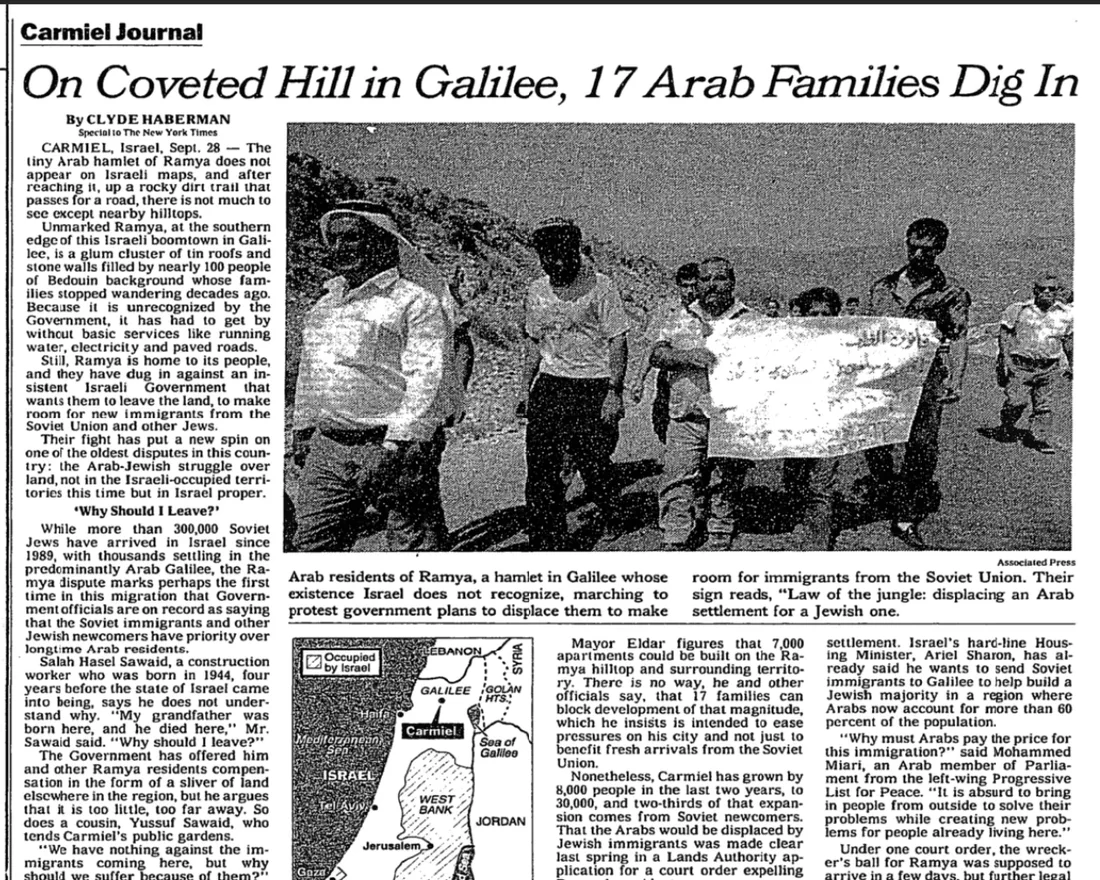
Settlements run through these years, described again and again as the obstacle. In 1991 the Times drives up a dirt track to Ramya, a village of about a hundred people outside Carmiel that doesn't appear on Israeli maps and has no running water, electricity or paved road, because the government doesn't recognize it exists.
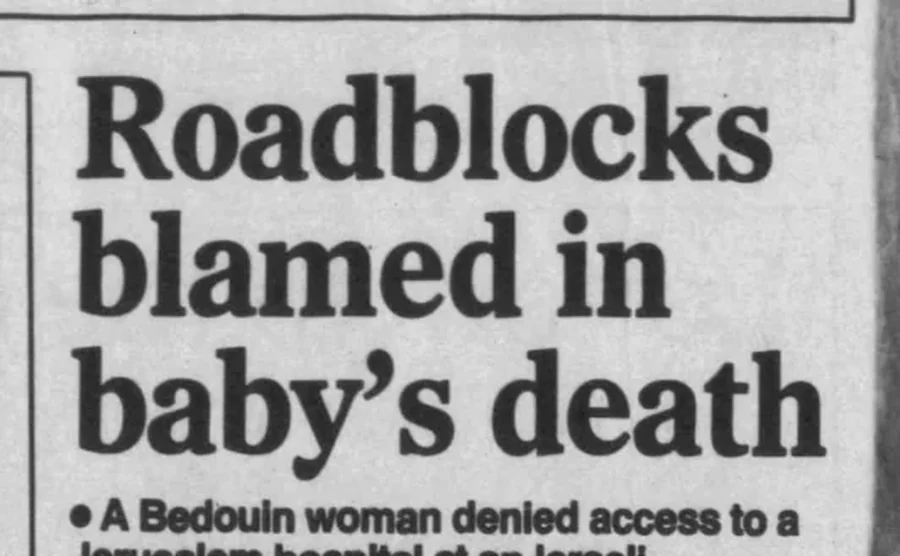
The checkpoints arrive in this decade too, and the papers start reporting what they cost. A short item in 1996: Roadblocks blamed in baby's death.
In the whole decade, not one clipping tells its readers the copy had been through a censor.
2000s2000–2009
A new word takes over, and nobody ever says it out loud.
Militant becomes standard. It isn't a softer way of saying terrorist — both words run side by side for thirty years without ever trading places.
Which one you read depended on who wrote the story. Associated Press copy reaches for militant constantly and almost never says terrorist. Everyone else splits about evenly between the two.
Almost none of the uses of militant sit inside quotation marks, and it barely appears on opinion pages at all. When a paper argues in its own name it says terrorist, or fanatic, or killer. Militant is what gets written when a paper is trying not to take a side.
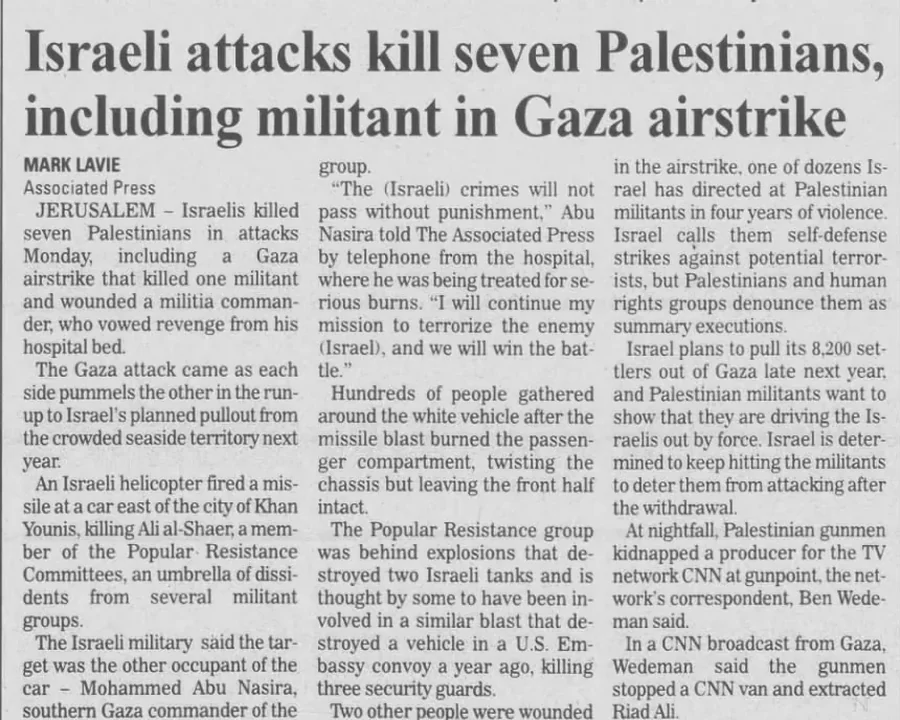
One Associated Press sentence from 2004 carries both: “Israel calls them self-defense strikes against potential terrorists, but Palestinians and human rights groups denounce them as summary executions.”
2010s2010–2019
The dead start getting named, and almost never by the paper.
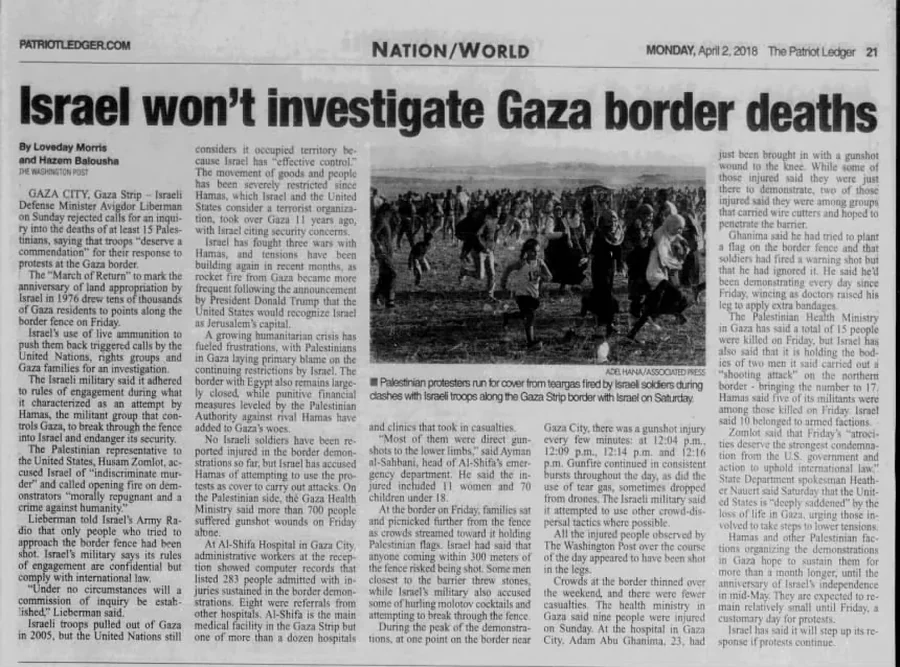
Across these years the rate at which a story says “the Palestinian Health Ministry identified the dead as…” climbs steadily. The rate at which the paper names them itself doesn't move. People get named at one remove, by a ministry, in a sentence that also tells you whose word it is.
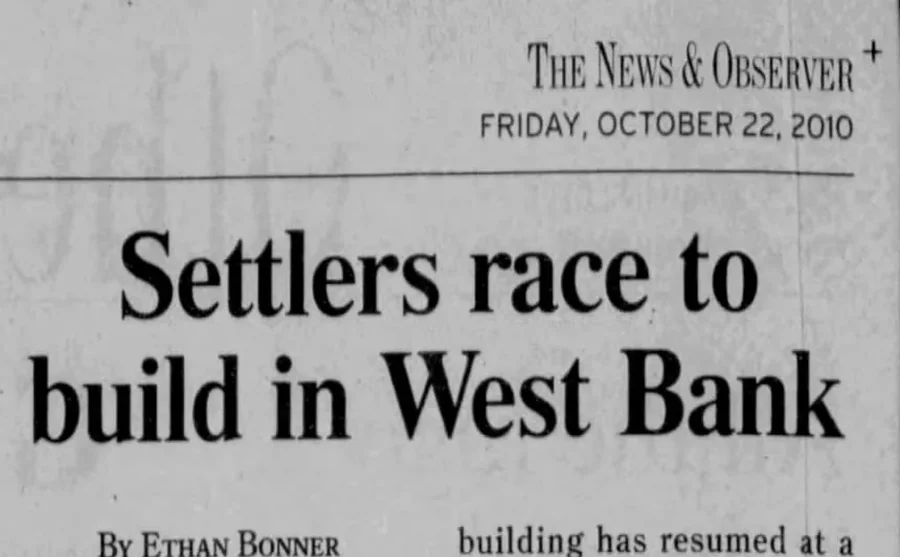
In October 2010 a North Carolina paper reports settlers racing to build before a construction freeze expires; by December, a Philadelphia paper reports the building has boomed again. The freeze is the story that keeps ending.
In 2018 Israel passes a law declaring the country the nation-state of the Jewish people and downgrading Arabic from an official language. American papers headline it four different ways on the same two days. Only one headline names anyone who loses something, and it was written by a Palestinian member of the Knesset.
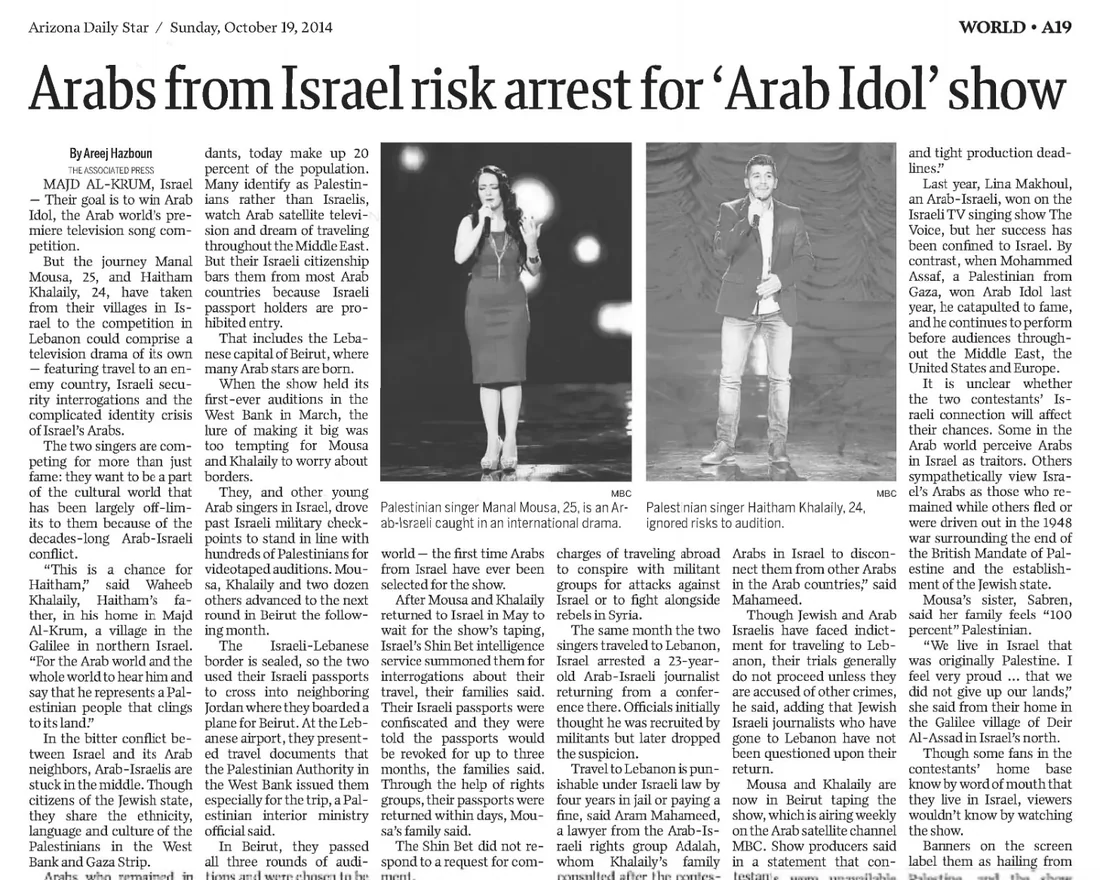
And occasionally a story arrives from inside Israel instead. In 2014 a paper covers Palestinian citizens of Israel risking arrest to watch a singing contest, because the singer was from Gaza.
2020s2020 – 6 October 2023
The archive stops on 6 October 2023, one day short, on purpose.
In May 2021 a campaign to evict Palestinian families from Sheikh Jarrah in East Jerusalem set off protests, then an eleven-day war on Gaza. The evictions didn't stop. A month later the Associated Press reported that they could still go ahead “as international attention wanes.”
In May 2022 Shireen Abu Akleh, a Palestinian-American journalist, was shot dead in Jenin. The coverage follows it from the killing, to Israeli police beating pallbearers at her funeral, to the case being referred to the International Criminal Court. Her name appears in six of the subheadings and in none of the headlines. Every headline identifies her by her employer and her job.
Through 2023 the West Bank fills the pages. Settlers rampaging through Palestinian towns in February and again in June. Police clearing worshippers out of Al-Aqsa in April. A hunger striker dying in custody in May. Israeli raids on Jenin in June and again in July, the second leaving residents returning to find “everything is destroyed.” Three villages emptying out entirely by August, their residents blaming settler attacks. Approval for more than 7,000 settlement homes.
The last clipping is from 6 October 2023. Everything on this page was already true the day before.
Nothing here is a reaction to what came after, which means none of it can be waved away as hindsight. Three hundred years in, the words keep changing — fellaheen, Arab, fedayeen, guerrilla, terrorist, militant — and the thing they're changing around doesn't. People are still being moved off land, still being counted rather than named, still waiting for somebody else's paper to describe what happened to them.
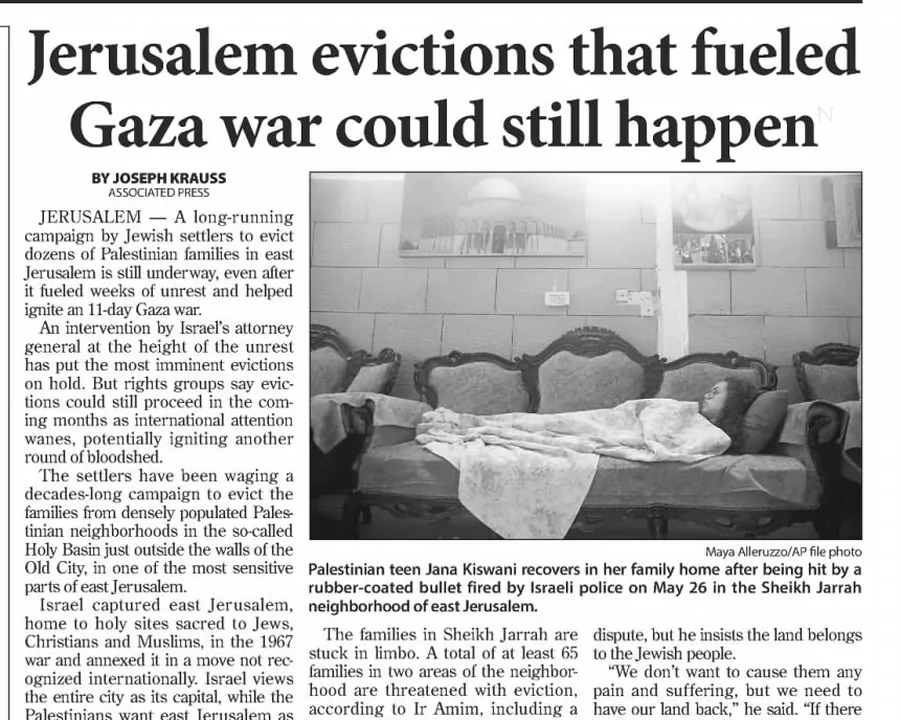 Jerusalem evictions that fueled Gaza war could still happenThe Herald · 2021-06-25
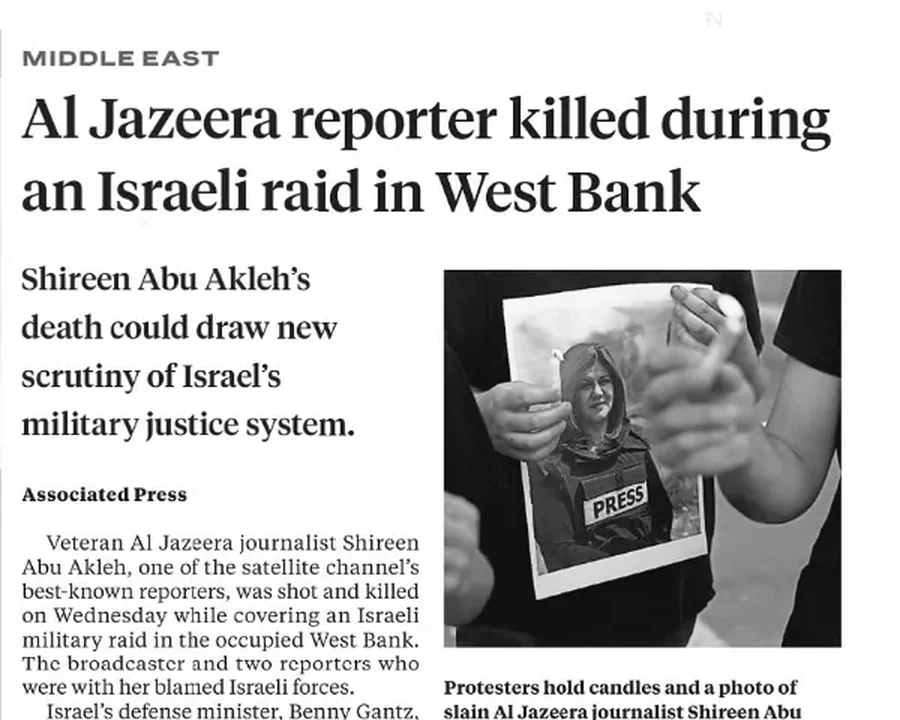 Al Jazeera reporter killed during an Israeli raid in West BankThe Star-Ledger · 2022-05-12
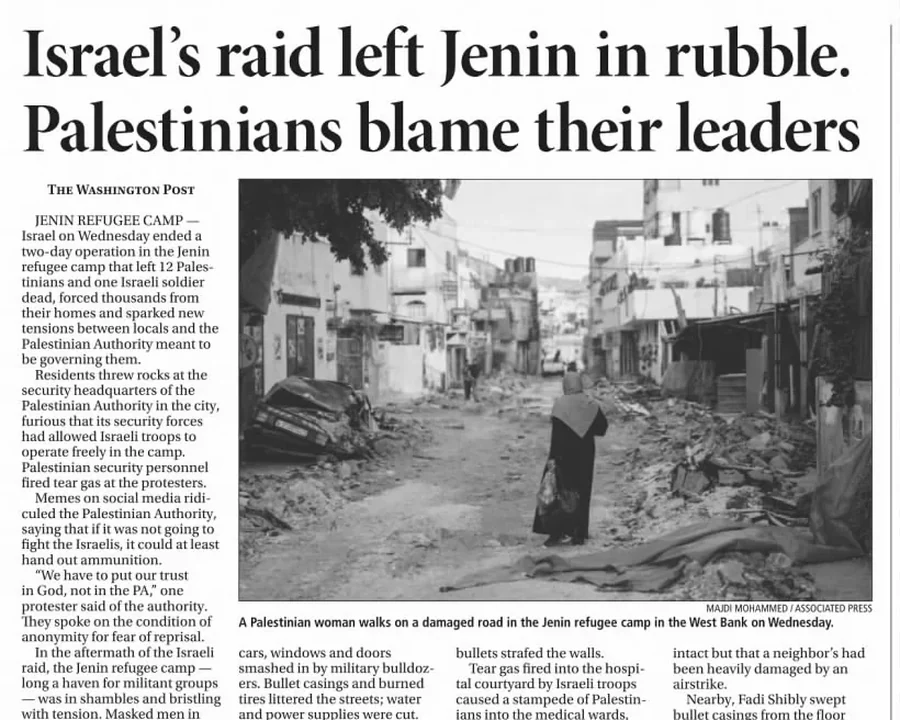 ‘Everything is destroyed’: Jenin residents return to wreckageDaily Herald · 2023-07-06
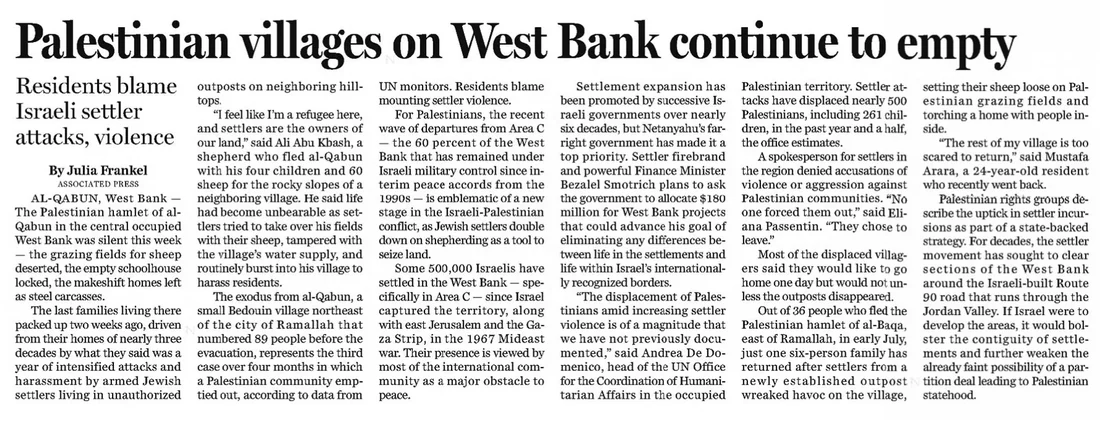 Palestinian villages on West Bank continue to emptyThe Boston Globe · 2023-08-25
Last updated 2 November 2026
Every clipping links to its record, with the scan and the full transcription.
Counts come from what the newspapers printed — headlines, standfirsts,
transcribed text and photo captions — never from our own notes.
Search the archive ·
The people they named ·
All the patterns ·
How this was built
Collected and checked by Maria Robles ·
maria@rozumstudio.com