The State · 30 September 1971
CP-1971-005
War Continues In Refugee Camps In Gaza Strip
Associated Press, Gaza Strip
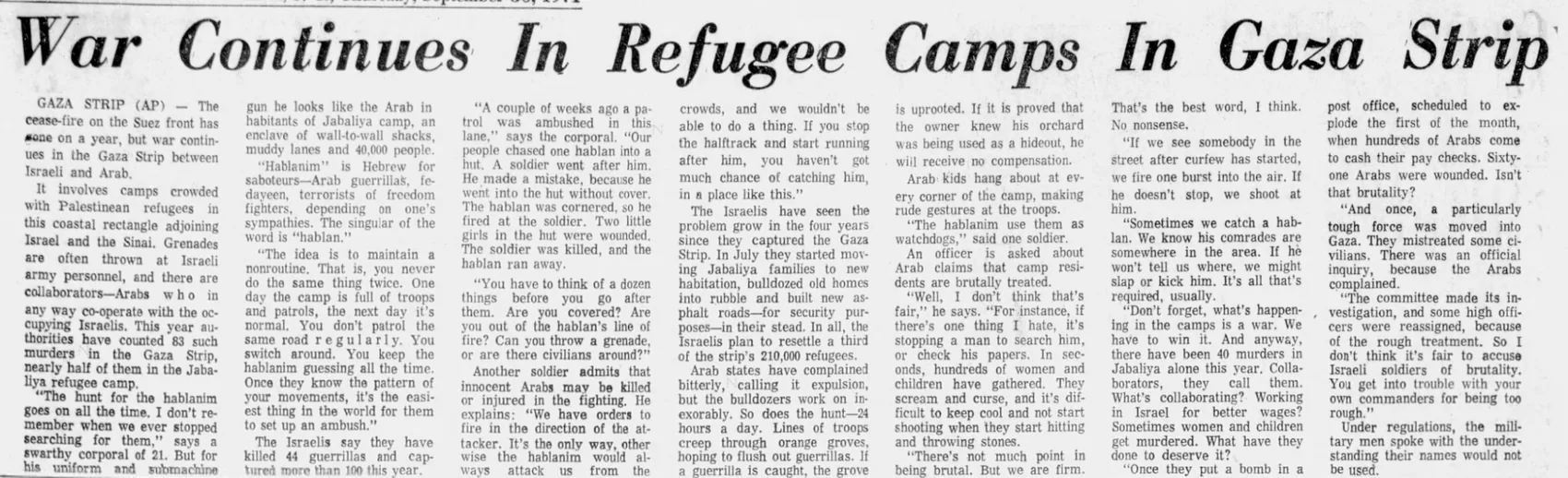
Transcribed from the clipping
“GAZA STRIP (AP) — The cease-fire on the Suez front has gone on a year, but war continues in the Gaza Strip between Israeli and Arab. It involves camps crowded with Palestinean refugees in this coastal rectangle adjoining Israel and the Sinai. Grenades are often thrown at Israeli army personnel, and there are collaborators—Arabs who in any way co-operate with the occupying Israelis. This year authorities have counted 83 such murders in the Gaza Strip, nearly half of them in the Jabaliya refugee camp. ‘The hunt for the hablanim goes on all the time. I don’t remember when we ever stopped searching for them,’ says a swarthy corporal of 21… ‘Hablanim’ is Hebrew for saboteurs—Arab guerrillas, fedayeen, terrorists or freedom fighters, depending on one’s sympathies… Another soldier admits that innocent Arabs may be killed or injured in the fighting. He explains: ‘We have orders to fire in the direction of the attacker. It’s the only way, otherwise the hablanim would always attack us from the crowds, and we wouldn’t be able to do a thing.’… The Israelis have seen the problem grow in the four years since they captured the Gaza Strip. In July they started moving Jabaliya families to new habitation, bulldozed old homes into rubble and built new asphalt roads—for security purposes—in their stead. In all, the Israelis plan to resettle a third of the strip’s 210,000 refugees. Arab states have complained bitterly, calling it expulsion, but the bulldozers work on inexorably… An officer is asked about Arab claims that camp residents are brutally treated. ‘Well, I don’t think that’s fair,’ he says. ‘For instance, if there’s one thing I hate, it’s stopping a man to search him, or check his papers. In seconds, hundreds of women and children have gathered. They scream and curse, and it’s difficult to keep cool and not start shooting when they start hitting and throwing stones. There’s not much point in being brutal. But we are firm. That’s the best word, I think. No nonsense. If we see somebody in the street after curfew has started, we fire one burst into the air. If he doesn’t stop, we shoot at him. Sometimes we catch a hablan. We know his comrades are somewhere in the area. If he won’t tell us where, we might slap or kick him. It’s all that’s required, usually. Don’t forget, what’s happening in the camps is a war. We have to win it. And anyway, there have been 40 murders in Jabaliya alone this year. Collaborators, they call them. What’s collaborating? Working in Israel for better wages? Sometimes women and children get murdered. What have they done to deserve it?’… ‘And once, a particularly tough force was moved into Gaza. They mistreated some civilians. There was an official inquiry, because the Arabs complained. The committee made its investigation, and some high officers were reassigned, because of the rough treatment. So I don’t think it’s fair to accuse Israeli soldiers of brutality. You get into trouble with your own commanders for being too rough.’ Under regulations, the military men spoke with the understanding their names would not be used.”
Context added by this archive
Israeli soldiers in Gaza talking to the Associated Press in 1971 on condition of anonymity, and the paper printing what they said at length. The demolition of Jabaliya is described as moving families and building asphalt roads for security purposes, and the next sentence gives the word the Arab states used for it: expulsion. The last column is an officer explaining the rules for shooting after curfew. “Palestinean” is the paper’s.
Cite this item
"War Continues In Refugee Camps In Gaza Strip," The State, 30 September 1971. Covering Palestine archive, CP-1971-005. https://coveringpalestine.org/archive/cp-1971-005
Elsewhere in the archive
- Terror Stalks GazaBeaumont Journal · 29 July 1971 · the same year
- Terror Still Stalks Residents Of Gaza Strip As Political Murders Increase In NumberThe Sun · 1 August 1971 · the same year
- Israeli Program Ousts Number of Refugee Families in Gaza StripDaily Oklahoman · 20 August 1971 · the same year
This record is part of Covering Palestine, an archive of American and Anglophone newspaper clippings about Palestinians, 1812 to 2022. Researched and assembled by Maria Robles.
The clipping belongs to the newspaper that printed it, or to the wire service that supplied the copy. It is reproduced here for research, criticism and commentary.
Something wrong here, or something you know about this clipping? The archive is still being built and corrections are wanted: maria@rozumstudio.com, quoting CP-1971-005.
See it in the archive reel · Full text of every clipping · Dataset