The State · Columbia, South Carolina · 25 April 1982
CP-1982-030
Palestinian Diaspora
By Mort Rosenblum, Associated Press
Transcribed from the clipping
“Palestinian Diaspora Today, nearly four million Palestinians are in diaspora, six times the Palestinian population of Israel. They increase by nearly 3 percent a year, with one of the world’s highest birth rates.
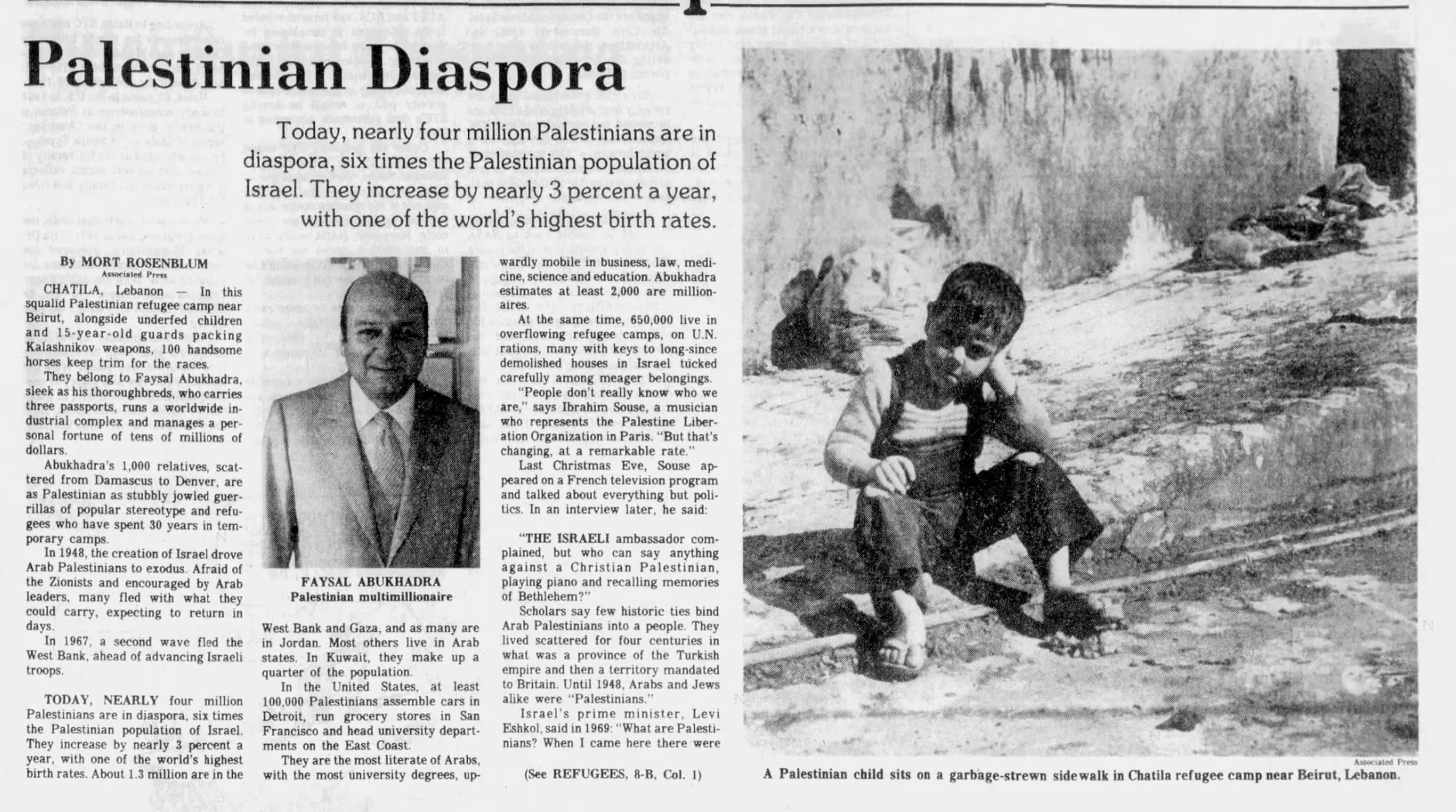
CHATILA, Lebanon — In this squalid Palestinian refugee camp near Beirut, alongside underfed children and 15-year-old guards packing Kalashnikov weapons, 100 handsome horses keep trim for the races.
They belong to Faysal Abukhadra, sleek as his thoroughbreds, who carries three passports, runs a worldwide industrial complex and manages a personal fortune of tens of millions of dollars.
Abukhadra’s 1,000 relatives, scattered from Damascus to Denver, are as Palestinian as stubbly jowled guerrillas of popular stereotype and refugees who have spent 30 years in temporary camps. In 1948, the creation of Israel drove Arab Palestinians to exodus.
Afraid of the Zionists and encouraged by Arab leaders, many fled with what they could carry, expecting to return in days. In 1967, a second wave fled the West Bank, ahead of advancing Israeli troops. TODAY, NEARLY four million Palestinians are in diaspora, six times the Palestinian population of Israel.
They increase by nearly 3 percent a year, with one of the world’s highest birth rates. About 1.3 million are in the West Bank and Gaza, and as many are in Jordan. Most others live in Arab states. In Kuwait, they make up a quarter of the population.
In the United States, at least 100,000 Palestinians assemble cars in Detroit, run grocery stores in San Francisco and head university departments on the East Coast. They are the most literate of Arabs, with the most university degrees, upwardly mobile in business, law, medicine, science and education. Abukhadra estimates at least 2,000 are millionaires.
At the same time, 650,000 live in overflowing refugee camps, on U.N. rations, many with keys to long-since demolished houses in Israel tucked carefully among meager belongings. ‘People don’t really know who we are,’ says Ibrahim Souse, a musician who represents the Palestine Liberation Organization in Paris.
‘But that’s changing, at a remarkable rate.’ Last Christmas Eve, Souse appeared on a French television program and talked about everything but politics. In an interview later, he said: THE ISRAELI ambassador complained, but who can say anything against a Christian Palestinian, playing piano and recalling memories of Bethlehem?
Scholars say few historic ties bind Arab Palestinians into a people. They lived scattered for four centuries in what was a province of the Turkish empire and then a territory mandated to Britain. Until 1948, Arabs and Jews alike were ‘Palestinians.’ Israel’s prime minister, Levi Eshkol, said in 1969: ‘What are Palestinians?
When I came here there were…’”
Context added by this archive
Datelined Chatila, five months before the massacre there.
The dispatch carries the sentence this archive spent a long time proving from headlines: Until 1948, Arabs and Jews alike were ‘Palestinians.’ It also carries the keys — 650,000 people on United Nations rations, many with keys to long-since demolished houses in Israel tucked carefully among meager belongings — and it lets a Palestinian say what the piece is about: People don’t really know who we are. Two Palestinians are named, one a millionaire and one a musician, and neither is a guerrilla, which the copy says out loud.
Cite this item
"Palestinian Diaspora," The State, 25 April 1982. Covering Palestine archive, CP-1982-030. https://coveringpalestine.org/archive/cp-1982-030
More from The State
- War Continues In Refugee Camps In Gaza StripThe State · 30 September 1971
- Israel cracks down in Gaza Strip; Palestinians prepare for meetingThe State · 11 November 1988
- Palestinians take over Christmas in BethlehemThe State · 21 December 1995
More from the 1980s
- Even Israelis protest West Bank university shutdownThe Evening Sun · 11 January 1982
- art review/Childhood reflectionsNewsday · 12 March 1982
- Israeli troops kill boy, hurt 17 in Arab unrestThe Star-Ledger · 14 April 1982
- Israeli troops fire into protesters, killing boyBryan College Station Eagle · 14 April 1982
- Jews Against GenocideThe Post-Standard · 29 June 1982
- Jordan no Palestine state, Hussein saysThe Plain Dealer · 3 August 1982
- All 147 clippings from the 1980s →
This record is part of Covering Palestine, an archive of American and Anglophone newspaper clippings about Palestinians, 1799 to 2023. Researched and assembled by Maria Robles.
The clipping belongs to the newspaper that printed it, or to the news agency that supplied the copy. It is reproduced here for research, criticism and commentary. The city is derived from the masthead, not read off the clipping.
Something wrong here, or something you know about this clipping? The archive is still being built and corrections are wanted: maria@rozumstudio.com, quoting CP-1982-030.
See it in the archive reel · Full text of every clipping · Dataset