The New York Times · New York, New York · 21 April 1982
CP-1982-056
Why Israel Bans Some Arab Books
By Shmuel E. Moyal
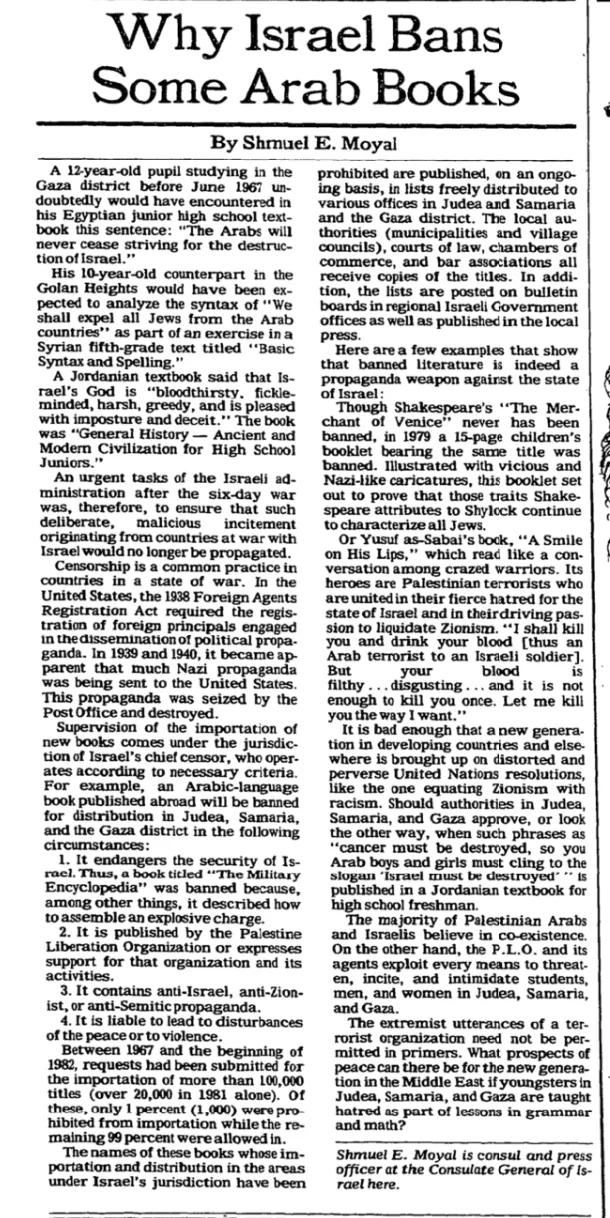
Transcribed from the clipping
A 12-year-old pupil studying in the Gaza district before June 1967 undoubtedly would have encountered in his Egyptian junior high school textbook this sentence: “The Arabs will never cease striving for the destruction of Israel.”
His 10-year-old counterpart in the Golan Heights would have been expected to analyze the syntax of “We shall expel all Jews from the Arab countries” as part of an exercise in a Syrian fifth-grade text titled “Basic Syntax and Spelling.” A Jordanian textbook said that Israel’s God is “bloodthirsty. fickle-minded, harsh, greedy, and is pleased with imposture and deceit.”
The book was “General History — Ancient and Modern Civilization for High School Juniors.” An urgent tasks of the Israeli administration after the six-day war was, therefore, to ensure that such deliberate, malicious incitement originating from countries at war with Israel would no longer be propagated. Censorship is a common practice in countries in a state of war.
In the United States, the 1938 Foreign Agents Registration Act required the registration of foreign principals engaged in the dissemination of political propaganda. In 1939 and 1940, it became apparent that much Nazi propaganda was being sent to the United States. This propaganda was seized by the Post Office and destroyed.
Supervision of the importation of new books comes under the jurisdiction of Israel’s chief censor, who operates according to necessary criteria. For example, an Arabic-language book published abroad will be banned for distribution in Judea, Samaria, and the Gaza district in the following circumstances: 1. It endangers the security of Israel.
Thus, a book titled “The Military Encyclopedia” was banned because, among other things, it described how to assemble an explosive charge. 2. It is published by the Palestine Liberation Organization or expresses support for that organization and its activities. 3. It contains anti-Israel, anti-Zionist, or anti-Semitic propaganda. 4.
It is liable to lead to disturbances of the peace or to violence.
How this transcription was made
Read from the scan by a machine looking at the image of the page, not by optical character recognition and not by a person. The clipping carries no masthead and no dated folio line, so the date recorded here could not be checked against anything printed on the page. Nothing on the page contradicts it.
Cite this clipping
"Why Israel Bans Some Arab Books," The New York Times, 21 April 1982. Covering Palestine archive, CP-1982-056. https://coveringpalestine.org/archive/cp-1982-056
More from The New York Times
- The Maine Colony in PalestineThe New York Times · 12 November 1866
- Jewish Colonization in PalestineThe New York Times · 9 December 1883
- Jewish State in Palestine OpposedThe New York Times · 9 July 1897
- ZIONIST CONGRESS IN BASELThe New York Times · 31 August 1897
- ROME FEARS THE ZIONISTSThe New York Times · 12 September 1897
- PROGRESS OF ZIONISMThe New York Times · 16 December 1901
- 852 more from this paper in the full text →
More from the 1980s
- Even Israelis protest West Bank university shutdownThe Evening Sun · 11 January 1982
- Israel renews charge against PalestiniansThe Baltimore Sun · 3 March 1982
- Israelis Survive Storm Over Bedouin Baby’s DeathThe New York Times · 9 March 1982
- art review/Childhood reflectionsNewsday · 12 March 1982
- Looking the Other WayThe New York Times · 15 March 1982
- Begin will stay on despite voteStamford Advocate · 24 March 1982
- All 527 clippings from the 1980s →
Last updated 2 November 2026
This record is part of Covering Palestine, an archive of American newspaper clippings about Palestinians, 1724 to 2023. Researched and assembled by Maria Robles.
The clipping belongs to the newspaper that printed it, or to the news agency that supplied the copy. It is reproduced here for research, criticism and commentary. A city here is where the newspaper was published, not where the story came from, and on most records it was taken from the masthead.
Something wrong here, or something you know about this clipping? The archive is still being built and corrections are wanted: maria@rozumstudio.com, quoting CP-1982-056.
Everything printed in 1982 · Printed on this day · See it in the archive reel · Full text of every clipping · Dataset