In January 1959 a Chicago Tribune reporter walked into a hotel on Mount Scopus and got talking to the barman. His name was Said Ahmad. He was fourteen when the militias came to Deir Yassin, where his father had a small farm. “The Jews mowed down men, women, and children with machine guns,” he said. The reporter wrote his name down.
Almost nobody else did. Across the 548 clippings here printed before December 1987, nineteen ordinary Palestinians are named. Said Ahmad is one of them. So is Fahimeh Ali Moustafa Zeidan, twelve, from the same village, who lost her mother, both grandparents, two brothers and a three-month-old sister, and whose account of that morning runs to five paragraphs in the Evening Star of 12 April 1948.
That is one clipping. What follows is 24 patterns in how the papers wrote — things no single clipping can show you, because they only appear when the same move repeats across decades and hundreds of papers. A word that arrives. A word that leaves. A sentence built the same way for fifty years.
Who was already there +
A country, counted
Who was already there
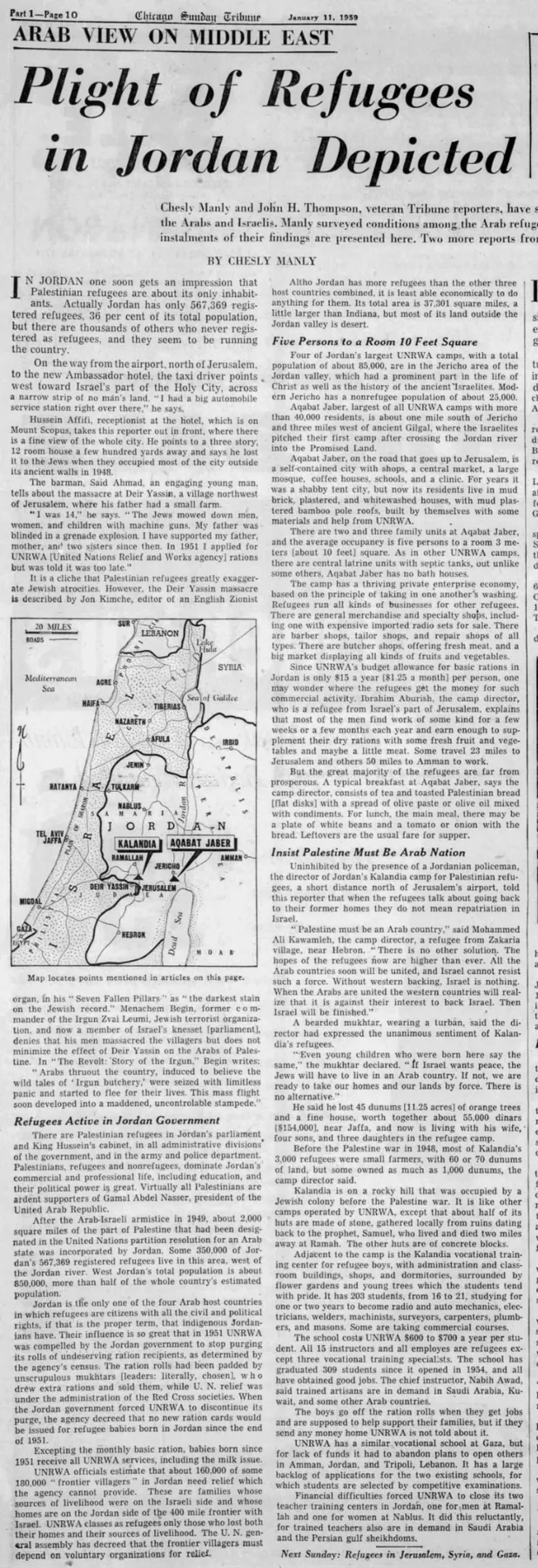
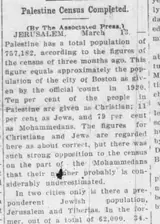
On 13 March 1923 the Associated Press moved a short dispatch from Jerusalem, and the Madison Courier in Indiana printed it. Palestine had a total population of 757,182. 79% Muslim, 11% Jewish, 10% Christian. The news agency explained the number by comparing it to a city its readers knew: about the size of Boston.
That is a government counting people and a newspaper making the figure legible to Americans, twenty-five years before 1948.
The rest of this section is the same kind of material: not a case being made, but the ordinary vocabulary of papers that assumed a populated country because they were describing one.
An American government document
In October 1908 the Rochester Journal printed a report from Thomas R. Wallace, the United States consul in Jerusalem, itemizing what the Palestinian peasantry grew and ate. Barley bread, olives and olive oil, cheese, leben, dried figs. Grapes and figs around Jerusalem, watermelons “grown largely on the plains,” apricots, tomatoes, cucumbers, onions, garlic. Then the sentence that does the most work:
They grow other vegetables, but ordinarily do not consume them but sell them.
Thomas R. Wallace, United States consul in Jerusalem, in Consular Reports · Rochester Journal and the Post Express, 31 October 1908
Sell them to somebody, somewhere. The report distinguishes throughout between country people and townspeople, who ate three times a day. A consul wrote it, the State Department published it, and a New York paper carried it.
A crop, by the boxful
The Akron Beacon Journal explained the Jaffa orange trade in 1893: recently famous, good for thirty or forty days in transit, three months if properly packed. The Perris Progress, in the California citrus belt, put a number on it in 1901 — a crop of about 300,000 boxes, grafted on lemon stock. Those readers knew exactly what that meant, because it was their own business.
Shipping and produce columns are the hardest evidence in this archive, because they had no argument to make.
Land, and who reallocated it
The Cincinnati Enquirer of March 1910 called the fellaheen “the aboriginal inhabitants of the Holy Land” in its own subheading, and then set out the machinery of a village: land held as freehold or in common, the common land apportioned among the villagers every year by lot, a sheikh who governed and was “the father of the community,” and one building in every village kept for strangers.
Eight years later a United Press dispatch in the Freeport Journal-Standard gave Nablus “about 25,000 population,” in the same paragraph in which it overstated an advance of 3,000 yards as the capture of a city thirty-three miles away.
The word
Searching Chronicling America, the Library of Congress’s collection of scanned American newspapers, for “fellaheen” returns 2,130 candidate pages. Most are not about this: 1,688 of them also mention Egypt, where American papers used the word far more often. 270 mention Palestine, steadily from the 1880s through the 1920s.
What the word carries is the argument. You cannot write the fellaheen of Palestine about an empty country. Settled agriculture, land tenure, a harvest and a market are inside the term, which is why papers reaching for it were documenting the thing later denied, without meaning to and without anyone contesting it at the time.
And the other description, running at the same time
None of this was the only thing Americans read. The oldest clipping in this archive, an 1812 Philadelphia reprint of Chateaubriand, describes villages “laid waste by fire and sword” and Jerusalem as “a cemetery in midst of a desert.” The Kansas City Times in 1937 called it “the barren country.” A Brooklyn traveler in 1931 saw “miles and miles of arid, unbeautiful land… nothing green, nothing growing.”
And in October 1938 the Des Moines Register reprinted a Zionist Organization of America bulletin, saying plainly whose bulletin it was, which argued that “only two generations ago, the entire Arab population of Palestine was less than 300,000.”
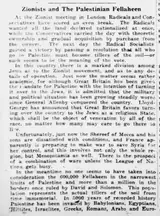
Set that against the Associated Press counting 757,182 fifteen years earlier, and the Philadelphia Inquirer counting 600,000 fellaheen in 1920 and calling them “the actual tillers of the soil from time immemorial.”
“no one seems to have taken into consideration the 600,000 Fellaheen in the narrowest limits of Palestine and more than a million in the borders once ruled by David and Solomon. This population represents the actual tillers of the soil from time immemorial.”
The Philadelphia Inquirer, under the headline Zionists and The Palestinian Fellaheen. CP-1920-002
 CP-1920-002
“Palestine has a total population of 757,182, according to the figures of the census of three months ago. This figure equals approximately the population of the city of Boston as given by the official count in 1920.”
The Madison Courier, Indiana, carrying Associated Press copy. A government counting the people it governed, translated for American readers into a city they knew. CP-1923-001
 CP-1923-001
“Only two generations ago, the entire Arab population of Palestine was less than 300,000.”
The Des Moines Register, reprinting a bulletin of the Zionist Organization of America and saying whose bulletin it was. Fifteen years after the census, and a third of its figure. CP-1938-004
 CP-1925-005
Before there was a PLO +
1925 to 1958
Before there was a PLO
The Palestine Liberation Organization was founded in 1964. These clippings show otherwise: Palestinians were making national claims in American newspapers for decades before it existed.
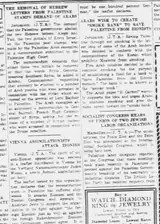
The Removal Of Hebrew Letters From Palestine Stamps Demand Of Arabs
Two columns of news-agency briefs. The demand that the Palestine government abolish the two Hebrew letters, Aleph and Yud, the two initials of Eretz Israel, on the Palestine post stamps, was made by the Palestine Arab executive in a memorandum submitted to the Palestine High Court.
The same executive asks amnesty for Arab youths who were arrested in connection with the strike which occurred on the arrival of Lord Balfour to Palestine
, and an Arabic paper, El Carmel, is quoted backing a boycott fund. The Jewish Press
Mayors of Leading Palestine Cities Plan Price Control
Mustapha Bey Khalidi, Mayor of Jerusalem; Shabbatai Levi, Mayor of Haifa and Omar II Bitar, Mayor of Jaffa
, sitting with Tel Aviv, and the meeting decided to form a permanent committee and to present a joint declaration to the High Commissioner
. It runs as a story about the price of flour. Buffalo Jewish Review
Palestine Arabs Plan Political Body
The Associated Press, in a Washington state daily: No official political body representing all Arabs of the country has existed since dissolution of the Arab High committee by the Palestine government in October, 1936, during disturbances.
There had been one. The government dissolved it. Peninsula Daily News
Palestine Arabs Ask Creation of Nat’l Government
Eight months later: the Arabs in Palestine this week issued a demand that a National government be established in Palestine. The demand was voiced in a resolution adopted at a conference of representatives of the Arab Chambers of Commerce in Palestine.
Twenty-one years before the PLO. Wisconsin Jewish Chronicle
Palestinians Due More Voice In Gaza Rule
A council of 23 Palestinians and 7 Egyptians
, and in passing, as background nobody thought remarkable: An all-Palestine government was formed in 1948 with its capital in Gaza and still exists in theory.
The Evening Sun
An executive in 1925, a High Committee until the British dissolved it in 1936, a demand for a national government in 1943, a government in Gaza from 1948, a legislative council in 1958. Each reported in American newspapers at the time, in the ordinary way, as news.
When American papers started saying Palestinian +
A word for the people
When American papers started saying Palestinian
The colonization chart tracks a word for the land. This one tracks the word for the people, and it moves the other way: absent for decades, then standard.
In the 1930s these papers covered Palestine constantly. Fourteen of the twenty-nine clippings from that decade put Arab in the headline. None puts Palestinian. The lines cross between the 1970s and the 1980s, and after 2000 the older word nearly disappears: two headlines out of a hundred and eleven.
Share of each decade’s clippings whose headline or subheading uses the word. Before about 1930, “Palestinian” in these papers usually just meant of Palestine and was applied to Jewish residents too, so the left end of the blue line is not national identity.
Before 1964, in their own sentences
The Palestine Liberation Organization was founded in 1964, which is the date usually given for when the word acquired its present meaning. This archive holds fifty-six clippings older than that which use it. Seven of them say plainly who is meant.
“Before the ‘menace’ of Zionism, Moslems and Christians alike are united… They are no longer enemies. They are Palestinians.”
San Antonio Express, under the headline Does Palestine Want To Be Zionized? The correspondent, Clair Price, does not use the word loosely: he defines it in the sentence before. The same dispatch ran in the Deseret News the previous morning and in the Buffalo Courier Express the same day, so the two entries below are the same piece of writing arriving in three cities.
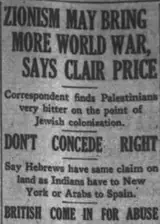 CP-1919-009
“Resentment of Jewish Colonization by Natives Whose Demand Is ‘Palestine For Palestinians’ — Moslems and Christians For Once United.”
Deseret News, Salt Lake City. The subheading names the people, their demand and the two faiths making it together. The same dispatch: “None knows this better than the Palestinians themselves.”
“Zionists and the Palestinian Fellaheen.”
The Philadelphia Inquirer, in a headline. Fellaheen is the Arabic for peasant farmers, so the phrase cannot be describing Jewish residents.
CP-1920-002“the same fear of the native Arab Palestinians”
Brooklyn Eagle, on Chesterton. Three words doing the work of a definition.
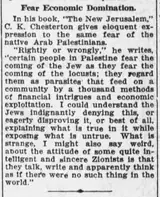 CP-1926-001
“Palestinian Arabs Ready to Live With Jewish ‘Cousins’.”
Boston Evening Globe, reporting a rabbi’s account. The compound distinguishes them from the other people in the sentence.
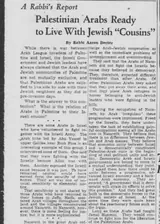 CP-1948-044
“Palestinian Refugees Awaken Arab World.”
Freeport Journal-Standard, Illinois, carrying the Washington Merry-Go-Round column. Seven years before the PLO, in a small Midwestern daily, as ordinary syndicated copy.
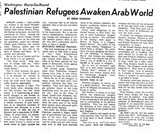 CP-1957-009
“Plight Of The Palestinian.”
Odessa American, Texas. The definite article and the singular: a kind of person, assumed known to the reader.
 CP-1959-002
Checked against the Library of Congress
Everything above is a count of the clippings collected here, which were found by searching, which means they can only show what searching found. So the same question was put to Chronicling America, the Library of Congress’s collection of scanned American newspapers: millions of pages, assembled by librarians for no purpose connected to this.
Counting only pages that also mention Palestine.
| Phrase | Pages | Heaviest decade |
|---|---|---|
| “Palestinian Jews” | 272 | 1940s |
| “Palestinian Arabs” | 78 | 1950s |
| “Palestine for the Palestinians” | 31 | 1920s |
| “Jewish Palestinians” | 26 | 1920s |
| “Palestinian citizenship” | 25 | 1920s |
| “Palestine Arab delegation” | 22 | 1920s |
| “Palestine Arab Congress” | 16 | 1920s |
| “Palestinian people” | 14 | 1920s |
American papers used this word for Jewish residents more often than for Arab ones, by roughly three and a half to one. That is the opposite of a convenient finding and it is the main thing that collection says.
What it also says is that the Arab-referent use is not a late arrival. Palestine for the Palestinians is a political slogan about Arab self-rule, and twenty-four of its thirty-one pages fall in the 1910s and 1920s. The Palestine Arab Congress, a body that first met in 1919, is named on sixteen pages. So is a Palestine Arab delegation. So is the Palestinian people, ten times in the 1920s alone.
Both meanings were in circulation for decades, and the one that survived was not the more common one. The claim this actually settles is narrow: the word was in American newspapers, attached to Arab political demands, forty years before the Palestine Liberation Organization was founded in 1964.
And the ones that do not count. Several early uses here are the plain geographic sense and are no evidence of anything: a 1902 New York Times reference to the Palestinian Kingdom means the ancient one; a 1920 American Israelite headline about Palestinian Restoration means the Zionist project; a 1946 New Jersey paper calls a Jewish resident of Mandate Palestine a Former Palestinian Native.
The same pattern, in the Library of Congress’s own newspaper collection
The same shape appears in the Library of Congress
Chronicling America holds millions of American newspaper pages, digitized by librarians for reasons unconnected to any of this. Searched for “Jewish colony” and “Jewish settlement” on pages that also mention Palestine, per 10,000 such pages:
| decade | “Jewish colony” | “Jewish settlement” |
|---|---|---|
| 1890s | 9.5 | 5.5 |
| 1900s | 21.8 | 11.1 |
| 1910s | 22.2 | 20.4 |
| 1920s | 44.2 | 61.4 |
| 1930s | 21.5 | 51.3 |
| 1940s | 17.9 | 130.2 |
| 1950s | 1.7 | 31.5 |
Colony leads two to one in the 1900s. They run level in the 1910s. Settlement passes it in the 1920s and by the 1940s wins seven to one.
Across 263,128 pages mentioning Palestine between 1890 and 1959, Arab outruns Palestinian in every decade: fourteen to one in the 1930s, thirty-four to one in the 1950s.
Chronicling America stops around 1963, so it cannot test what came after.
A people can be written about for forty years without being named as themselves. That is what the left half of this chart is. The right half is not a correction anyone apologized for; the word simply became usable, around the time there was a political movement making it impossible to avoid.
Colonization, until 1948 +
A word that goes missing
Colonization, until 1948
Calling it colonization now starts an argument. It used to be the plain word, and American papers used it in their own headlines: Plan of Colonizing Palestine With Jews (1902), Jewish Colonists Advancing (1908), Jewish Colonists Redeem Palestine (1912), Palestine Natives Oppose Zionism (1921).
Every use of it by a newspaper describing the project as it happened sits before 1948. After that it turns up twice more and both are different in kind: an Arab physicist in 1957 given space to argue back, writing about "when Zionist colonization began," and a looking-back column in Sioux City reprinting an old notice about local fundraising. After that only critics and historians reach for it, and always about the past.
What returns in the 1990s is settlement, which names a smaller thing: an outpost, a problem, an obstacle to peace.
Counts are from these 949 clippings, not from the whole American press. This finding has been checked against the Library of Congress’s collection of scanned American newspapers, and the result is in the section on the word for the people.
Nakba, in quotation marks, for thirty-eight years +
A word held at arm’s length
Nakba, in quotation marks, for thirty-eight years
Colonization is a word the American press used plainly and then dropped. Nakba is the opposite case: a word it would not take into its own voice at all.
It appears in this archive in 1983, and it arrives already quarantined: quotation marks, a translation, and an attribution to the people who use it. A quarter of a century later it is still in quotation marks.
“Already the best-educated Arabs before what they call ‘al nakba’ — the disaster —”
The Register-Guard. The earliest use here, and it carries all three devices at once.
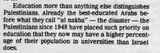 CP-1983-005
“Arab Protests Erupt in Violence. 9 people die in riots over Israel’s birth.”
San Francisco Chronicle, running Serge Schmemann of the New York Times. The headline names the day from one side. The other name appears only in the body, twice removed: “an event they call the ‘catastrophe.’” The same report notes Israeli forces killed eight Palestinians in Gaza that day, two of them eight-year-old boys.
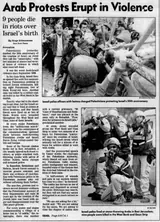 CP-1998-004
“…commemorating the 50th anniversary of the Palestinian Nakba, their uprooting after…”
Stamford Advocate, in a photo caption. Here it runs without quotation marks, glossed instead. The Houston Chronicle three days later: “unrest over ‘al nakba’”. The Arizona Republic in July: “Palestinians remember ‘Nakba’”.
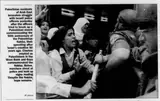 CP-1998-006
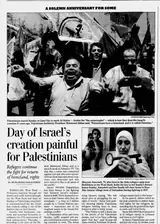 CP-2005-001
“‘Al-Nakba denial’ pervades letter.”
The Register-Guard letters page. A reader uses the word as a word, argues about it, and counts “the 531 villages and 11 urban areas.” The readers get there before the newsroom does.
 CP-2007-005
“Palestinians mourn Israel’s anniversary as the ‘Nakba’. Black-clad marchers, moments of silence mark the ‘catastrophe’.”
The Day, from the Los Angeles Times. Two sets of quotation marks in one headline stack, twenty-five years on.
 CP-2008-001
“They left without anything… It was called Nakba, ‘the catastrophe.’”
The Pantagraph, Bloomington, Illinois, quoting Noor Alsaqri of Normal on what her grandparents lost in 1948. Thirty-eight years after the first of these, and the quotation marks are still there.
 CP-2021-003
“Remembering the Nakba on Israel’s 60th anniversary.”
Wisconsin State Journal, a guest column by Judith Laitman and Tsela Barr: “we are Jews who will not be celebrating.” No quotation marks. It took a guest column by two Jewish writers for the word to run in a headline with no quotation marks around it.
 CP-1980-004
Every clipping here that prints the word Nakba →
Two words, opposite journeys. Colonization was the establishment’s own term for the project, printed without argument until 1948, after which it stops appearing in these papers. Nakba arrives in 1983 inside quotation marks and is still inside them in 2021, thirty-eight years later.
What the quotation marks track here is not the year. The one headline in this collection that prints the word with no quotation marks around it belongs to a guest column by two Jewish writers saying they will not be celebrating — a piece written from inside the Palestinian account of 1948 rather than reporting on it.
Who was allowed to say genocide +
A word, and whose mouth it came out of
Who was allowed to say genocide
Raphael Lemkin coined the word in 1944. Four years later the United Nations wrote it into law, and in August 1948, while that debate was still going on, an American newspaper printed it about Palestine for the first time. It has been in American papers about Palestine ever since. The question worth asking is not whether it was said. It is who got to say it.
A syndicated column, 1969

The Sentinel, 14 November 1969 · Joseph Alsop
No quotation marks. No attribution. The paper’s own columnist, in the headline.
A local column, forty-five years later
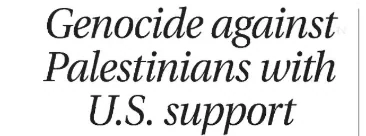
Lincoln Journal Star, 8 August 2014 · Ruth Raymond Thone
The first time in this collection that an American paper says it plainly, in its own voice, with Palestinians as the subject.
Every clipping here that uses the word, sorted by whose voice carries it. Counts are of 33 clippings found by searching for the word, so they describe this collection and not the American press.
A Palestinian, in 1980. The section above sorts the word by whose voice carries it, and this is the earliest instance in the collection where that voice is Palestinian and named. Mamoun el Sayyed, editor of the East Jerusalem paper El Fajar, quoted in a Florida daily on the settlers of Kiryat Arba: Rabbi Levinger is writing his own version of the Nuremberg laws. Kahane is inclined toward deportation and genocide.
On the same page Meir Kahane is quoted saying There is only one solution: The Arabs must leave Israel.
Twice it is the other way round. A Jewish weekly in 1948 calls what is happening to Jews in Arab countries “genocide,” in quotation marks, because the word was four years old. Alsop uses it about Israelis in 1969 with no quotation marks. And in 2014 two syndicated columnists put it in their headlines with no quotation marks in order to deny it: Genocide in Gaza is a lie worthy of Goebbels, and Facts disprove genocide charges hurled at Israel.
The word was never unavailable. It ran with no quotation marks around it, in mainstream papers, in their own voice, for decades — to warn about Israelis, and to rebut the charge. What took until 2014 was saying it plainly about Palestinians.
The ugliest clipping in this section is the one that has to stay. In August 2002 the Atlanta Constitution reported that white supremacists in Georgia were leafleting homes with the words “stop subsidizing Israeli genocide against Palestine.” The story is about Palestinian solidarity groups barring them from the pickets. Samir Moukaddam of the American-Arab Anti-Discrimination Committee describes how the approach goes: “At some point, they start saying, ‘Jews are this and Jews are that.’” Adam Levenstein, who is Jewish and a member of Atlanta Palestine Solidarity: “We want nothing to do with these people.”
Cropped to the leaflet it would say the opposite of what the page says, so it is held whole.
What the clipping records is a tactic. Organized white-supremacist groups attach themselves to Palestinian solidarity in order to move an audience from criticizing a state to a claim about Jewish people, which is antisemitism and is the thing the leafleting is for. The people actually doing the organizing in this story say so themselves and shut it down on the spot: Moukaddam describes the pivot, Levenstein refuses the association. The leaflet is not evidence about the movement it was aimed at. It is evidence about who tries to stand next to it.
60,000 people, six verbs +
23 April 1948
60,000 people, six verbs
Haifa fell overnight. Three news agencies filed by morning, and American papers set the same number of people in motion using whichever verb they chose. Forced out. Fleeing. Set to evacuate. Forced to evacuate. Leaving. Mass exodus. One Friday.
The Associated Press filed from Haifa. Two papers in this archive ran that copy, one of them twice.
The copy underneath never changed. “Arab leaders bowed to a Jewish blitz yesterday and agreed to evacuate Haifa, one of the most important port cities in the Middle East. Zionist militia began a whirlwind attack for control of Haifa Wednesday when the British withdrew from all but the port area… By noon yesterday they had forced the Arabs to sue for peace.”
The dispatch contains both explanations, in order: an attack, a British withdrawal, Arabs forced to sue for peace, leaders agreeing to evacuate. Every one of those three headlines is a defensible reading of it. The editors were not choosing between true and false. They were choosing which half of the sentence went in large type.
One paper did both. The Idaho Statesman printed Forced Out on page one and Set To Evacuate on page three of the same edition, above the continuation of the same story.
International News Service filed from Haifa the same morning, and two more papers ran that.
The copy underneath never changed. “Haifa, April 23 (Friday) (INS) — Jewish forces won complete military control of Haifa last night and today 60,000 Arabs began a mass evacuation from the great port city on Palestine’s…”
United Press filed too, and reached the Daily Report under Report Arabs Fleeing Haifa by Land and Sea. Of the three services it is the only one that says what the Arabs of Haifa were refusing:
The Arab population of Haifa was reported fleeing by land and sea today after refusing a Jewish truce demanding they lay down their arms and submit to search. More than 6,000 fled to sea in small fishing boats across the bay to Acre.
United Press, Haifa · The Daily Report, 23 April 1948
One more sentence begins — It was understood that the British commander, Maj. Gen. H. C. Stockwell, virtually ordered the… — and runs off the edge of the clipping. What survives is enough. A truce was offered on terms, the terms were disarmament and search, and they were refused before the flight.
A third INS story, datelined Jerusalem rather than Haifa, reached the Pasadena Star-News under Militiamen Consolidate Gains in Haifa. Its copy is blunter than any of the headlines: the militiamen consolidated their positions “following a mass exodus of Arabs who fled under attack.”
Four headlines in which the 60,000 do not appear
Of the eleven clippings here from that day, four put the number and the people nowhere in the headline. The story becomes the capture of a city.
- Jewish Forces In Control of Haifa The Patriot-News, Harrisburg
- Militiamen Consolidate Gains in Haifa Pasadena Star-News
- Jewish Troops Attack Town Near Haifa The M’Alester News-Capital, Oklahoma
- Palestine Beaumont Journal, Texas — a jump page under the standing word
And one set the Haifa headline directly beneath an unrelated one in the same deck, so the page read PUNISHMENT CONSIDERED OF NO VALUE and then 60,000 Arabs Leaving Haifa In Mass Exodus. That is the Sidney Daily News of Ohio, and it is a layout accident rather than an argument.
What the continuation page carries
The Idaho Statesman’s page three holds what no headline had room for:
Arab men, women and children began leaving the city by boat, truck and other means when the battle began… the only Arabs due to remain in Haifa will be Moslem and Christian clergymen who will watch over religious shrines. British army transport assisted in the evacuation, which will continue today.
The Idaho Statesman, Boise, 23 April 1948, page 3
They left when the battle began. Almost nobody was to remain. And the British army helped carry them out. None of that is in any of the eleven headlines, and the last clause complicates every short version of this story, including the short version this archive would find convenient.
Jaffa, from 70,000 to 2,000 +
April 1948 to August 1958
Jaffa, from 70,000 to 2,000
Jaffa was the largest Arab city in Palestine, a Mediterranean port immediately south of Tel Aviv. The United Nations partition plan of November 1947 assigned it to the Arab state, as an enclave inside the Jewish one.
“Arabs Flee by Thousands as Jews Pound Jaffa in Fiercest Fighting Yet in Palestine.”
One United Press dispatch, three papers on the same morning: the Morning Advocate in Baton Rouge, the Lodi News-Sentinel in California as “Arabs Flee City Under Bombs,” and the News & Observer in Raleigh. Thousands of Arabs fled this ancient city today as men of the Jewish extremist Irgun Zvai Leumi battered the city with mortars in the fiercest attack of the five-month ‘war,’ police said tonight.
A British police superintendent is quoted by name: at least four persons were killed and 82 wounded
.
The same dispatch carries the objection from the other Jewish force: A Haganah broadcast tonight accused Irgun of ‘indulging in dangerous adventures.’
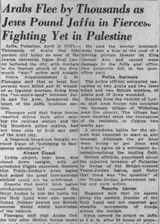 CP-1948-052
“Arabs Flee Jaffa as Zionist Forces Battle Way Into City.”
The Observer, from the United Press. British tanks are now firing on the Irgun, and the Haganah is pushing in from the south. An Arab defeat seemed probable, and some 60,000 civilian Arabs in the city were seeking to escape. Some boarded Lebanese schooners and sailing ships in the harbor, and others sought to flee through the Jewish lines
The photograph above it counts them again: A reported 60,000 civilian Arabs were reported attempting to escape the city.
The Expositor in Brantford, Ontario, runs the fall of the Manshieh quarter the same day.
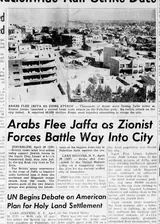 CP-1948-065
“JEWISH FORCES SEIZE A MILE OF ARAB JAFFA.”
Chicago Tribune. Headline only; the archive holds no body text for it.
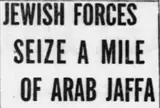 CP-1948-030
“Arabs Flee Jewish Advance.”
An Associated Press photograph in the Beatrice Daily Sun, Nebraska. There is no story. The picture and its caption are the whole item: A caravan of trucks lines a street in Jaffa as residents of the Arab port city in Palestine pile their household goods aboard the vehicles during the evacuation of the city in the face of Jewish forces advancing from neighboring Tel Aviev.
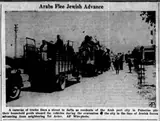 CP-1948-068
“Jaffa Is a Dead City.”
The Boston Globe, the day Israel declared independence and the day after Jaffa surrendered. The subheading does the arithmetic: this correspondent found only 2000 left of its 70,000 people
. The correspondent remembers what it had been: full of wild taxi drivers, donkey carts and smells of bad sanitation
.
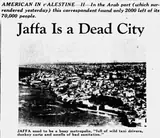 CP-1948-034
“Refugees Pin All Hopes on Nasser.”
Ten years on, a Scripps-Howard reporter in a camp outside Jericho. ‘I will show you two secrets,’ said a man with flashing black eyes outside a refugee hut near the walls of ancient Jericho. Inside the mud brick hut he untangled a muddle of old clothes and shook two objects out on the matted floor. One was a key to his abandoned house in Jaffa, Israel.
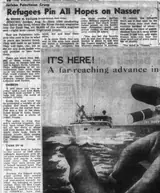 CP-1958-006
70,000 people, then 2,000, in nineteen days, printed at every stage in ordinary American papers while it was happening. Nothing here was uncovered later.
Three verbs for taking a Palestinian house +
1949 to 1952
Three verbs for taking a Palestinian house
In the summer of 1950 the Associated Press moved one paragraph out of Tel Aviv about the Israeli custodian of abandoned property. Three papers in this archive ran it. The copy is identical down to the figures. The headlines choose three different verbs for what happened.
“Immigrants Use Arab Properties.”
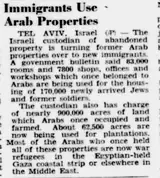 CP-1950-003
“Jewish Immigrants Get Former Arab Property.”
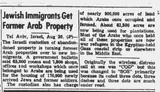 CP-1950-004
“Immigrants Taking Over Arab Property.”
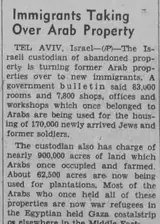 CP-1950-005
A year earlier the Wisconsin Jewish Chronicle had described the same machinery from the inside, without a headline verb to choose: land, houses and equipment of all kinds from this source are now being disposed of systematically and legally. The army has priority on all such transactions
. And, on the economics of it: the cultivation of small orchards by a few hired hands ceased to be an economic proposition as soon as Arab cheap labor was eliminated
.
The archive holds the other direction too. In January 1950 an Associated Press photograph ran in Oklahoma under the line Arab families are reunited in Acre following repatriation of Arabs, both Christian and Moslem, who fled Palestine during the fighting.
The news agency expected more of it.
Two years after that, in St. Louis, the Arab position at the United Nations was reported as a single sentence: the Arabs would accept any form of negotiations in the Palestine dispute if Israel respected UN resolutions calling for the repatriation of Arab refugees
.
Thirty-four years of plans to settle them in someone else’s country +
Resettlement
Thirty-four years of plans to settle them in someone else’s country
Fifteen months after the people left, the proposals start, and for thirty-four years they are all the same proposal: that the refugees should be permanently housed, fed and employed in Jordan, or Iraq, or Syria, or Libya — anywhere except the towns they came from. Return is not among the options discussed.
It runs for thirty-four years in these clippings, from a British cheque to a committee buying advertisements in the New York Times, and the thing being proposed never changes. Only the country named as the destination does.
“Britain Gives $2,000,000 To Resettle Arab Refugees.”
The Evening Star, Washington. Half a million pounds to Jordan “to help the Arab kingdom resettle Palestine Arab refugees on its territory.” The earliest of these, and the frame is already complete: somebody else’s territory, paid for by a third party.
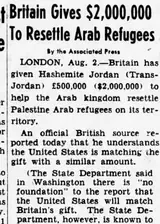 CP-1949-003
“Urge $800,000 UN Project To Resettle Arab Refugees.”
The Afro-American, Baltimore. Nineteen American public figures propose $800 million to settle them “in the Arab states,” of which $500 million is to develop those states’ natural resources so they can absorb the people. Absorption, as a budget line.
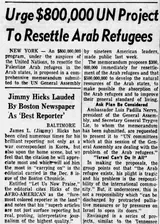 CP-1952-001
“830,000 unhappy, dislocated people chased out of what now is Israel.”
Press & Sun-Bulletin, Binghamton, in a news-agency story about the resettlement program. The sentence that explains why the program exists, printed in an ordinary American daily in 1952, in the same paragraph as the proposal to make the situation permanent.
 CP-1952-002
“Israel Drafts Plan to Absorb Arab Refugees.”
The Daily Journal, running United Press International. “About 700,000 Palestinians who fled from what is now Israel fell under Israeli control again in this month’s war.” The number and the word Palestinians, in a news-agency dispatch, nineteen years after.
 CP-1967-010
“Jordan no Palestine state, Hussein says.”
The Plain Dealer, Cleveland. The king rejects the proposition that “Jordan was once Palestine, making Jordan the proper Palestinian homeland.” By now the destination has a name and the argument has to be had with the country being volunteered.
 CP-1982-004
“Is Jordan really Palestine? Well . . .”
Houston Chronicle, Sidney Zion. “Ariel Sharon says yes. King Hussein says no. The State Department agrees with Hussein. It provides no evidence to support the king. But neither does the king.” The question asked as a question, and answered both ways on the same page.
 CP-1982-020
“Two million Palestinians already have a homeland in Palestine” — so says a group called the Jordan Is Palestine Committee, in ads in The New York Times.
The Morning Union, Springfield, Massachusetts, quoting the advertisement in order to answer it: “Palestinians don’t regard themselves as Jordanians… They want the opportunity to go back to Palestine, preferably to an independent Palestinian state.” A named organization, buying space in the paper of record.
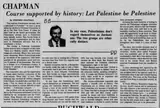 CP-1983-001
“Jordan is indeed Palestine.”
Chicago Tribune, Charles Chi Halevi, two months later, making the case in full: “Jordan occupied almost 77 percent of Britain’s original Palestine Mandate.” The advertisement has become a column in a major American paper.
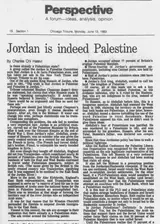 CP-1983-002
What the sequence shows is not that the proposal was unreasonable. It is that across these ten clippings, spanning thirty-four years, where Palestinians should live is treated as a question with an answer — and in none of the ten is the answer the place they had left. The 1952 news-agency story is the sharpest instance: it prints the resettlement plan and the phrase chased out of what now is Israel in the same breath, and treats only the first as news.
See these ten in the archive →
Ten clippings, 1949 to 1983, found by searching for resettlement and absorption language rather than for any event. The Library of Congress puts the same vocabulary in the same papers from October 1948.
The argument that Palestinians’ own leaders caused their expulsion +
Blame within
The argument that Palestinians’ own leaders caused their expulsion
One of the oldest arguments about 1948 is that Palestinians were failed above all by their own leaders — that the Arab states told them to leave, and so their displacement is not Israel’s doing. It is usually treated as a later rationalization. It is not. It was in American newspapers in 1948, in full, with its sources named, while the people it describes were still moving.
What changes over the following sixty years is not the claim but its standing. In 1948 it arrives attributed — to a magazine, to a letter, to a named Arab official who said it himself. By 2016 it is a headline with no argument attached.
“Thus, the Arab League forced the Arabs to evacuate Palestine. " Having created the Arab ‘refugee’ problem, they now present it as an international " issue.”
Rabbi Aaron Decter, reporting from Israel for the Boston Evening Globe. The same piece sits down with the National Liberation League and the Arab Workers’ Trade Congress, names the men he spoke to, and records that in Nazareth the inhabitants “did not fight, nor did they run away.”
CP-1948-044“Arab Refugees’ Plight Caused by Own Leaders.”
Wisconsin Jewish Chronicle, carrying a Jewish Telegraphic Agency report of a letter by Herbert Bayard Swope in the New York Herald Tribune. It cites the London Economist on “the announcements made over the air by the Arab Higher Executive, urging all Arabs in Haifa to quit,” and quotes Emil el Ghory of the Arab Higher Committee saying the refugee problem is “the direct result of the policy of resistance to partition… and it is they who have to bear responsibility.” This is the argument at its source, seven months after the Haifa evacuation.
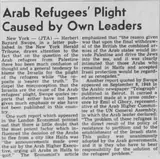 CP-1948-059
“Martial Law Ordered by Arab Leader.”
Great Falls Tribune, Montana, running the Associated Press from northern Palestine on Fawzi al-Qawuqji. The one clipping here from the period the leaders-told-them-to-leave claim is usually made about. It reports a commander declaring martial law. It does not report anyone being told to go.
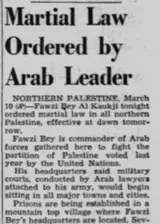 CP-1948-006
“Murders linked to land sales reopen an ugly chapter.”
The Oregonian, Barbara Demick for Knight-Ridder. It opens on one man: “Ali Jumhour kissed his wife goodbye at 9 a.m. Saturday and headed off to driving school.” Three Palestinians suspected of selling land to Jews killed in a month. The Palestinian Authority blames Israelis; Israelis say Palestinian officials encouraged it. Both accusations printed, neither resolved.
 CP-1997-002
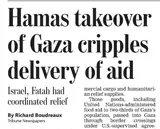
“Hamas takeover of Gaza.”
Chicago Tribune. A headline with no verb attached to anybody outside Gaza.
 CP-2007-003
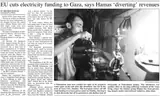
“EU cuts electricity funding to Gaza, says Hamas ‘diverting’ revenues.”
Gettysburg Times, running Ibrahim Barzak of the Associated Press from Gaza City. The word is in the paper’s own quotation marks, and a Hamas adviser is given the reply in the same story: the money, he says, was stolen by the company’s former director, and the investigation will be announced. The aid-diversion frame, on the day it arrives, with its rebuttal attached.
 CP-2007-004
“Israel accuses Hamas of diverting aid.”
The Rock Island Argus, on Israel’s ambassador to the United Nations. Nine years on the quotation marks are gone from the headline and the accusation is the story rather than the occasion for one.
 CP-1958-001
Both cases, printed in the same year: 1958 +
1958
Both cases, printed in the same year: 1958
Every 1958 clipping in the collection, in order, on both sides of the argument.
In 1958 American papers carried the case that Palestinians had been expropriated and forced out, and the case that they were never really Palestinian and left because their own leaders told them to. Both ran in full.
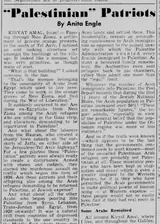
“Palestinian” Patriots
The quotation marks are the headline’s own. most of the so-called Palestinian Arab refugees are probably not Palestinian at all
. And the sourcing chain, named: a British-run station which gave strong encouragement to the exodus that created the Arab refugee problem.
Wisconsin Jewish Chronicle
Needs of Palestinian Arab Refugees Are Ignored by the UN and the World
Dorothy Thompson, syndicated. these victims of the partition of Palestine, forced out of the land of their ancestors to make room for a new immigration from elsewhere
… But to do anything for Arabs is an unpopular cause.
Jackson Citizen Patriot
Palestinian Arabs Still Expect to Regain Homes
The Associated Press, on a card worth a dollar fifty a month. Issued by the UN, it implicitly recognizes that he has been dispossessed
… When an Arab dies in a refugee camp, his family may bury him secretly and continue to draw his rations.
Herald News
Refugees Pin All Hopes on Nasser
Scripps-Howard, from Jericho. Inside the mud brick hut he untangled a muddle of old clothes and shook two objects out on the matted floor. One was a key to his abandoned house in Jaffa, Israel.
Four paragraphs later, both explanations in one breath: The refugees claim they were driven out at Israeli bayonet point. The Israelis say they fled with no urging
. Washington Daily News
The censor, printed in the paper +
What did not reach the page
The censor, printed in the paper
On 18 October 1982 the Baltimore Sun ran a dispatch from Tel Aviv with a line sitting above the dateline, before the story had begun: “This article was subject to Israeli military censorship.” The story underneath was about an Israeli columnist who had got a cabinet debate past the censor by rewriting it as Polish history from 1922.
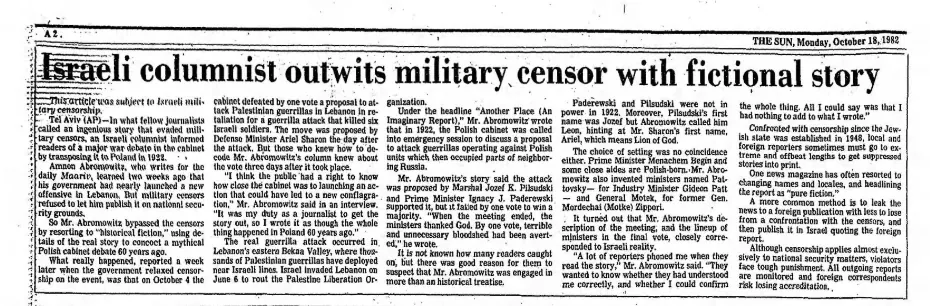
A censor who works well leaves nothing behind. These are the clippings where one left something — a notice above a story, a deletion marked on the page, a sentence explaining why the reporting could not be checked.
“Military Censors Hampering News Coverage in Palestine.”
Jackson Citizen Patriot, Associated Press from London. A news agency auditing the censorship around it, the day before the state was declared. It reports that “In Palestine Haganah, the Jewish defense force, censors all Jewish papers,” and that the strictest censorship of the whole region is in Syria and Lebanon. The machinery is older than the state it would serve.
 CP-1948-033
“The incident occurred immediately after Israeli launched its Sinai campaign but was not disclosed officially until Dec. 12.”
The Evening Gazette, on the trial of the officers and men who shot the villagers of Kafr Qasim. Six weeks between the killings and the disclosure, stated by the paper as ordinary background. “Israeli” for “Israel” is the paper’s.
 CP-1957-012
“Israel Soldiers Patrol Town; Shops Closed.”
Honolulu Star-Bulletin, Associated Press from Ramallah. Two youths arrested for unfurling a flag, and a pair of Palestinian newspapers shut or their editors arrested, reported inside a story about a business strike.
 CP-1981-002
“This article was subject to Israeli military censorship.”
The Baltimore Sun, Associated Press from Tel Aviv. The notice is the first line of a dispatch about evading the censor: Amnon Abromowitz of Maariv had learned of a near-offensive in Lebanon, and “military censors refused to let him publish it on national security grounds.” So he published it as a Polish cabinet debate of sixty years earlier.
 CP-1982-021
“The conflict goes on in numerous, non-violent ways. It includes the closure or publication restrictions by Israeli mil…”
Omaha World-Herald, under the headline Control of Palestinian Expression Is Invisible Part of Gaza Conflict. The clipping is the headline, the credit line and two lines of the story. The rest was not cut out, so where the sentence was going is not known.
 CP-1984-001
“Despite government claims that restricting residents and closing off the area to journalists would inhibit violence, military officials said there were major incidents in at least 23 locations.”
Press & Sun-Bulletin, on Land Day. The paper says in its own column that it cannot check the army’s account, and reports in the same column that the army had just closed the Palestinian news agency the correspondents relied on.
 CP-1988-011
“The military censor, meanwhile, has asked police to open an investigation into a report in the Sunday Times of London…”
Ann Arbor News, Associated Press from Jerusalem. The censor is not only cutting copy at home; he is asking for a criminal investigation into a paper printed in another country. The army spokesman quoted in the same dispatch is, by regulation, not named.
 CP-1989-009
“Israel censoring news of Soviet immigrants.”
The sidebar carries its own warning in italics — Israeli military censors made deletions from this article — and on the clipping two phrases about the occupied West Bank and Gaza are underlined by hand, where the deletions fell. Somebody marked the holes before filing it away. This is the clipping at the top of this section.
 CP-1990-001
“Israel bans film about battle at refugee camp.”
The Star-Ledger, on Jenin, Jenin. Four words of headline for a documentary the state would not allow to be shown.
 CP-2002-021
“lifting a nearly 25-year veil of secrecy and allowing a rare glimpse into the shadowy world of its secret operations.”
Roanoke Times, Associated Press, on Israel confirming it killed Khalil al-Wazir in Tunisia in 1988. It could be printed in 2012 because a military censor allowed it to be. The gardener killed on the way in is mentioned twice and never named.
 CP-2012-001
The censor turns up in these ten in four ways: as a notice set above the story, as a deletion marked on the page, as a reporter’s explanation of why an account could not be checked, and as a delay — six weeks in 1957, twenty-four years in 2012. In 1948 the machinery is already running, and running on papers rather than on foreign correspondents, eight days before there is a state.
What this cannot show is the censorship that worked. Every clipping here is a case where an American paper printed the fact of it, which is to say a case where the censoring was visible, reported, or eventually released. A deletion nobody marked and a story nobody filed leave no clipping behind, and this archive is made of clippings. The ten below are the floor, not the measure.
See these ten in the archive →
Ten clippings, 1948 to 2012, found by searching for the censor rather than for any event. The archive’s wider censorship collection is larger and takes in suppression of other kinds, including a word struck out of a United Nations resolution to get it past the United States.
The grammar of a death headline +
Who is the subject of the sentence
The grammar of a death headline
This archive holds 32 news headlines that report Palestinians or Arabs being killed. Sorted by nothing more controversial than grammar, they fall three ways.
Twenty headlines report a death with nobody doing it. Someone is killed the way weather happens. “Three Palestinians killed, 137 injured.” “4 Palestinians killed in occupied territories.” “Heavy Toll in Gaza Protests.”
Six name Israel as the one doing it, across thirty-seven years. One of those six adds “witnesses say.”
The same habit, from the other side
When the state does appear in the sentence, it is often the one answering. Somebody else started it. Sixty-one years apart, the same construction:
British troops blew up three Arab houses at Daharia, near Hebron, “in reprisal for an Arab raid.”
Omaha World-Herald. The demolition is the answer. The raid is the deed.
 CP-1937-010
“Palestinian youths threw stones and bottles Sunday at Israeli troops who responded with rubber bullets.”
Houston Chronicle. Youths throw. Troops respond. One side acts and the other replies, and which is which was settled before the sentence began.
 CP-2022-003
Nine clippings here use the language of retaliation, reprisal or response. In six the state is the one retaliating; in two, Palestinians. Nine is a small number and is offered as an observation, not a measurement.
The same test, run on both sides
One headline, two deaths
4 Israelis killed in firebombing of bus; Arab dies in clash
Clarion-Ledger, 31 October 1988 · Associated Press
Same sentence, same paper, same day.
name a specific violent act — firebombing, ambush, shooting, stabbing
use only a mutual or weather noun — clash, unrest, violence, toll
Israeli deaths in these years mostly came from discrete attacks; Palestinian deaths mostly came during protests and military operations, so some of this is circumstance. But offensive, raid, bombardment, tank and incursion all appear in the body text of the same stories whose headlines say violence and toll. The eight were found by searching for Israeli deaths, which makes them purposive rather than random.
Two days where two papers disagree
Shireen Abu Akleh, and what it took to be named +
May to July 2022
Shireen Abu Akleh, and what it took to be named
The section above counts how rarely an ordinary Palestinian is named in these clippings. Here is the exception, and it is worth reading for what it took.
Shireen Abu Akleh was shot in the head in Jenin on 11 May 2022. She was fifty-one, a reporter for twenty-five years, and an American citizen. Over the next ten weeks her name was printed in New Jersey, North Dakota, Pennsylvania, Illinois, Wisconsin and Montana. Six papers over ten weeks, and the account moves the whole time: a killing nobody will attribute, then stray Palestinian fire, then an Israeli army conceding a “high possibility” and opening no criminal case.
Al Jazeera reporter killed during an Israeli raid in West Bank
The morning after. The Israeli military initially suggested that Abu Akleh might have been killed by stray fire from Palestinians
— and the defense minister, the same evening: We are trying to figure out exactly what happened… I don’t have final conclusions.
The Star-Ledger
Israeli police beat pallbearers at Al Jazeera journalist’s funeral
Two services, two papers, one day. The Associated Press: causing them to briefly drop the casket in a shocking start to a procession that turned into perhaps the largest display of Palestinian nationalism in Jerusalem in a generation
. Her brother Tony said the scenes prove that Shireen’s reports and honest words … had a powerful impact.
Daily Herald · Dickinson Press
Palestinians say journalist killed by Israeli forces
The Palestinian attorney general: The only shooting was by the occupation forces, with the aim of killing
. The Israeli chief of staff, the same day: No soldier fired intentionally at a journalist. We investigated that. We checked it.
The Philadelphia Inquirer
U.N. agency says Israeli troops killed journalist
The United Nations found the shots came from Israeli forces and that she was not struck from indiscriminate firing by armed Palestinians, as initially claimed by Israeli authorities
. The photograph beside it is her face on a wall in Bethlehem, next to George Floyd. The Philadelphia Inquirer
US: Israeli fire likely killed reporter; no final conclusion
The State Department: likely fired from an Israeli position, but too badly damaged to reach an absolute determination
and no reason to believe
she was deliberately targeted. An Israeli rights group called it whitewash
. The Billings Gazette
The account moved in print over ten weeks: stray fire from Palestinians, then Israeli fire, then likely Israeli fire and no conclusion about intent. Every stage is in this archive because every stage was printed.
What the naming section measures is not whether American papers can name a Palestinian. It is what a Palestinian has to be before they do.
Security reasons, and what they were given for +
The reason given
Security reasons, and what they were given for
In 1985 five Palestinian women were refused permission to leave the occupied territories for a United Nations conference. The news-agency story puts the explanation in quotation marks: their applications “were turned down because of ‘security reasons.’”
Three years later an American headline prints the same phrase with no quotation marks at all. What those quotation marks were doing, while they lasted, was holding the explanation at arm’s length.
Applications “were turned down because of ‘security reasons.’”
Telegram & Gazette, Worcester, running United Press International from Nairobi. The paper names them: Ni’mah al Helon and Amal Wahdan, social workers and women’s rights activists. Two of the nineteen ordinary Palestinians this archive can find named before December 1987 are here, in a story about being refused an exit permit.
 CP-1985-002
“Israel considering sealing off areas for security reasons.”
Hartford Courant, running Dan Fisher of the Los Angeles Times. No quotation marks. The phrase has become the description rather than the claim, in a headline, in under three years.
 CP-1988-010
“Palestinian’s arrest schocks Arabs, Israelis.”
Kilgore News Herald, Texas, on Faisal Husseini given “up to six months’ administrative detention.” The first use of the term in this archive. Hanna Siniora, editing a Palestinian paper, is quoted against it: “The road to peace is being obstructed by detentions.”
 CP-1988-023
Administrative detention orders “normally used to detain Palestinians without trial.”
Ann Arbor News, running Marjorie Olster of the Associated Press. The story is about a Lebanese cleric; the mechanism is explained in a subordinate clause, as background a reader is assumed not to need explained further.
CP-1989-009“‘Administrative detention’: Israelis skip due process.”
The Baltimore Sun, Doug Struck. The term in quotation marks and the translation of it in the same headline.
 CP-1991-001
“There is no such thing as a benevolent occupation.”
Cordelia Edvardson, filing from Jerusalem for The Baltimore Sun, under the headline Security Reasons. She takes the phrase apart under its own name: “security is also, and more so, the result of national consensus about life and death issues like war and peace.”
 CP-1994-006
“Netanyahu’s 450 ‘security reasons’.”
The Arizona Republic. Back inside quotation marks, attached to a name, with a number on it: the 450 settlers in Hebron whose presence is stalling the withdrawal.
 CP-1996-003
“Palestinian freed after 6 years in Israeli jail.”
Journal Tribune, Biddeford, Maine, running Samar Assad of the Associated Press. Ahmed Qatamesh, 46, held since 1 September 1992 without charge or trial, his detention extended for the tenth time. His wife, Soha Barghouti, is quoted: he was never convicted of a crime.
 CP-1998-001
“7 Palestinians killed by Israeli army gunfire.”
Marshfield News-Herald, Wisconsin, Associated Press. A named agent in the headline, the phrase working quietly in the body, and the Israeli account of the suicide bombing that preceded it printed in the same dispatch. The archive’s own death-headline finding has exceptions, and this is one.
 CP-2002-020
Quotation marks are the cheapest thing a newspaper owns and the most revealing. On this phrase they come off in 1988, go back on in 1996 when a politician’s name is attached to it, and come off again in a 1994 column that argues with the phrase rather than reporting it. Nothing here shows the explanation was false. What these twelve clippings show is the quotation marks moving, and where they sit tracks how far the sentence stands from the claim it is carrying.
No partner for peace, and the answer printed beside it +
The negotiation
No partner for peace, and the answer printed beside it
The phrase reaches an American headline in October 2000, already inside quotation marks. Google’s database of scanned books does not show it in general use until 2003.
Nearly every paper that prints this argument also prints someone answering it, by name, on the same page. It is the only explanation in the archive that American newspapers rarely ran on its own.
“Arafat rejected $30 billion for refugee relocation, aide says.”
Indianapolis Star. Attributed to an aide, and carrying the older frame inside it: the money is for relocation.
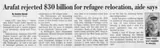 CP-2000-001
“Israel has no ‘partners for peace’.”
The State Journal-Register, Springfield, Illinois, over a syndicated George Will column datelined Jerusalem. The earliest use here, in a headline, in quotation marks, three years before the phrase becomes common in print — and it arrives as argument rather than as reporting.
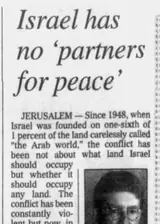 CP-2000-007
“It was the Arabs who rejected this plan and every other plan since.”
The Journal News, White Plains, in the letters column. The letter directly beside it is headed Zionist propaganda dehumanizes Arabs. Two readers, opposite positions, same page, same day.
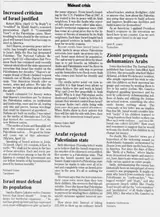 CP-2002-005
“They were offered a very generous deal in Camp David, and they rejected it. And this lie…”
San Francisco Chronicle, Edward Epstein. The same news story quotes Dennis Ross, Clinton’s envoy, saying Arafat rejected the deal, and quotes the reply to it. The frame and its contradiction, attributed, in one piece of reporting.
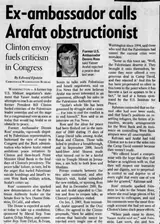 CP-2002-010
“Arafat is ‘partner for peace’ all right — as in ‘rest in peace, Israel’.”
The Free Lance-Star, Fredericksburg. Eighteen months on the phrase is established enough to be a pun, and the column attacks the New York Times on its way past for burying a report on A10.
 CP-2002-012
“Arafat rejected the best offer Palestinians are ever likely to get.”
Morton Kondracke, syndicated into the Southwest Daily News of Sulphur, Louisiana. Set as a pull quote, which is how a contested claim becomes the thing a reader takes away from the page.
 CP-2002-013
“Netanyahu: Israel ‘partner for peace’ with Palestinians.”
Huntsville Times, Alabama. The phrase turned around and claimed, by the man the 1996 clipping in the section above is about.
 CP-2009-023
Two things are visible here that are not visible in the other explanations. The phrase arrives in American headlines about three years before it becomes common in books, which means newspapers had it first. And where the other frames travel unanswered, this one is printed alongside the people disputing it — a former ambassador and the word lie, in the same column of the same newspaper.
How “human shields” changed sides in three years +
A phrase reversing
How “human shields” changed sides in three years
On 19 November 2006 the Israeli air force telephoned a house in Beit Lahiya to say it was about to destroy it, which was the standing procedure. Several hundred people went and stood on the roof. The strike was called off.
The Associated Press filed it as a new tactic. In 2003 human shields named people who volunteered to stand in the way — it was what they called themselves. Within three years the same two words named the opposite: civilians said to be held in place against their will by Hamas. The dispatch about the roof carries both meanings in one column.
“We are here because we decided to be human shields.”
The Associated Press, from Arafat’s compound in Ramallah. The paper names two of them: Morad Hashash, 28, a construction worker, and Fatima, 77, who had come to see Arafat for the first time. The phrase belongs to the people it describes, and the verb is theirs.
 CP-2003-006
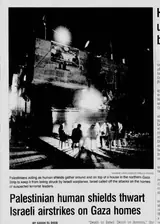
“Palestinian human shields thwart Israeli airstrikes on Gaza homes.”
The Star-Ledger, running Sarah El Deeb of the Associated Press from Beit Lahiya. “Hundreds of Palestinians serving as human shields guarded the homes of two top militants yesterday, a new tactic that forced Israel to call off missile strikes.” Israeli officials told her they did not know how to respond. The same story prints what the crowd was chanting, which was “Death to Israel, Death to America.”
 CP-2006-003
“A cynical exploitation by the terrorists of uninvolved people as human shields.”
The Israeli army, quoted in that same dispatch. This is the whole reversal, and it is already finished. The words are identical. The people on the roof have gone from the subject of the sentence to the object of it, and nobody had to wait for the argument to develop.
CP-2006-003“U.S. nun, priest are human shields at Palestinian militant’s house.”
The Beaumont Enterprise, three days later. Whatever the phrase is describing here, an American nun who flew to Gaza is not being exploited by anyone. The same dispatch carries the objection: Human Rights Watch called militants asking civilians to shield a house a “war crime,” and the UN human rights commissioner called the tactic a sign of Palestinian desperation. Both are printed alongside the volunteers.
 CP-2006-004
“We can’t go out and fight with guns, so we are participating in the resistance this way.”
A Palestinian woman in Beit Lahiya, to Joel Greenberg of the Chicago Tribune. The headline over her is “Use of human shields complicates Israel’s approach.” She is explaining a decision; the headline above her describes a problem of method.
 CP-2006-005
“Human shields: Hamas’ favorite tactic.”
Alan Dershowitz, syndicated from the Los Angeles Times into the Log Cabin Democrat of Conway, Arkansas. Two years and two months after Beit Lahiya. The people the phrase now refers to do not appear in the sentence at all, and no version of it is offered in which they chose anything.
 CP-2009-016
“Hamas is using the Gaza population as human shields.”
Santa Barbara News-Press, in quotation marks, attributed. Elsewhere on the page: twenty of the twenty-seven people killed that Sunday were civilians, mostly women and children, and a photograph captioned “An emergency rescue worker carries a child’s body.”
 CP-2012-002
“Human rights and human shields.”
USA Today, as a news analysis, the two set against each other in a headline as though they were opposing considerations of the same kind.
 CP-2014-005
The usual way to describe this is that a phrase was later twisted. That is not what these clippings show. Both meanings are printed on the same day, in the same dispatch, by the same news agency: the people on the roof saying what they decided, and the army describing the identical act with the subject moved. One of those two sentences is the one that kept being printed.
One man, and the position he never changed +
1984 to 1998
One man, and the position he never changed
A position often described now as a response to October 2023 was being printed in American newspapers in 1984, when Benjamin Netanyahu was a thirty-five-year-old ambassador giving a speech in a Baltimore hotel.
Nine clippings from ordinary American papers, 1984 to 1998, in which Netanyahu sets out the same position: no Palestinian state, no negotiable withdrawal, no legitimate Palestinian representative, annexation as the answer to a declaration. Every one of them was in print decades before October 2023.
He was out of office for much of this, and the archive holds Israeli governments of several kinds saying overlapping things. What these nine clippings establish is availability: no Palestinian state, no negotiable withdrawal, no legitimate Palestinian representative, annexation as the answer to a declaration — all of it in ordinary American papers, in his own quoted words, between 1984 and 1998. What they do not establish is that any of it caused a later policy. The chronology is the whole claim.
“The Arab decade is over… We smashed the PLO.”
Baltimore Sun, reporting a speech to a thousand people at the Hyatt Regency. One result, he says, is that “no longer is the PLO able to say it represents the Palestinian Arabs.” The argument that Palestinians have nobody entitled to speak for them is already finished and portable.
 CP-1984-002
“There is no reason to create a 22nd Arab state at the expense of the one Jewish state.”
Arizona Republic. Also: “Israel’s eastern front will remain in IDF hands. That is not negotiable,” and “the real challenge to peace is not our occupation, but would be our giving up the region.”
 CP-1985-001
A Security Council vote asking Israel not to deport Palestinians is “a day of hypocrisy” and a “rigged game.”
Birmingham News. The resolution had American support, and he says he is disappointed by the American vote.
 CP-1988-007
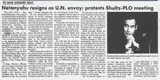
He resigns as U.N. envoy and begins campaigning “as a militant Likud-Herut hard-liner, only minutes after tendering his resignation.”
St. Louis Jewish Light, carrying the Jewish Telegraphic Agency. That description is the Jewish press writing in its own voice, in 1988.
 CP-1988-012
American talks with the PLO send “a very clear message, that terrorism pays.”
Palm Beach Post. Talking to Palestinians is itself the concession to be refused.
 CP-1988-036
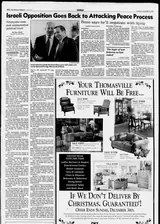
Two weeks after Rabin is buried, the opposition goes back to attacking the peace process.
San Francisco Chronicle. The report recalls the rallies where he “was often the chief speaker,” and which “became the scene of some of the worst excesses of anti-Rabin incitement.” He says he did not see the placards, or the coffin.
 CP-1995-002
“Killings don’t deter Netanyahu.”
Delaware Gazette. Now prime minister, he calls the settlers “heroes” and promises to strengthen the settlements.
 CP-1996-005
Declare a state and Israel will retaliate. The likely step is annexation of West Bank land.
The Herald. Israel cannot accept “a new Iraq or Iran” next door, so the answer to a declaration of statehood is to take the territory.
 CP-1998-002
“Netanyahu: No Palestine.”
Atlanta Constitution, on his rebuff of Hillary Clinton’s call for a Palestinian state. The paper calls him “ever the courtly hard-liner.” A week later, in St. Cloud: Palestinians may have control over their “lives, but not the powers of statehood.”
CP-1998-006Rabbis and Jewish papers arguing against Zionism, and what happened to the argument +
An argument that used to be ordinary
Rabbis and Jewish papers arguing against Zionism, and what happened to the argument
In the years either side of the Balfour Declaration, American papers printed Jewish opposition to Zionism as routine news. Rabbis, editors and congregations argued it in public, and the papers carried it as news rather than as scandal. Most of what follows ran in the New York Times. Two ran in The American Israelite, a Jewish weekly out of Cincinnati.
Says the Zionists Disturb Palestine
Dr. Paul Nathan of Berlin asserts the Jewish cause is imperiled. The New York Times
Palestine Not a Solution of Jewish Problem
"Zionism has no positive message to Jews in America — preservation of Hebraic spirit needed rather than separate nationality." The New York Times
Jewish Socialists for Free Palestine
An appeal to brethren here and in Russia. The New York Times
Jewish Nation Not Wanted in Palestine
"The views of those who are opposed to Zionism, expressed by a leading American rabbi." Printed three weeks after the Balfour Declaration. The New York Times
Americanism vs. Zionism
"Many American Jews unsympathetic to a political homeland in Palestine," says the former Attorney General of New York. The New York Times
Criticizes Zionists’ Methods
Rabbi David Philipson: "In our view Palestine, whenever the independent Palestinian state will be founded, will be a homeland for Palestinian Jews, as the United States is for us. It is not our homeland in any sense." The American Israelite
The Situation in Palestine
"Very disquieting reports concerning conditions in Palestine cause the Jews of the world to pause and consider the next step in the Zionist program." The American Israelite
Anti-Zionist Group Rejects American Democracy, Charge
Judge Louis E. Levinthal, president of the Zionist Organization of America, answers the new American Council for Judaism: anti-Zionists, he says, are “denuding Judaism.” Buffalo Jewish Review
Anti-Zionists to Fight ‘Nationalism’
Rabbi Elmer Berger of the American Council for Judaism meets anti-Zionist figures in London. The report frames it as “combatting world-wide proponents of the Jewish State.” Wisconsin Jewish Chronicle
Study of Arab Propaganda Here Lists Role of Anti-Zionist Jews
A JTA report on a Beirut study, which it says credits anti-Zionist Jews with more effective anti-Israel pressure than Americans of Arab descent. The cartoon beside it is captioned “No mention of his little gremlin.” Buffalo Jewish Review
U.S. Nurse Tells Israelis Of Sabra Camp Massacre
Ellen Segal, an American Jewish nurse, testifies to Israel’s commission of inquiry: “I can’t sleep at night unless I tell people what happened there.” St. Louis Post-Dispatch
Remembering the Nakba on Israel’s 60th anniversary
Judith Laitman and Tsela Barr: “Nevertheless, we are Jews who will not be celebrating… more than 700,000 Palestinians were made into refugees to make room for the future state of Israel.” Wisconsin State Journal
What changes between 1922 and 1957. In the first cluster, Jewish opposition to Zionism is ordinary news, printed without adjectives. By 1942 it is a charge to be answered — a rejection of American democracy, a denuding of Judaism. By 1957 it is filed under foreign propaganda, alongside a cartoon about oil money. The position did not move. What moved was the space allowed for holding it, and the record of that move is in the Jewish press itself.
It does not disappear. It reappears in 1982 in an Israeli courtroom and in 2008 on a Wisconsin op-ed page, and it is still being called the same things.
Houses for rifles +
One practice, eighty-four years
Houses for rifles
In 1937 the British army blew up three houses at Daharia, near Hebron, then marked more for demolition to match the number of rifles taken in a raid. They offered the village a rate of exchange: return a rifle, keep a house.
The rate of exchange changes. Sometimes it is rifles, sometimes a permit, sometimes a body held back from a funeral. The practice has a paper trail in ordinary American and British newspapers running from 1937 to 2021.
Jabalia, then and now +
One camp
Jabalia, then and now
Jabalia is a refugee camp in northern Gaza, set up in 1948 for people pushed out of villages a few miles away. It turns up in this collection thirteen times over sixty-one years. The reporters change. The camp doesn't.
Sabra and Shatila: from who fired to who knew +
September 1982
Sabra and Shatila: from who fired to who knew
Sabra and Shatila were two Palestinian refugee camps in Beirut, built for people driven out of Palestine in 1948 and lived in ever since; by 1982 they held tens of thousands and sat inside a city under Israeli military control. The killing there was done by Lebanese Christian militiamen, and American papers said so at the time.
They printed the rest of it too. Those militias had been armed and set up by Israel years before. Within a week the question in these pages had moved from who pulled the triggers to which Israeli commanders knew, and when. Israel’s own commission of inquiry spent months taking evidence. Survivors told reporters that Israeli soldiers were inside Shatila while the killing went on.
“Arab refugees massacred. Stench of death rises from rubble.”
The Morning Union. The Atlanta Journal and Constitution and the Abilene Reporter-News carry it the same morning, the Abilene under “Sabra Camp Eyewitness.”
 CP-1982-011
“Papers say Israel knew of massacre. Government denies advance knowledge.”
The News Tribune, from the AP in Jerusalem. Israeli newspapers report that Begin’s government knew for at least thirty-six hours and took no action. “Though the government knew on Thursday night,… it didn’t raise a finger nor did it do anything to prevent the massacre until Saturday morning.”
 CP-1982-012
“Questions from Shatila and Sabra.”
A Washington Post editorial, reprinted in Honolulu. It names the killers precisely: the militia of Maj. Saad Haddad, “set up as a fireforce by the Israelis some years ago,” and the Christian Phalangist militia, “also with Israeli ties.” Then: “THE ISRAELIS, however, cannot avoid their own measure of responsibility… By their invasion they made themselves accountable for its consequences… At the least, it appears, their entry created the conditions in which the massacre took place.”
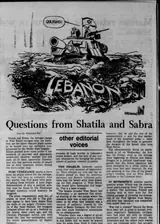 CP-1982-013
“Sabra and Shatila: Where Israel Got Its Wish.”
Richmond Times-Dispatch. The following day the Stamford Advocate runs “From My Lai to Sabra-Chatilla”: “What needs to be established clearly is precisely which Israeli leaders knew what and when.”
 CP-1982-015
“U.S. Nurse Tells Israelis Of Sabra Camp Massacre.”
St. Louis Post-Dispatch. Ellen Segal, an American Jewish nurse, volunteers testimony to Israel’s commission of inquiry because she “can’t sleep at night.” Three weeks later the Sun reports an Israeli soldier whose identification tags were found inside Sabra testifying that he was never there.
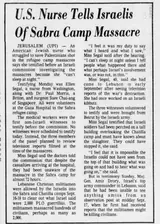 CP-1982-022
“Survivors: Israelis watched massacre.”
Philadelphia Inquirer, from the AP in Beirut. Three Palestinian women — Ektefa Shallah, her daughter Jamila, 16, and their neighbor Amenah Khalifa — contradict the official testimony. The same sentence states who did the killing: “the slaughter Sept. 16-18 by Lebanese Christian militiamen.”
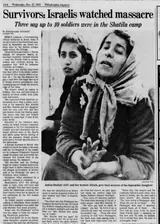 CP-1982-024
Israel’s own Kahan Commission reached the same place the following February, finding Israel indirectly responsible and the defense minister, Ariel Sharon, personally responsible. He resigned the post.
December 1987: the intifada begins, and Hamas is founded +
December 1987
December 1987: the intifada begins, and Hamas is founded
On 8 December 1987 an Israeli army truck killed four Palestinians at the Erez checkpoint. They were from Jabalia camp. The protests began at their funeral, and that is where the first intifada starts.
Hamas was founded in Gaza within days, out of a Muslim Brotherhood welfare network that Israel had licensed in 1979 and tolerated for years as a counterweight to the secular PLO. Its charter came the following August.
Four American papers ran a dispatch from Jabalia on 20 December, twelve days in. None of them mentions Hamas, because it was two weeks old and nobody had heard of it. Everything above the 1987 mark on this page was printed before any of it happened.