 Held without charge, for eighty-four yearsA category that never required a charge · 1939 to 2023
1939 to 2023
Held without charge, for eighty-four years
Twenty-seven clippings here carry a Palestinian prison story in the headline, across twenty-four papers, from 1939 to 2023. Read in order they are not twenty-seven stories. They are one arrangement, told again and again: a person can be taken and held with no charge, no trial and no end date. That is not the system breaking down. It is a category inside it.
The category has a name in the clippings, and it changes — emergency defense regulations, administrative detainee, security prisoner — but the substance holds. Start with one woman, because the first record here is about one woman and an editor’s desk.
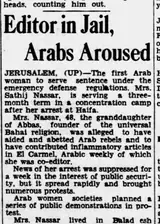
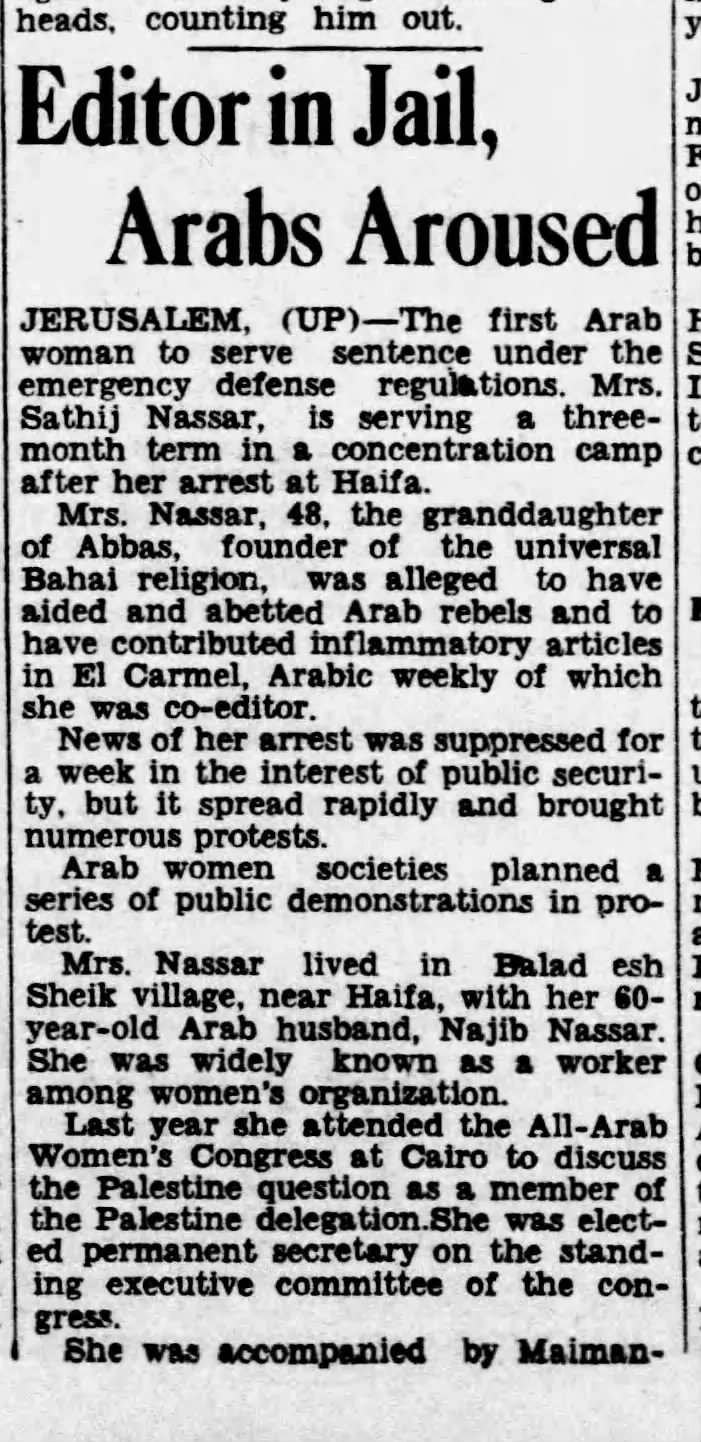
“Editor in Jail, Arabs Aroused”
Sathij Nassar, 48, co-editor of the Arabic weekly El Carmel, was serving three months in a concentration camp — the paper’s own words, printed in Allentown, Pennsylvania in 1939 — as the first Arab woman sentenced under the emergency defense regulations. The charge was contributing inflammatory articles to her own newspaper. The detail that gives the whole section its shape is one clause: “News of her arrest was suppressed for a week in the interest of public security.” The United Press also records what she did before the arrest: she went to the All-Arab Women’s Congress in Cairo as a member of the Palestine delegation, and was elected permanent secretary of its executive committee.
CP-1939-005Forty-three years later, a Texas paper explained the mechanism more plainly than any other clipping in this archive, and did it while reporting on a war.
The category, stated outright
“Israel’s position appears to be in violation of the Geneva Convention”
That is the Houston Chronicle, in its own voice, not quoting anybody. Israel had taken 6,000 Palestinians in Lebanon and was holding them as administrative detainees; the 60 Syrian soldiers captured in the same invasion were regarded in all aspects as prisoners of war. The reason given is the whole argument: the Palestinians were not serving in the army of a recognized state. The paper then prints Article 2 of the Convention against that reasoning, and notes the thing Israel was actually weighing — that if the Palestinians got no protection, neither would the ten Israeli soldiers held by the PLO.
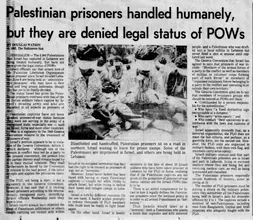 CP-1982-036
Statelessness is not incidental to the category. It is the qualification for it. A person with no recognized state cannot be a prisoner of war, so he becomes something with no fixed term.
The number that never settles
Every paper counts. No two counts agree, and none of them is corrected by the next one.
“Four thousand Arabs are in jail for political reasons”
Felicia Langer, an Israeli lawyer born in Poland whose husband survived Buchenwald, defending Palestinians charged with offenses that ran, in the paper’s summary, from passing out leaflets to giving a glass of water to a demonstrator. Her flat verdict on the courts: “There’s nothing lawful in the eyes of the authorities.”
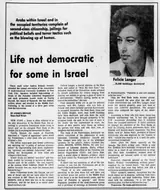 CP-1976-010
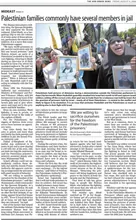
“We have 10,000 prisoners in jail, and the world cares only for this one Israeli prisoner.”
Mohsin Jirjawi, in Al Shifa hospital, where his wounded nephew was. The same page reports that the Palestinian Authority keeps a ministry with 300 bureaucrats simply to track who is inside, and that its own minister was by then in prison. It also reports Fakhri al-Barghouti of Ramallah sharing a cell with two of his sons, all three serving long sentences, and a woman shackled while she was taken in for a Caesarean section.
 CP-2006-010
Across the clippings the running total is given as 4,000 in 1976, about 2,000 in 1999, more than 5,300 in 2003, 9,200 in 2007, 10,000 in 2006 and about 4,500 in 2012. The papers are not lying to each other. They are each printing whichever figure the source in front of them offered, and nobody is counting the same category twice.
The only thing left to withhold
What a person holds when nothing else is his to give is whether he eats. Six clippings here are about that, and the earliest is about not being allowed to do it.
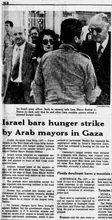
“Israel bars hunger strike by Arab mayors in Gaza”
The mayors were not prisoners. They planned to meet at Red Cross headquarters and refuse food for one day, in sympathy with Bassam Shakaa of Nablus, who had been arrested and ordered deported with no formal charges brought. Soldiers stopped them on the way. The Gaza mayor, Rashid A-Shawa, was turned back before he had walked 100 yards from his home.
 CP-1979-018
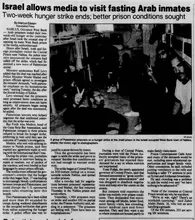
“conditions are not bad enough to warrant street riots”
Israel opened its main West Bank prison to Israeli, Arab and foreign journalists, who were allowed to interview fasting inmates at random, out of earshot of the wardens. The Associated Press states the purpose without varnish: the government was eager to prove to inmates’ families that conditions did not warrant riots. The prison commissioner offered ventilators in the cells and a taller television aerial to pick up Syrian and Jordanian broadcasts, and said of the crowding that “we have nothing to be ashamed of.” None of the inmates would say why he was there.
 CP-1992-010
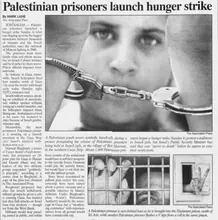
“an Israeli Cabinet minister said he’d rather let them starve”
The prisoners wanted more family visits and telephone access. Prison officials responded by imposing more sanctions. The demands are worth holding beside the answer.
 CP-2004-018
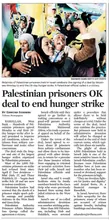
“Under the terms of the deal, Israel may continue the practice.”
Twenty-eight days without food, 1,600 prisoners, the longest such strike organized by Palestinians, and a Palestinian minister calls the settlement a victory. What the strikers won: eighteen men out of solitary, family visits from Gaza, a promise that the more than 300 men held indefinitely without charges or a trial would be charged or released at the end of their current terms. What they did not win is in the sentence above. The practice stays.
 CP-2012-009
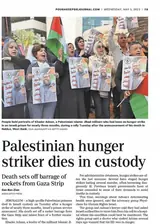
“Hunger strikes are one of the few nonviolent tools left to Palestinians”
Dana Moss, after a prisoner died in Israeli custody following a strike of nearly three months. The last clipping in this run, eighty-four years after Sathij Nassar, and the sentence that gets printed is the one explaining why anybody would do this at all.
 CP-2023-027
Released as a favor
The other half of these clippings is about letting people out, and almost every one of them uses the same word for it.
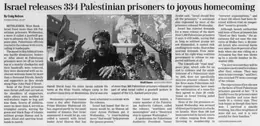
“worthless and meaningless”
Yasser Abed Rabbo on the release of 334 men, which Israel called a goodwill gesture and a Sharon adviser called a trust-building move. More than 180 of the 334 had been convicted of offenses the paper lists as running from stone-throwing to membership in “terrorist organizations”, and at least 150 had been held without trial on unspecified “security grounds.” A release is a gift only if the holding was ever a right.
 CP-2003-014
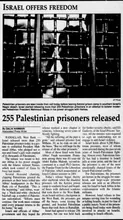
“Israel had agreed to release 256 prisoners, but one was held back for further security checks”
The same Associated Press report ran that day in Hanover, Pennsylvania under 255 Palestinian prisoners released and in Bay City, Michigan under Israel releases 250 Palestinian prisoners today. Only the first printing carries the sentence above, so only one set of readers learns that the number in the other paper’s headline is a number that moved. Every man freed had to sign an undertaking first.
 CP-2007-015
And then the children
“We were not even allowed to see the sun.”
Amer Salah, taken from his bedroom in the middle of the night at 14 and held with nine other boys in a cell about six feet by six. The paper gives the scale from the Israeli Prison Service’s own statistics: 420 Palestinians under the age of 18, the youngest aged eleven. Court figures obtained under freedom of information show bail denied to 70 percent of the Palestinian children detained. B’Tselem’s spokeswoman does not dispute the attacks and does not need to: even when involved in serious offenses, a child offender is still a child.
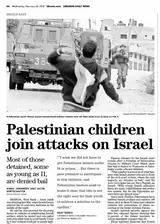 CP-2016-001
A United Nations committee reported in 1977 that Israeli agents made frequent use of torture on Arab prisoners, and the strongest evidence it cited was not Arab testimony but the Israeli press and the International Red Cross. Israel called the report biased and refused to cooperate with it. That clipping ran in Florida, on the same pages as everything else here.
Nothing in this section depends on what any of these men and women did. Some of them killed people. Some of them handed out leaflets. Some of them were eleven. The arrangement does not sort them, which is the point: a category that does not require a charge cannot, by construction, distinguish between them, and for eighty-four years American newspapers printed the category as background rather than as the news.
The next time you read that a number of prisoners are to be released as a gesture of goodwill, the question worth holding is the one none of these clippings asks: goodwill costs the giver something he was entitled to keep. What was Israel entitled to keep?