The Ann Arbor News · Ann Arbor, Michigan · 4 August 2006
CP-2006-010
Palestinian families commonly have several members in jail
Transcribed from the clipping
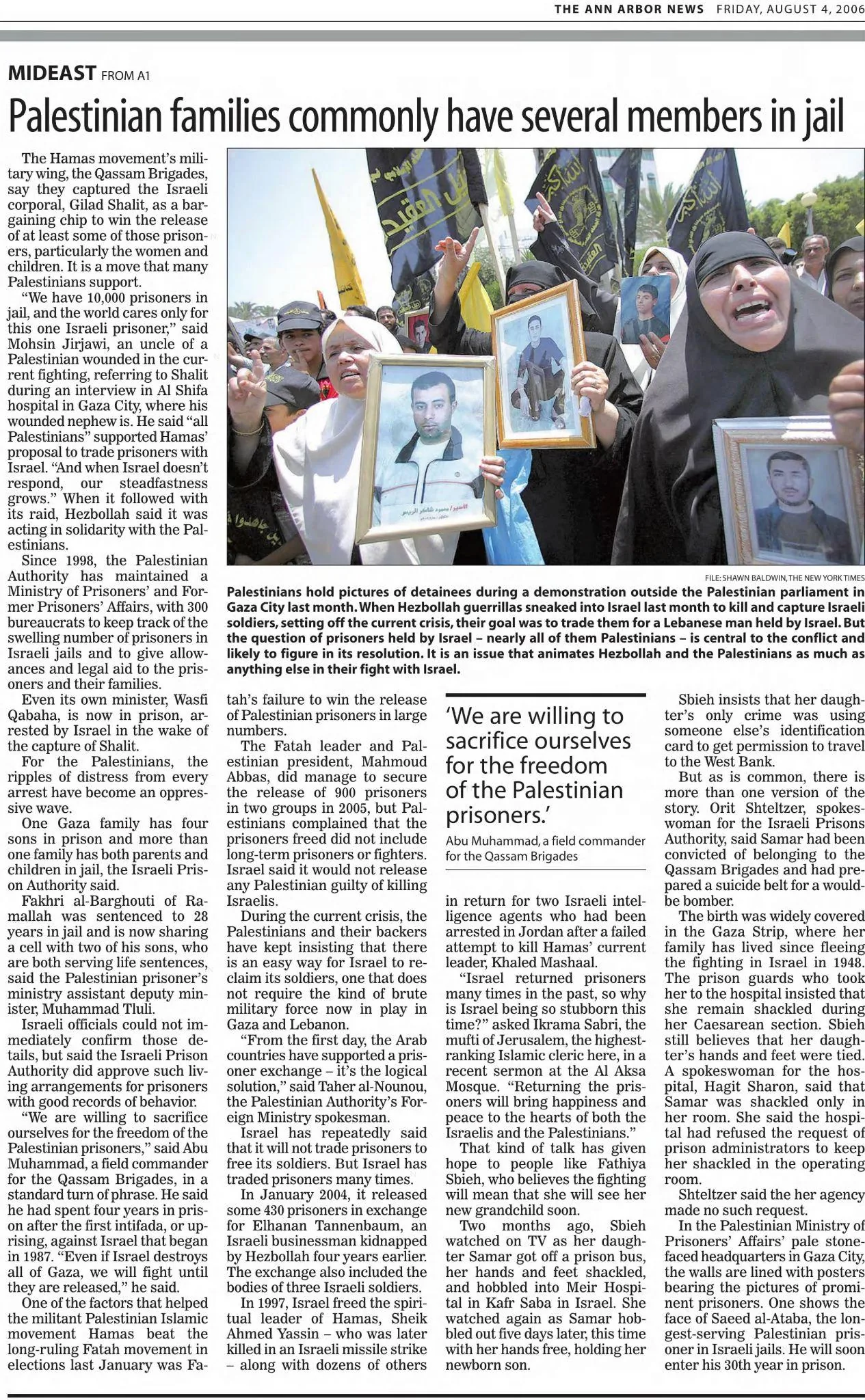
The Hamas movement's military wing, the Qassam Brigades, say they captured the Israeli corporal, Gilad Shalit, as a bargaining chip to win the release of at least some of those prisoners, particularly the women and children. It is a move that many Palestinians support.
“We have 10,000 prisoners in jail, and the world cares only for this one Israeli prisoner,” said Mohsin Jirjawi, an uncle of a Palestinian wounded in the current fighting, referring to Shalit during an interview in Al Shifa hospital in Gaza City, where his wounded nephew is. He said “all Palestinians” supported Hamas' proposal to trade prisoners with Israel.
“And when Israel doesn't respond, our steadfastness grows.” When it followed with its raid, Hezbollah said it was acting in solidarity with the Palestinians.
Since 1998, the Palestinian Authority has maintained a Ministry of Prisoners' and Former Prisoners' Affairs, with 300 bureaucrats to keep track of the swelling number of prisoners in Israeli jails and to give allowances and legal aid to the prisoners and their families.
Even its own minister, Wasfi Qabaha, is now in prison, arrested by Israel in the wake of the capture of Shalit. For the Palestinians, the ripples of distress from every arrest have become an oppressive wave. One Gaza family has four sons in prison and more than one family has both parents and children in jail, the Israeli Prison Authority said.
Fakhri al-Barghouti of Ramallah was sentenced to 28 years in jail and is now sharing a cell with two of his sons, who are both serving life sentences, said the Palestinian prisoner's ministry assistant deputy minister, Muhammad Tluli.
Israeli officials could not immediately confirm those details, but said the Israeli Prison Authority did approve such living arrangements for prisoners with good records of behavior. “We are willing to sacrifice ourselves for the freedom of the Palestinian prisoners,” said Abu Muhammad, a field commander for the Qassam Brigades, in a standard turn of phrase.
He said he had spent four years in prison after the first intifada, or uprising, against Israel that began in 1987. “Even if Israel destroys all of Gaza, we will fight until they are released,” he said.
One of the factors that helped the militant Palestinian Islamic movement Hamas beat the long-ruling Fatah movement in elections last January was Fatah's failure to win the release of Palestinian prisoners in large numbers.
The Fatah leader and Palestinian president, Mahmoud Abbas, did manage to secure the release of 900 prisoners in two groups in 2005, but Palestinians complained that the prisoners freed did not include long-term prisoners or fighters. Israel said it would not release any Palestinian guilty of killing Israelis.
During the current crisis, the Palestinians and their backers have kept insisting that there is an easy way for Israel to reclaim its soldiers, one that does not require the kind of brute military force now in play in Gaza and Lebanon.
“From the first day, the Arab countries have supported a prisoner exchange — it's the logical solution,” said Taher al-Nounou, the Palestinian Authority's Foreign Ministry spokesman. Israel has repeatedly said that it will not trade prisoners to free its soldiers. But Israel has traded prisoners many times.
In January 2004, it released some 430 prisoners in exchange for Elhanan Tannenbaum, an Israeli businessman kidnapped by Hezbollah four years earlier. The exchange also included the bodies of three Israeli soldiers.
In 1997, Israel freed the spiritual leader of Hamas, Sheik Ahmed Yassin — who was later killed in an Israeli missile strike — along with dozens of others in return for two Israeli intelligence agents who had been arrested in Jordan after a failed attempt to kill Hamas' current leader, Khaled Mashaal.
“Israel returned prisoners many times in the past, so why is Israel being so stubborn this time?” asked Ikrama Sabri, the mufti of Jerusalem, the highest-ranking Islamic cleric here, in a recent sermon at the Al Aksa Mosque. “Returning the prisoners will bring happiness and peace to the hearts of both the Israelis and the Palestinians.”
That kind of talk has given hope to people like Fathiya Sbieh, who believes the fighting will mean that she will see her new grandchild soon. Two months ago, Sbieh watched on TV as her daughter Samar got off a prison bus, her hands and feet shackled, and hobbled into Meir Hospital in Kafr Saba in Israel.
She watched again as Samar hobbled out five days later, this time with her hands free, holding her newborn son. Sbieh insists that her daughter's only crime was using someone else's identification card to get permission to travel to the West Bank. But as is common, there is more than one version of the story.
Orit Shteltzer, spokeswoman for the Israeli Prisons Authority, said Samar had been convicted of belonging to the Qassam Brigades and had prepared a suicide belt for a would-be bomber. The birth was widely covered in the Gaza Strip, where her family has lived since fleeing the fighting in Israel in 1948.
The prison guards who took her to the hospital insisted that she remain shackled during her Caesarean section. Sbieh still believes that her daughter's hands and feet were tied. A spokeswoman for the hospital, Hagit Sharon, said that Samar was shackled only in her room.
She said the hospital had refused the request of prison administrators to keep her shackled in the operating room. Shteltzer said the her agency made no such request. In the Palestinian Ministry of Prisoners' Affairs' pale stone-faced headquarters in Gaza City, the walls are lined with posters bearing the pictures of prominent prisoners.
One shows the face of Saeed al-Ataba, the longest-serving Palestinian prisoner in Israeli jails. He will soon enter his 30th year in prison.
Context added by this archive
A jump page, labeled MIDEAST FROM A1. Photograph credited File: Shawn Baldwin, The New York Times.
Cite this item
"Palestinian families commonly have several members in jail," The Ann Arbor News, 4 August 2006. Covering Palestine archive, CP-2006-010. https://coveringpalestine.org/archive/cp-2006-010
More from the 2000s
- Mind-set of suicide bombers covered in Globe-winning filmThe Grand Rapids Press · 20 January 2006
- Emotion PicturesSan Antonio Express-News · 4 March 2006
- Palestinian women argue with security officers in RamallahThe Journal News · 8 March 2006
- Trying to atone for deadly errorHouston Chronicle · 8 June 2006
- Palestinian dance troupe is taking steps to peaceTelegram & Gazette · 27 July 2006
- Gaza Strip: Israeli air strikesPost Bulletin · 4 November 2006
- All 175 clippings from the 2000s →
This record is part of Covering Palestine, an archive of American and Anglophone newspaper clippings about Palestinians, 1799 to 2023. Researched and assembled by Maria Robles.
The clipping belongs to the newspaper that printed it, or to the news agency that supplied the copy. It is reproduced here for research, criticism and commentary. The city is derived from the masthead, not read off the clipping.
Something wrong here, or something you know about this clipping? The archive is still being built and corrections are wanted: maria@rozumstudio.com, quoting CP-2006-010.
See it in the archive reel · Full text of every clipping · Dataset