The Grand Rapids Press · Grand Rapids, Michigan · 20 January 2006
CP-2006-006
Mind-set of suicide bombers covered in Globe-winning film
Not all Palestinians, Israelis appreciate effort
Ali Daraghmeh, The Associated Press, Nablus
Transcribed from the clipping
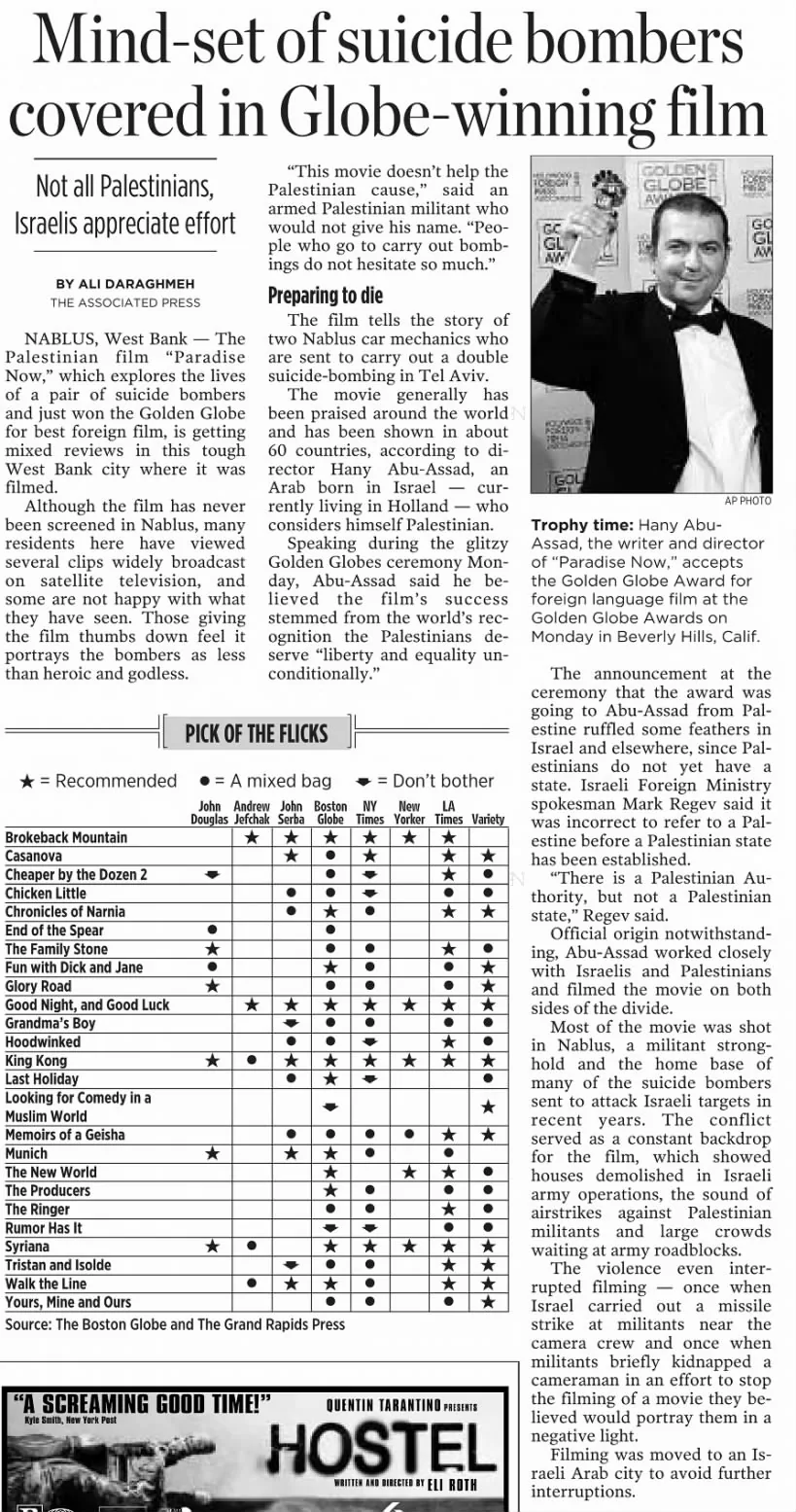
“NABLUS, West Bank — The Palestinian film ‘Paradise Now,’ which explores the lives of a pair of suicide bombers and just won the Golden Globe for best foreign film, is getting mixed reviews in this tough West Bank city where it was filmed. Although the film has never been screened in Nablus, many residents here have viewed several clips widely broadcast on satellite television, and some are not happy with what they have seen. Those giving the film thumbs down feel it portrays the bombers as less than heroic and godless. ‘This movie doesn’t help the Palestinian cause,’ said an armed Palestinian militant who would not give his name. ‘People who go to carry out bombings do not hesitate so much.’… The movie generally has been praised around the world and has been shown in about 60 countries, according to director Hany Abu-Assad, an Arab born in Israel — currently living in Holland — who considers himself Palestinian. Speaking during the glitzy Golden Globes ceremony Monday, Abu-Assad said he believed the film’s success stemmed from the world’s recognition the Palestinians deserve ‘liberty and equality unconditionally.’ The announcement at the ceremony that the award was going to Abu-Assad from Palestine ruffled some feathers in Israel and elsewhere, since Palestinians do not yet have a state. Israeli Foreign Ministry spokesman Mark Regev said it was incorrect to refer to a Palestine before a Palestinian state has been established. ‘There is a Palestinian Authority, but not a Palestinian state,’ Regev said. Official origin notwithstanding, Abu-Assad worked closely with Israelis and Palestinians and filmed the movie on both sides of the divide. Most of the movie was shot in Nablus, a militant stronghold and the home base of many of the suicide bombers sent to attack Israeli targets in recent years. The conflict served as a constant backdrop for the film, which showed houses demolished in Israeli army operations, the sound of airstrikes against Palestinian militants and large crowds waiting at army roadblocks. The violence even interrupted filming — once when Israel carried out a missile strike at militants near the camera crew and once when militants briefly kidnapped a cameraman in an effort to stop the filming of a movie they believed would portray them in a negative light. Filming was moved to an Israeli Arab city to avoid further interruptions.”
Photograph caption
“Trophy time: Hany Abu-Assad, the writer and director of ‘Paradise Now,’ accepts the Golden Globe Award for foreign language film at the Golden Globe Awards on Monday in Beverly Hills, Calif.” · AP Photo
Context added by this archive
A government objecting to a word spoken at an awards ceremony. The Globes announced the winner as coming from Palestine, and Israel’s foreign ministry spokesman told reporters that was incorrect because there is a Palestinian Authority and not a Palestinian state. The piece is filed from Nablus by a Palestinian Associated Press reporter, and it also reports that Palestinians there disliked the film — for the opposite reason to the American reviewers in this archive, because it made the bombers hesitate. On the same page, a grid of critics’ picks for twenty-three current films does not list it.
Cite this item
"Mind-set of suicide bombers covered in Globe-winning film," The Grand Rapids Press, 20 January 2006. Covering Palestine archive, CP-2006-006. https://coveringpalestine.org/archive/cp-2006-006
Elsewhere in the archive
- Caught in the conflictThe Grand Rapids Press · 20 June 2013 · the same newspaper
- Palestinian opens fire at West Bank gas stationThe Grand Rapids Press · 21 June 2023 · the same newspaper
- Israel Snatching Pieces of Lebanese BorderThe Grand Rapids Press · 27 November 1980 · the same newspaper
- Emotion PicturesSan Antonio Express-News · 4 March 2006 · the same year
- Trying to atone for deadly errorHouston Chronicle · 8 June 2006 · the same year
- Gaza Strip: Israeli air strikesPost Bulletin · 4 November 2006 · the same year
This record is part of Covering Palestine, an archive of American and Anglophone newspaper clippings about Palestinians, 1812 to 2022. Researched and assembled by Maria Robles.
The clipping belongs to the newspaper that printed it, or to the wire service that supplied the copy. It is reproduced here for research, criticism and commentary. The city is derived from the masthead, not read off the clipping.
Something wrong here, or something you know about this clipping? The archive is still being built and corrections are wanted: maria@rozumstudio.com, quoting CP-2006-006.
See it in the archive reel · Full text of every clipping · Dataset