The Advocate · Stamford, Connecticut · 12 October 1992
CP-1992-010
Israel allows media to visit fasting Arab inmates
Two-week hunger strike ends; better prison conditions sought
By Marcus Eliason, Associated Press
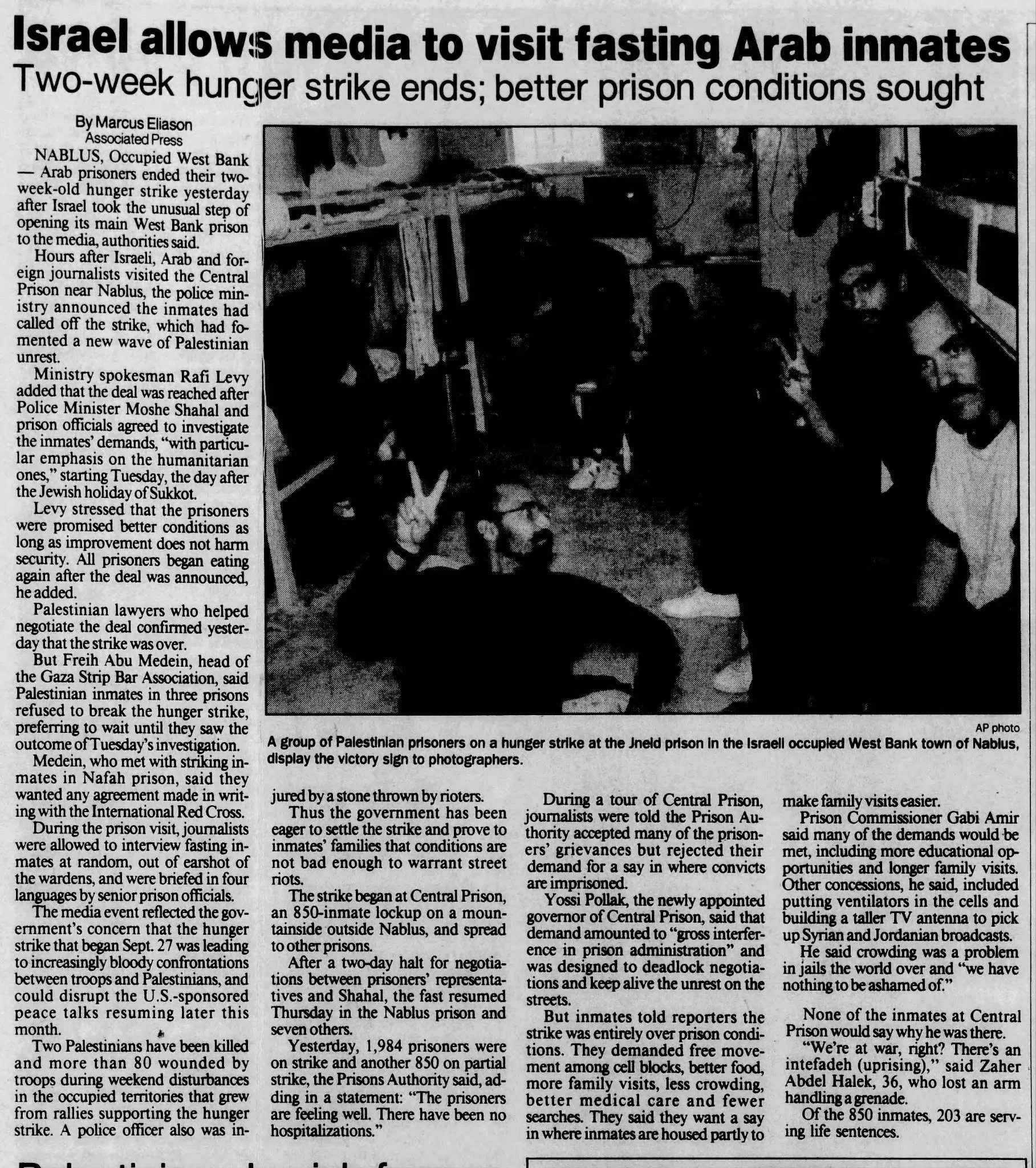
Transcribed from the clipping
NABLUS, Occupied West Bank — Arab prisoners ended their two-week-old hunger strike yesterday after Israel took the unusual step of opening its main West Bank prison to the media, authorities said.
Hours after Israeli, Arab and foreign journalists visited the Central Prison near Nablus, the police ministry announced the inmates had called off the strike, which had fomented a new wave of Palestinian unrest.
Ministry spokesman Rafi Levy added that the deal was reached after Police Minister Moshe Shahal and prison officials agreed to investigate the inmates' demands, “with particular emphasis on the humanitarian ones,” starting Tuesday, the day after the Jewish holiday of Sukkot.
Levy stressed that the prisoners were promised better conditions as long as improvement does not harm security. All prisoners began eating again after the deal was announced, he added. Palestinian lawyers who helped negotiate the deal confirmed yesterday that the strike was over.
But Freih Abu Medein, head of the Gaza Strip Bar Association, said Palestinian inmates in three prisons refused to break the hunger strike, preferring to wait until they saw the outcome of Tuesday's investigation. Medein, who met with striking inmates in Nafah prison, said they wanted any agreement made in writing with the International Red Cross.
During the prison visit, journalists were allowed to interview fasting inmates at random, out of earshot of the wardens, and were briefed in four languages by senior prison officials. The media event reflected the government's concern that the hunger strike that began Sept.
27 was leading to increasingly bloody confrontations between troops and Palestinians, and could disrupt the U.S.-sponsored peace talks resuming later this month. Two Palestinians have been killed and more than 80 wounded by troops during weekend disturbances in the occupied territories that grew from rallies supporting the hunger strike.
A police officer also was injured by a stone thrown by rioters. Thus the government has been eager to settle the strike and prove to inmates' families that conditions are not bad enough to warrant street riots. The strike began at Central Prison, an 850-inmate lockup on a mountainside outside Nablus, and spread to other prisons.
After a two-day halt for negotiations between prisoners' representatives and Shahal, the fast resumed Thursday in the Nablus prison and seven others. Yesterday, 1,984 prisoners were on strike and another 850 on partial strike, the Prisons Authority said, adding in a statement: “The prisoners are feeling well. There have been no hospitalizations.”
During a tour of Central Prison, journalists were told the Prison Authority accepted many of the prisoners' grievances but rejected their demand for a say in where convicts are imprisoned.
Yossi Pollak, the newly appointed governor of Central Prison, said that demand amounted to “gross interference in prison administration” and was designed to deadlock negotiations and keep alive the unrest on the streets. But inmates told reporters the strike was entirely over prison conditions.
They demanded free movement among cell blocks, better food, more family visits, less crowding, better medical care and fewer searches. They said they want a say in where inmates are housed partly to make family visits easier. Prison Commissioner Gabi Amir said many of the demands would be met, including more educational opportunities and longer family visits.
Other concessions, he said, included putting ventilators in the cells and building a taller TV antenna to pick up Syrian and Jordanian broadcasts. He said crowding was a problem in jails the world over and “we have nothing to be ashamed of.” None of the inmates at Central Prison would say why he was there. “We're at war, right?
There's an intefadeh (uprising),” said Zaher Abdel Halek, 36, who lost an arm handling a grenade. Of the 850 inmates, 203 are serving life sentences.
Context added by this archive
Photograph credited AP photo.
Cite this item
"Israel allows media to visit fasting Arab inmates," The Advocate, 12 October 1992. Covering Palestine archive, CP-1992-010. https://coveringpalestine.org/archive/cp-1992-010
More from the 1990s
- Is Zionism racism? YesFort Worth Star Telegram · 4 January 1992
- Repealed / PendingThe Bay City Times · 13 January 1992
- Editorial was inaccurateIowa City Press-Citizen · 31 January 1992
- 4 Palestinians killed in occupied territoriesCourier-Journal · 4 April 1992
- Israeli couple: Army murdered PalestiniansPueblo Chieftain · 22 April 1992
- Dispossessed Palestinians Gain Attention For Their Demands to Be EmancipatedThe Salt Lake Tribune · 20 June 1992
- All 112 clippings from the 1990s →
This record is part of Covering Palestine, an archive of American and Anglophone newspaper clippings about Palestinians, 1799 to 2023. Researched and assembled by Maria Robles.
The clipping belongs to the newspaper that printed it, or to the news agency that supplied the copy. It is reproduced here for research, criticism and commentary. The city is derived from the masthead, not read off the clipping.
Something wrong here, or something you know about this clipping? The archive is still being built and corrections are wanted: maria@rozumstudio.com, quoting CP-1992-010.
See it in the archive reel · Full text of every clipping · Dataset