The Morning Call · Allentown, Pennsylvania · 31 July 1939
CP-1939-005
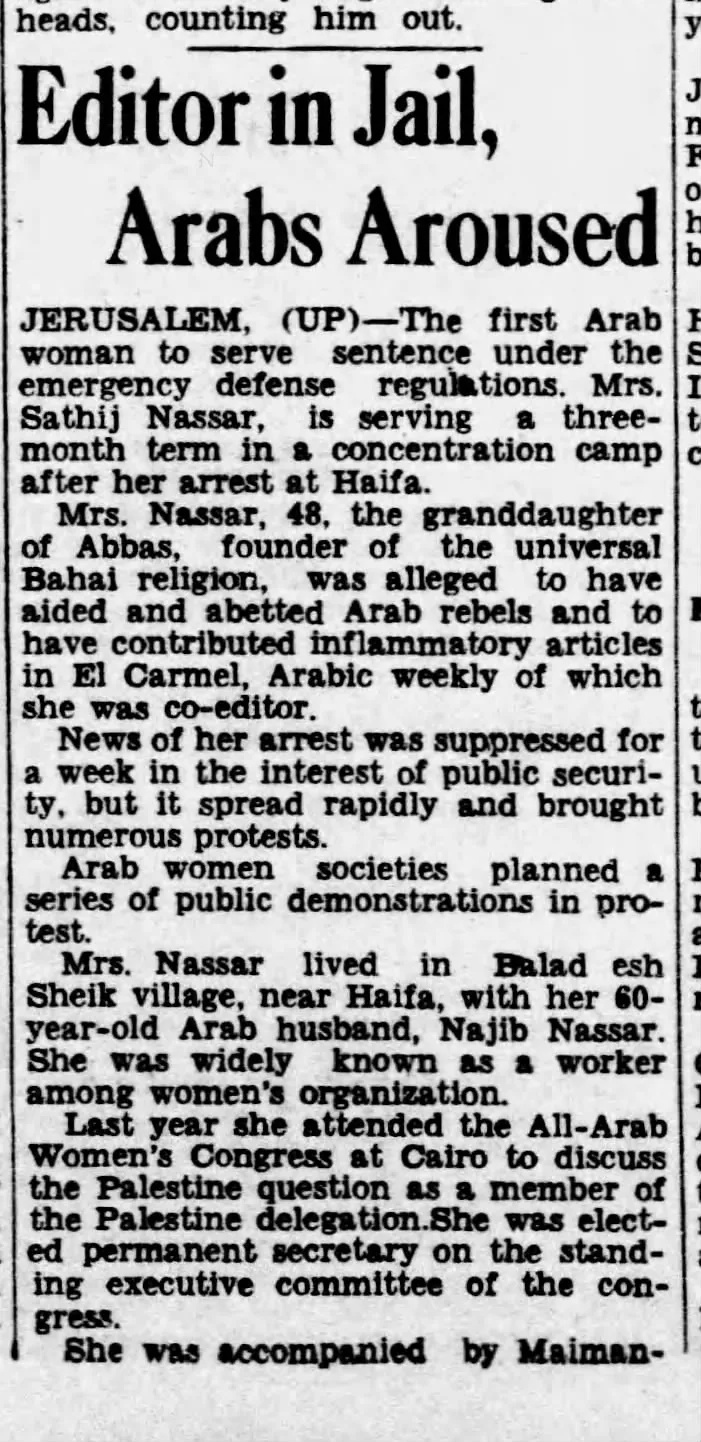
Editor in Jail, Arabs Aroused
United Press, Jerusalem
Transcribed from the clipping
JERUSALEM, (UP) — The first Arab woman to serve sentence under the emergency defense regulations, Mrs. Sathij Nassar, is serving a three-month term in a concentration camp after her arrest at Haifa. Mrs.
Nassar, 48, the granddaughter of Abbas, founder of the universal Bahai religion, was alleged to have aided and abetted Arab rebels and to have contributed inflammatory articles in El Carmel, Arabic weekly of which she was co-editor. News of her arrest was suppressed for a week in the interest of public security, but it spread rapidly and brought numerous protests.
Arab women societies planned a series of public demonstrations in protest. Mrs. Nassar lived in Balad esh Sheik village, near Haifa, with her 60-year-old Arab husband, Najib Nassar.
She was widely known as a worker among women’s organization. Last year she attended the All-Arab Women’s Congress at Cairo to discuss the Palestine question as a member of the Palestine delegation.
She was elected permanent secretary on the standing executive committee of the congress.… She was accompanied by Maiman[…]ah, daughter of the late Sheik Izzeddin Kassam, founder of a secret order whom Arabs regard as the herald of armed resistance to Zionist aims. Mrs.
Nassar received her primary education in the home of her grandfather, Abdul Baha Abbas, at Acre. Then she completed the English High School for girls at Haifa.
In her teens she was regarded as the prettiest of her town and at the age of 20 she married a cousin who died a few years later. Her marriage with Najib Nassar, proprietor of El Carmel, in 1926, was the romantic culmination of some previous years of “literary acquaintance,” a phenomenon in Arab harem society.
It started by her contributing articles on social subjects to his paper. She professed Bahaism, a religion that reveres three great faiths, and Najib Nassar was a Christian. The Nassars have a 10-year-old son named Farouk, because his birthday coincided with that of King Farouk of Egypt. Mrs.
Nassar has always preferred to serve behind the scenes in her various organizations, refusing to accept leadership. In speeches she has propagated the theme that Zionism does not limit its program to Palestine, but looks forward to Egypt, Syria, Lebanon, Iraq and eventual domination of the Arab and Moslem East.
Context added by this archive
A Palestinian newspaper editor imprisoned for what she printed, and the paper reporting it says so plainly: the arrest was suppressed for a week, and Arab women’s societies organized demonstrations when it came out. The detention is called a concentration camp, in 1939, by United Press.
The emergency defense regulations she was jailed under are the same body of British law that the Communist Party of Israel names in this archive in 1967, when Mahmoud Darwish is among those arrested under it. Her name is more usually written Sadhij Nassar; the spelling here is the paper’s. The story runs on two pages and both scans are held.
The jump carries her whole life: the Bahai grandfather at Acre, the English High School for girls at Haifa, the years of “literary acquaintance” with the editor she married after writing for his paper, the son named for the king of Egypt, and the line that she refused leadership of the organizations she worked in.
Her companion at the Cairo congress is identified as a daughter of Izz ad-Din al-Qassam.
Cite this clipping
"Editor in Jail, Arabs Aroused," The Morning Call, 31 July 1939, p. 1. Covering Palestine archive, CP-1939-005. https://coveringpalestine.org/archive/cp-1939-005
This clipping is read closely in the section below
More from The Morning Call
- Haganah and Irgunists Make Attacks on ArabsThe Morning Call · 9 March 1948
- Israeli Seizure of Gaza Equals Bitter World War II BattlesThe Morning Call · 3 November 1956
- Crossing the JordanThe Morning Call · 17 June 1967
- Israel cites POW torture; Palestinians ask statehoodThe Morning Call · 10 June 1972
- Consul deplores equating Zionism with racismThe Morning Call · 1 December 1975
- Lebanese civilian cycles through Palestinian camp at Sabra, passing two of hundreds of corpsesThe Morning Call · 19 September 1982
- 8 more from this paper in the full text →
More from the 1930s
- Irish Deputy Seeks Refugee Aid by U. S.The New York Times · 3 January 1939
- British-Arab Parley Will Start Jan. 18The New York Times · 4 January 1939
- BRITAIN MOPS UP IN HOLY LAND; 3-YEAR ARAB REVOLT PUT DOWN; PEACE SESSION IN LONDON NEARThe Daily Notes · 13 January 1939
- Demands Moderated by Palestine ArabsThe New York Times · 20 January 1939
- New Zoning Plan on Palestine SeenThe New York Times · 15 February 1939
- Five Moslem Nations Support the Proposal of Palestine Arabs for an Independent StateThe New York Times · 21 February 1939
- All 218 clippings from the 1930s →
In these collections
Last updated 17 November 2026
This record is part of Covering Palestine, an archive of American newspaper clippings about Palestinians, 1724 to 2023. Researched and assembled by Maria Robles.
The clipping belongs to the newspaper that printed it, or to the news agency that supplied the copy. It is reproduced here for research, criticism and commentary. A city here is where the newspaper was published, not where the story came from, and on most records it was taken from the masthead.
Something wrong here, or something you know about this clipping? The archive is still being built and corrections are wanted: maria@rozumstudio.com, quoting CP-1939-005.
Read in: Held without charge, for eighty-four years
Everything printed in 1939 · Printed on this day · See it in the archive reel · Full text of every clipping · Dataset