The Morning Call · Allentown, Pennsylvania · 3 November 1956
CP-1956-006
Israeli Seizure of Gaza Equals Bitter World War II Battles
‘Now We Can Work Fields in Peace’
Serge Fliegers, International News Service, inside the Gaza Strip
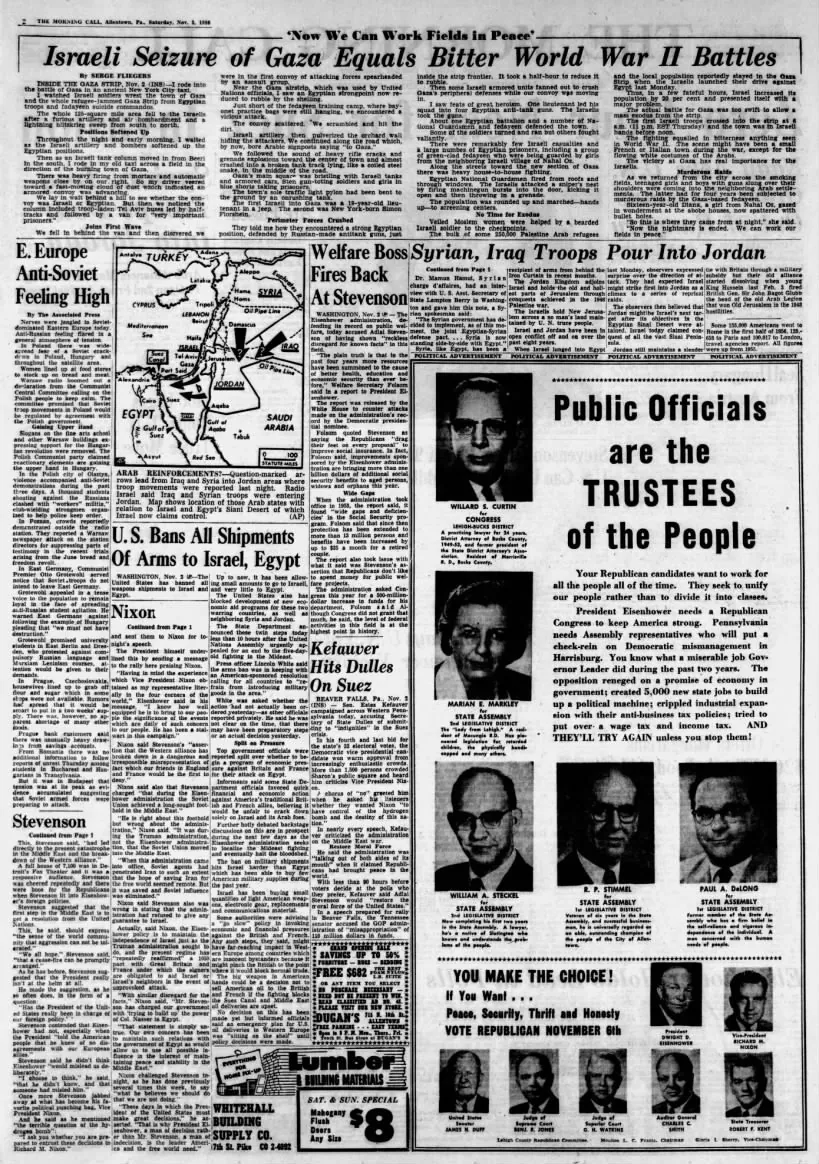
Transcribed from the clipping
“INSIDE THE GAZA STRIP, Nov. 2 (INS)—I rode into the battle of Gaza in an ancient New York City taxi. I watched Israeli soldiers wrest the town of Gaza and the whole refugee-jammed Gaza Strip from Egyptian troops and fadayeen suicide commandos.
The whole 135-square mile area fell to the Israelis after a furious artillery and air bombardment and a lightning blitzkrieg sweep from south to north.
Positions Softened Up. Throughout the night and early morning, I waited as the Israeli artillery and bombers softened up the Egyptian positions… rounded up and marched—hands [up]… and the local population reportedly stayed in the Gaza Strip when the Israelis launched their drive against Egypt last Monday.
Thus, in a few fateful hours, Israel increased its population by 20 per cent and presented itself with a major problem. The actual battle for Gaza was too swift to allow a mass exodus from the strip. The first Israeli troops crossed into the strip at 6 a.m. (11 p.m. EST Thursday) and the town was in Israeli hands before noon.
The fighting equalled in bitterness anything seen in World War II. The scene might have been a small French or Italian town during the war, except for the flowing white costumes of the Arabs. The victory at Gaza has real importance for the Israelis.
Murderous Raids. As we returned from the city across the smoking fields, teenaged girls and boys with guns slung over their shoulders were coming into the neighboring Arab settlements. The latter had for four years been subjected to murderous raids by the Gaza-based fedayeen.
Sixteen-year-old Diana, a girl from Nahal Oz, gazed in wonderment at the adobe houses, now spattered with bullet holes. ‘So this is where they came from at night,’ she said. ‘Now the nightmare is ended. We can work our fields in peace.’”
Context added by this archive
Written from inside the advance, and it says plainly what happened to the people: they stayed, because the battle was too fast for them to leave. The correspondent does the arithmetic on the spot — Israel 20% larger in a few hours, and “a major problem.” The page’s kicker is a quotation from an Israeli teenager.
A correction
masthead reads Morning Call, Allentown PA, Nov 3 1956; slide caption pairing swapped with Birmingham Post 1967
Cite this clipping
"Israeli Seizure of Gaza Equals Bitter World War II Battles," The Morning Call, 3 November 1956, p. 1. Covering Palestine archive, CP-1956-006. https://coveringpalestine.org/archive/cp-1956-006
More from The Morning Call
- Editor in Jail, Arabs ArousedThe Morning Call · 31 July 1939
- Haganah and Irgunists Make Attacks on ArabsThe Morning Call · 9 March 1948
- Crossing the JordanThe Morning Call · 17 June 1967
- Israel cites POW torture; Palestinians ask statehoodThe Morning Call · 10 June 1972
- Consul deplores equating Zionism with racismThe Morning Call · 1 December 1975
- Lebanese civilian cycles through Palestinian camp at Sabra, passing two of hundreds of corpsesThe Morning Call · 19 September 1982
- 8 more from this paper in the full text →
More from the 1950s
- Mr. Truman’s Memoirs: Palestine Crisis EruptsThe New York Times · 28 January 1956
- Shabbat Shalom!Buffalo Jewish Review · 2 March 1956
- BACK PALESTINE TRUCE CHIEF.The Kansas City Times · 16 March 1956
- ARAB SQUADS RAID ISRAEL FROM GAZAThe New York Times · 8 April 1956
- IsraelEvening Star · 8 April 1956
- Egypt, Israel Hurl Charges In Security Council NotesThe Salt Lake Tribune · 10 April 1956
- All 215 clippings from the 1950s →
Last updated 2 November 2026
This record is part of Covering Palestine, an archive of American newspaper clippings about Palestinians, 1724 to 2023. Researched and assembled by Maria Robles.
The clipping belongs to the newspaper that printed it, or to the news agency that supplied the copy. It is reproduced here for research, criticism and commentary. A city here is where the newspaper was published, not where the story came from, and on most records it was taken from the masthead.
Something wrong here, or something you know about this clipping? The archive is still being built and corrections are wanted: maria@rozumstudio.com, quoting CP-1956-006.
Everything printed in 1956 · Printed on this day · See it in the archive reel · Full text of every clipping · Dataset