 How “human shields” changed sides in three yearsVolunteers in 2006, a tactic used on them by 2009 · 2003 to 2014
A phrase reversing
How “human shields” changed sides in three years
On 19 November 2006 the Israeli air force telephoned a house in Beit Lahiya to say it was about to destroy it, which was the standing procedure. Several hundred people went and stood on the roof. The strike was called off.
The Associated Press filed it as a new tactic. In 2003 human shields named people who volunteered to stand in the way — it was what they called themselves. Within three years the same two words named the opposite: civilians said to be held in place against their will by Hamas. The dispatch about the roof carries both meanings in one column.
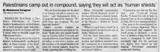
“We are here because we decided to be human shields.”
The Associated Press, from Arafat’s compound in Ramallah. The paper names two of them: Morad Hashash, 28, a construction worker, and Fatima, 77, who had come to see Arafat for the first time. The phrase belongs to the people it describes, and the verb is theirs.
 CP-2003-006
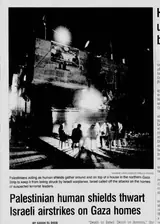
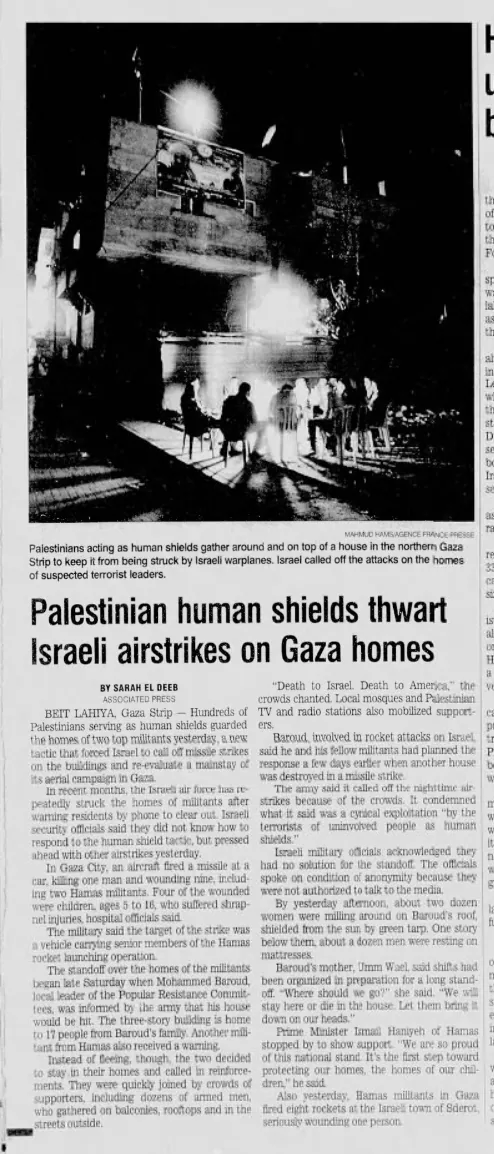
“Palestinian human shields thwart Israeli airstrikes on Gaza homes.”
The Star-Ledger, running Sarah El Deeb of the Associated Press from Beit Lahiya. “Hundreds of Palestinians serving as human shields guarded the homes of two top militants yesterday, a new tactic that forced Israel to call off missile strikes.” Israeli officials told her they did not know how to respond. The same story prints what the crowd was chanting, which was “Death to Israel, Death to America.”
CP-2006-003“A cynical exploitation by the terrorists of uninvolved people as human shields.”
The Israeli army, quoted in that same dispatch. This is the whole reversal, and it is already finished. The words are identical. The people on the roof have gone from the subject of the sentence to the object of it, and nobody had to wait for the argument to develop.
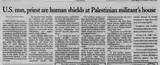
CP-2006-003“U.S. nun, priest are human shields at Palestinian militant’s house.”
The Beaumont Enterprise, three days later. Whatever the phrase is describing here, an American nun who flew to Gaza is not being exploited by anyone. The same dispatch carries the objection: Human Rights Watch called militants asking civilians to shield a house a “war crime,” and the UN human rights commissioner called the tactic a sign of Palestinian desperation. Both are printed alongside the volunteers.
 CP-2006-004
“We can’t go out and fight with guns, so we are participating in the resistance this way.”
A Palestinian woman in Beit Lahiya, to Joel Greenberg of the Chicago Tribune. The headline over her is “Use of human shields complicates Israel’s approach.” She is explaining a decision; the headline above her describes a problem of method.
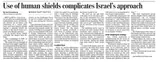 CP-2006-005
“Human shields: Hamas’ favorite tactic.”
Alan Dershowitz, syndicated from the Los Angeles Times into the Log Cabin Democrat of Conway, Arkansas. Two years and two months after Beit Lahiya. The people the phrase now refers to do not appear in the sentence at all, and no version of it is offered in which they chose anything.
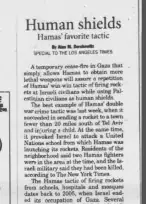 CP-2009-016
“Hamas is using the Gaza population as human shields.”
Santa Barbara News-Press, in quotation marks, attributed. Elsewhere on the page: twenty of the twenty-seven people killed that Sunday were civilians, mostly women and children, and a photograph captioned “An emergency rescue worker carries a child’s body.”
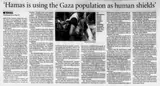 CP-2012-002
“Human rights and human shields.”
USA Today, as a news analysis, the two set against each other in a headline as though they were opposing considerations of the same kind.
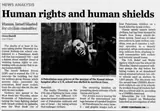 CP-2014-005
The usual way to describe this is that a phrase was later twisted. That is not what these clippings show. Both meanings are printed on the same day, in the same dispatch, by the same news agency: the people on the roof saying what they decided, and the army describing the identical act with the subject moved. One of those two sentences is the one that kept being printed.