Chicago Tribune · Chicago, Illinois · 27 November 2006
CP-2006-005
Use of human shields complicates Israel’s approach
Middle East tactics
Joel Greenberg, Tribune foreign correspondent, Beit Lahiya, Gaza Strip
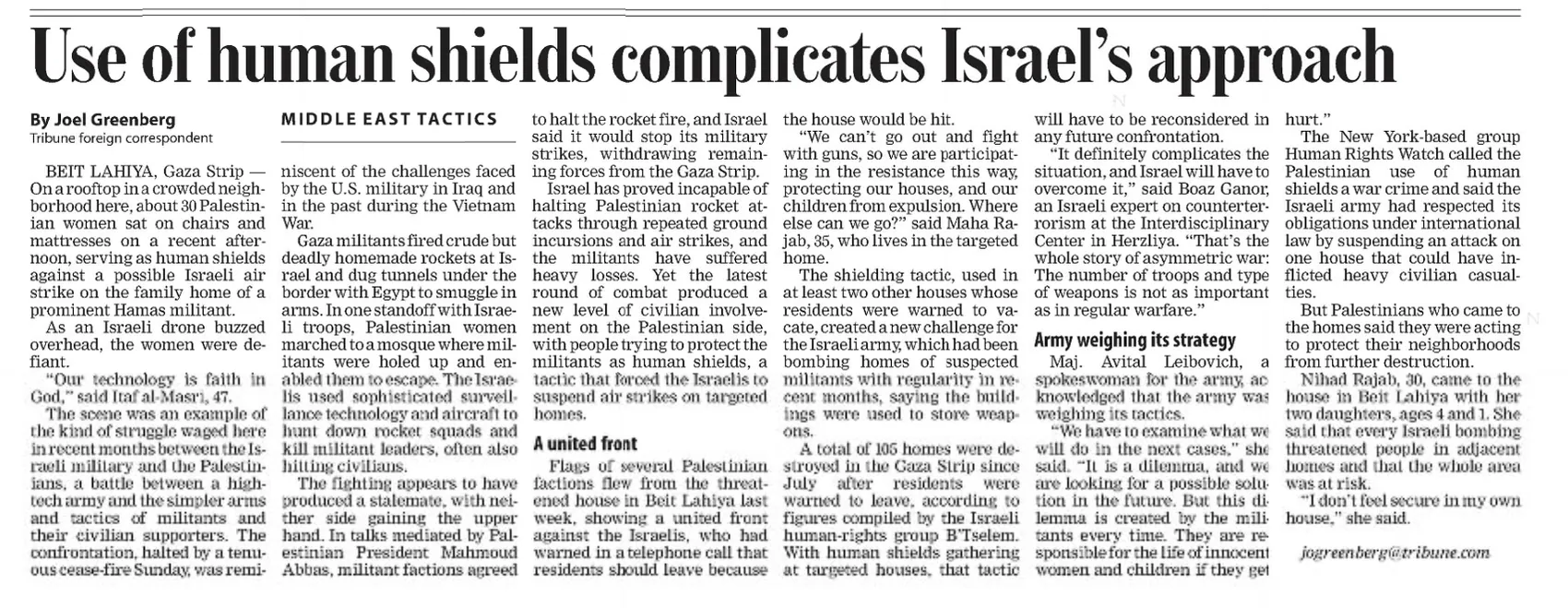
Transcribed from the clipping
“BEIT LAHIYA, Gaza Strip — On a rooftop in a crowded neighborhood here, about 30 Palestinian women sat on chairs and mattresses on a recent afternoon, serving as human shields against a possible Israeli air strike on the family home of a prominent Hamas militant. As an Israeli drone buzzed overhead, the women were defiant.
‘Our technology is faith in God,’ said Itaf al-Masri, 47.
The scene was an example of the kind of struggle waged here in recent months between the Israeli military and the Palestinians, a battle between a high-tech army and the simpler arms and tactics of militants and their civilian supporters… Gaza militants fired crude but deadly homemade rockets at Israel and dug tunnels under the border with Egypt to smuggle in arms.
In one standoff with Israeli troops, Palestinian women marched to a mosque where militants were holed up and enabled them to escape. The Israelis used sophisticated surveillance technology and aircraft to hunt down rocket squads and kill militant leaders, often also hitting civilians…
A united front. Flags of several Palestinian factions flew from the threatened house in Beit Lahiya last week, showing a united front against the Israelis, who had warned in a telephone call that residents should leave because the house would be hit.
‘We can’t go out and fight with guns, so we are participating in the resistance this way, protecting our houses, and our children from expulsion. Where else can we go?’ said Maha Rajab, 35, who lives in the targeted home.
The shielding tactic, used in at least two other houses whose residents were warned to vacate, created a new challenge for the Israeli army, which had been bombing homes of suspected militants with regularity in recent months, saying the buildings were used to store weapons.
A total of 105 homes were destroyed in the Gaza Strip since July after residents were warned to leave, according to figures compiled by the Israeli human-rights group B’Tselem. With human shields gathering at targeted houses, that tactic will have to be reconsidered in any future confrontation.
‘It definitely complicates the situation, and Israel will have to overcome it,’ said Boaz Ganor, an Israeli expert on counterterrorism at the Interdisciplinary Center in Herzliya. ‘That’s the whole story of asymmetric war: The number of troops and type of weapons is not as important as in regular warfare.’
Army weighing its strategy. Maj. Avital Leibovich, a spokeswoman for the army, acknowledged that the army was weighing its tactics. ‘We have to examine what we will do in the next cases,’ she said. ‘It is a dilemma, and we are looking for a possible solution in the future. But this dilemma is created by the militants every time.
They are responsible for the life of innocent women and children if they get hurt.’ The New York-based group Human Rights Watch called the Palestinian use of human shields a war crime and said the Israeli army had respected its obligations under international law by suspending an attack on one house that could have inflicted heavy civilian casualties.
But Palestinians who came to the homes said they were acting to protect their neighborhoods from further destruction. Nihad Rajab, 30, came to the house in Beit Lahiya with her two daughters, ages 4 and 1. She said that every Israeli bombing threatened people in adjacent homes and that the whole area was at risk.
‘I don’t feel secure in my own house,’ she said.”
Context added by this archive
The women are named and asked why. Human Rights Watch calls the practice a war crime and in the same sentence says the Israeli army respected its obligations by calling off a strike. The army spokeswoman calls it a dilemma. Everything is in one column.
Cite this clipping
"Use of human shields complicates Israel’s approach," Chicago Tribune, 27 November 2006, p. 1. Covering Palestine archive, CP-2006-005. https://coveringpalestine.org/archive/cp-2006-005
This clipping is read closely in the section below
More from Chicago Tribune
- FINDS the ROCK MOSES STRUCKChicago Tribune · 26 May 1901
- Chief Issue in ZionChicago Tribune · 16 August 1907
- Palestine and PatriotismChicago Tribune · 9 January 1916
- Move Palestine Arabs To Iraq, Hoover UrgesChicago Tribune · 20 November 1945
- Manhunt Is On For Palestine Jail FugitivesChicago Tribune · 6 May 1947
- CRISIS NEARS CLIMAXChicago Tribune · 9 February 1948
- 39 more from this paper in the full text →
More from the 2000s
- Mind-set of suicide bombers covered in Globe-winning filmThe Grand Rapids Press · 20 January 2006
- Bush: U.S. won’t deal with advocate of Israel’s destructionThe Blade · 27 January 2006
- Hamas victory surprises White House, CongressThe Daily Press · 27 January 2006
- Bush: U.S. won’t deal with Hamas if it threatens IsraelThe Morning Herald · 27 January 2006
- Hamas’ landslide victory takes world by surpriseLincoln Journal Star · 27 January 2006
- Hamas prepares to governThe Oregonian · 27 January 2006
- All 516 clippings from the 2000s →
In these collections
Last updated 2 November 2026
This record is part of Covering Palestine, an archive of American newspaper clippings about Palestinians, 1724 to 2023. Researched and assembled by Maria Robles.
The clipping belongs to the newspaper that printed it, or to the news agency that supplied the copy. It is reproduced here for research, criticism and commentary. A city here is where the newspaper was published, not where the story came from, and on most records it was taken from the masthead.
Something wrong here, or something you know about this clipping? The archive is still being built and corrections are wanted: maria@rozumstudio.com, quoting CP-2006-005.
Read in: How “human shields” changed sides in three years
Everything printed in 2006 · Printed on this day · See it in the archive reel · Full text of every clipping · Dataset