 The word that waited for a verdictMassacre arrives in 1958, after a court says murder · 1956 to 2001

1956 to 2001
The word that waited for a verdict
On the evening of 29 October 1956 Israeli border police shot forty-eight people at Kafr Qasim, a village inside Israel, as they came back from the fields. A curfew had been imposed that afternoon and most of the dead had never been told about it. The same day, Israel invaded Sinai.
No American newspaper printed a word about the killings for forty-four days. The story was held under Israeli military censorship and broke only when the government disclosed it on 12 December. This section is about what happened to the language once it did break, because the archive now holds nine American papers from the week of the disclosure and a further seven from the week of the verdict, and the difference between them is not a difference in the facts.
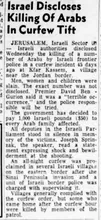
“Israel Discloses Killing Of Arabs In Curfew Tift.”
Day forty-four. A tift is a petty quarrel, a spat. Forty-eight people had been shot dead walking home from their fields. Of the nine papers in this archive that carried the disclosure, this is the smallest word any of them reached for.
 CP-1956-027
“48 ARABS KILLED; ISRAEL PENITENT.”
The only one of the nine to lead with the count and the verb killed. Then a semicolon, and the rest of the sentence is about the condition of Israel’s conscience. Penitent is a word about the state of a soul.
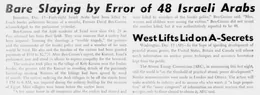
CP-1956-033“Bare Slaying by Error of 48 Israeli Arabs.”
No court had sat and no commission had reported. The headline has already settled the question of cause.
 CP-1956-030
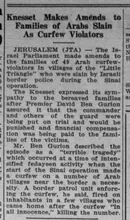
“Knesset Makes Amends to Families of Arabs Slain As Curfew Violators.”
The court would later establish that most of the dead had never been told the curfew existed; they were coming home from work when they were stopped. Here they are violators, and the news in the sentence is the compensation.
 CP-1956-038
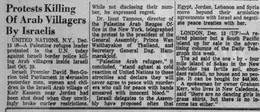
“Protests Killing Of Arab Villagers By Israelis.”
The one December headline in this archive that puts Israelis where the actor goes. It exists because a Palestinian filed a complaint: Dr. Izzat Tannous, of the Palestine Arab Refugee Office in New York, who cabled the President of the General Assembly. The agent appears only inside somebody else’s protest.
 CP-1956-034
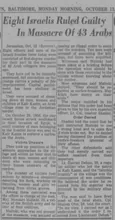
“Eight Israelis Ruled Guilty In Massacre Of 43 Arabs.”
Twenty-two months on, and the word massacre enters this archive’s coverage of Kafr Qasim for the first time. It arrives the week an Israeli court convicted eight policemen of murder, and then it is everywhere: Baltimore, Phoenix, Washington, Palm Beach, New York, inside four days.
 CP-1958-012
“ISRAEL SENTENCES 8 FOR MASSACRE.”
The same newspaper, the same killing. In December 1956 it was Israel penitent. In October 1958 it is a massacre. Nothing about what happened at Kafr Qasim changed in the interval. A court had ruled, and the paper followed the court.
 CP-1958-023
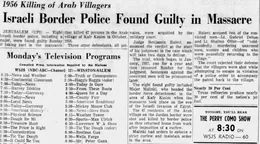
“Judge Benjamin Halevi accused two of the convicted men — Lt. Gabriel Dehan and Lt. Shalmo Offer — of cold-bloodedly murdering unarmed men, women and children who were peacefully returning to their homes.”
The fullest account in the archive, and the only one that carries the judge’s own words. It puts the count at forty-seven; other papers that week say forty-three, forty-eight and forty-nine.
 CP-1958-017
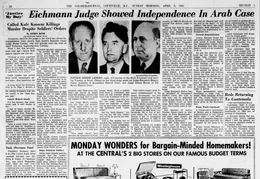
“Eichmann Judge Showed Independence In Arab Case.”
Benjamin Halevi is about to try Adolf Eichmann, and a Kentucky newspaper introduces him to American readers through the case in which he convicted Israeli policemen of murdering Arabs. Both trials in one headline, three years apart.
 CP-1961-005
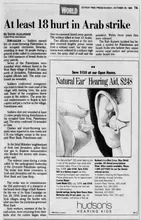
“Two officers received lengthy prison terms from a military court, but their sentences were reduced… Within three years they were released.”
How it ended, reported thirty-two years later, in a paragraph inside a story about something else. The same paragraph says the village has become a symbol for Palestinians and Arab citizens of Israel who believe they cannot get equal justice.
 CP-1988-086
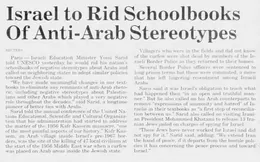
“Villagers who were in the fields and did not know of the curfew were shot dead by members of the Israeli Border Police as they returned to their homes. Several Border Police officers were sentenced to long prison terms but these were commuted.”
Filed from Paris on the anniversary, inside a story about Israeli schoolbooks. Two plain sentences supply what forty-three years of headlines had left out: they had not been told, and the men who shot them did not serve their sentences.
 CP-1999-017
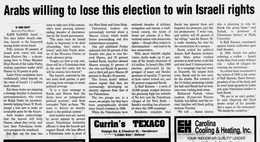
“I won’t vote, and neither will 95 percent of the village, said Ali Sarsur, 38, a roofer donating his time for the construction of a mosque.”
Forty-five years on the village is a dateline rather than an incident. An American wire reporter files from it two days before an Israeli election, and the history gets one sentence: in 1956 riot police enforcing a curfew killed forty-nine villagers for violating the restrictions.
 CP-2001-031
Line up the December headlines and read only the verbs. Israel regrets. Israel discloses. Israel mourns. Israel reveals. Israel is penitent. Israel says the Arabs were innocent. In nearly every one, the state is the grammatical subject and what is being reported is its conduct afterward — its sorrow, its candour, its remorse. The forty-eight people are the object of the sentence. One paper called it a tift.
Then look at the single December headline that puts Israelis in the actor’s place. It is in a Louisiana paper, and it is there because a Palestinian in New York cabled the United Nations. The agent arrives attached to a complaint, which is the pattern this archive finds again and again: when the source is official, the sentence has no one in it; when the source is Palestinian, it does.
The word massacre does not appear anywhere in 1956. It appears in October 1958, in the same week an Israeli court convicted eight policemen of murder, and then it is in five papers inside four days. The New York Times moves from Israel penitent to Israel sentences 8 for massacre without a single new fact about the killing. What changed is that a judge had used the word first, and the press was willing to follow a court where it had not been willing to lead.
Two things finish the story and neither is in a headline. The sentences, seven to seventeen years, were cut on appeal and every man was free within three. And it was 1999 before an American newspaper put in one place the two facts that decide what the word should have been all along: the villagers did not know about the curfew, and the men who shot them did not serve their sentences.
The next time an event takes a long time to acquire its name, the useful question is not what the papers believed. It is who they were waiting to hear it from.