 The olive harvest, and who the paper says owns the groundThe headmen said the land grew olives; the spokesman said it was state-owned · 1950 to 2023
Read this clipping in full →
1950 to 2023
The olive harvest, and who the paper says owns the ground
Hani Yousef was 22 and he was picking olives outside his village of Aqraba. Palestinians accused settlers from Itamar of shooting him. The Press of Atlantic City printed his name the next morning, down the column from forty Israeli tanks entering Khan Younis and a helicopter missile that killed eight people. The Israeli police spokesman told the paper the death was being investigated and no arrests had been made, and that the farmer had been shot in the back.
Ten clippings here follow the olive tree through American newspapers between 1950 and 2023. A statute puts olive orchards in a schedule of property the state may take title to and sell. An Israeli spokesman calls a field near Nablus state-owned and uncultivable while the village headmen say it belongs to the villagers and grows olives. Human rights groups count about a hundred thousand trees uprooted for a barrier. A village posts unarmed men in its olive groves after an arson killing. And a family in Bethlehem carves the wood, as it has since 1925.
“Israel to Seize Property… To Sell Arab Refugees’ Holdings to State Development Unit.”
The New York Times, reporting the absentees property bill out of the Knesset. What the law reaches is itemized: “almost whole cities like Jaffa, Acre, Ramleh, Lydda and the Arab quarters of Jerusalem, Haifa, Tiberias and Safed, scores of villages and large areas of citrus, olive and fruit orchards, quarries and farm land.” The groves enter the sentence as a schedule of assets. One amendment raising the price the buyers must pay came from Amin Jurjura, an Arab member from Nazareth, and the Knesset adopted it.
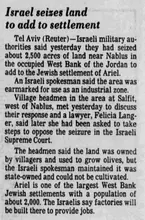
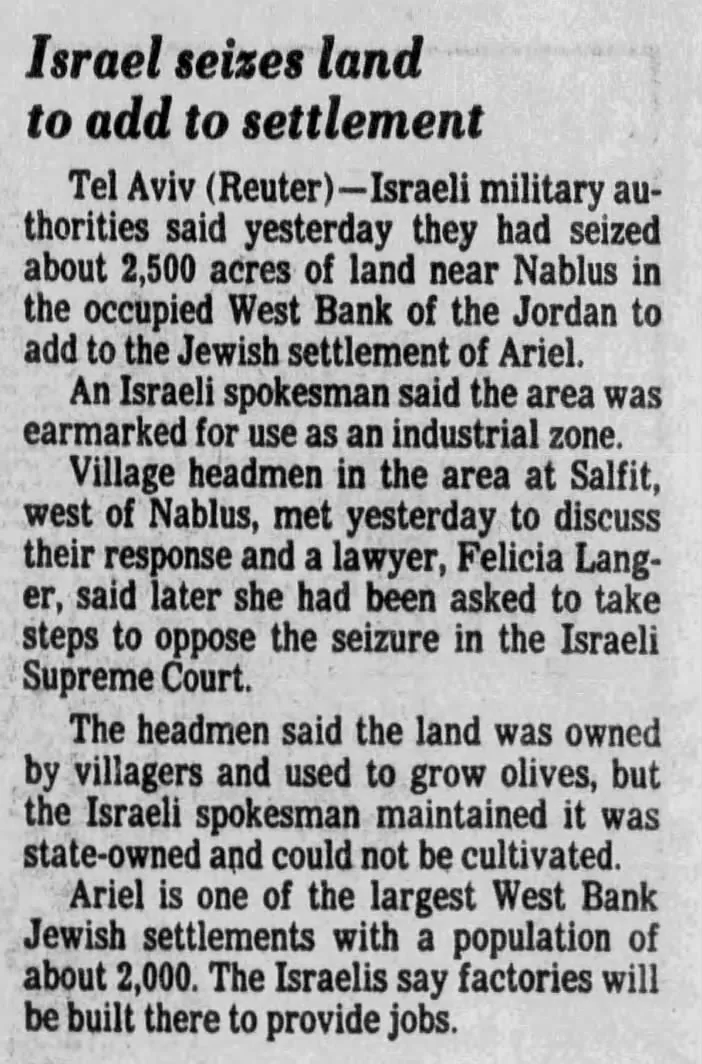
CP-1950-007“The headmen said the land was owned by villagers and used to grow olives, but the Israeli spokesman maintained it was state-owned and could not be cultivated.”
The Baltimore Sun, on 2,500 acres seized near Nablus to enlarge the settlement of Ariel. The spokesman says the ground is earmarked for an industrial zone. Two claims about the same field sit in one sentence, and the olives are the villagers’ evidence. Felicia Langer said she had been asked to take steps to oppose the seizure in the Israeli Supreme Court.
CP-1981-006“Palestinians accused Jewish settlers of killing Hani Yousef, 22, as he was harvesting olives near his village, Aqraba.”
Press of Atlantic City. The headline over it is “Israeli tanks enter Gaza; missile kills 10,” and the sentence before his names nobody: “two Palestinian men were shot dead in the northern West Bank, one in a gunbattle with Israeli troops, the other allegedly shot by a Jewish settler in an olive grove.” He is the other one. A second farmer was shot and wounded beside him.
CP-2002-040“On Oct. 6, Hani Minyeh, a 22-year-old grocery store clerk in the village of Aqraba, was killed when settlers from the Jewish community of Itamar, near Nablus, fired on a group of olive pickers.”
San Francisco Chronicle, bylined Danielle Haas for its foreign service, sixteen days on. The same killing, the same village, the same age — and a different name, plus a trade the other papers leave out. The story is datelined Tuwani, in the south Hebron hills, so this is a passing reference in a feature filed from somewhere else.
CP-2002-090“Settlers three weeks ago shot and killed a 24-year-old Palestinian man who was picking olives on his land, according to Palestinian witnesses.”
Hartford Courant, carrying John Ward Anderson of the Washington Post. The identical sentence ran in the Austin American-Statesman three days later. No name, an age two years out, and his death arrives qualified: according to Palestinian witnesses.
CP-2002-091“The Israelis love to talk about the trees they plant in Israel, but they never talk about the trees owned by Palestinians that they uproot.”
Ray Hanania in the Daily Herald, under the paper’s standing label for his column, “An Arab perspective.” He is not describing an incident. He is naming the asymmetry itself, in his own voice, in 2003.
CP-2003-008“Human rights groups say 7,000 acres of Palestinian land have been expropriated for the barrier, and about 100,000 trees uprooted.”
Casper Star-Tribune, Wyoming, under the headline “For Israelis a lifesaver; for Palestinians a curse.” The same story carries the United Nations count of who ends up on the wrong side of it, and keeps its condition: unless the route is changed, 274,000 Palestinians trapped in enclaves and 400,000 more blocked from their fields, jobs, schools and hospitals.
CP-2004-008“For now, the village will rely on bands of unarmed young men staking out the sprawling olive groves on its perimeter.”
Omaha World-Herald, from Duma, days after suspected Jewish arsonists hurled a firebomb into a house and killed an 18-month-old. The mayor, Abed Alsalam Dawabsheh, is working out how to protect three thousand people: “The only thing we can carry is sticks and lights… We are not allowed to carry weapons.” The same story carries Yesh Din’s figure: of 1,067 complaints Palestinians filed against Israeli assailants in the last decade, 19 ended in a conviction.
CP-2015-014“Olive wood artisans carry on Holy Land tradition.”
The State Journal-Register of Springfield, Illinois. Bassem Giacaman came back from New Zealand to run the shop and factory his grandfather founded in 1925, because his father Jiries, 72, could no longer manage it from a distance. The trade is carving, and the material is olive wood. Nobody dies in this story.
CP-2017-009“Recently, in a single night, there were well over a hundred attacks by settlers, who shot and beat Palestinians, setting fire to homes and businesses and uprooting olive trees, all the while Israeli soldiers stood by or beat and arrested Palestinians who resisted.”
Kristen Salvatore, writing a column in the Portland Press Herald under the headline “Senators’ silence on Israeli human rights violations equals complicity.” Eight months before October 2023, a reader in Maine is holding her own senators to the olive trees. The count is hers, and the paper prints it as hers.
CP-2023-077These ten were gathered by searching for particular events, so nothing here measures how often American papers covered the olive harvest, or how often they named the dead. Nor is this a census of how the archive treats olive trees: it holds many more clippings in which a grove is scenery, a crop, or a carving shop than ones in which a tree is destroyed.
Three American papers printed that one death three ways. The Press of Atlantic City called him Hani Yousef, 22. Danielle Haas, filing for the San Francisco Chronicle, called him Hani Minyeh, 22, and gave his trade. John Ward Anderson’s Washington Post copy called him a 24-year-old Palestinian man and gave no name at all, and that is the version two papers ran.
Bassem Giacaman buys his wood from farmers around Bethlehem after the October harvest, and he is exact about where it comes from: “The branches come from pruning the trees, never by cutting them.” Carvers there have worked olive wood since the fourth century. A grove is the slowest record a family can keep of where it has been, and it can be taken out in an afternoon. When a harvest is in the news, read for whether the person killed is named in that sentence, and whose account of who owns the land the paper puts second.