The State Journal-Register · Springfield, Illinois · 24 December 2017
CP-2017-009
Olive wood artisans carry on Holy Land tradition
Michele Chabin, Religion News Service, Bethlehem
Transcribed from the clipping
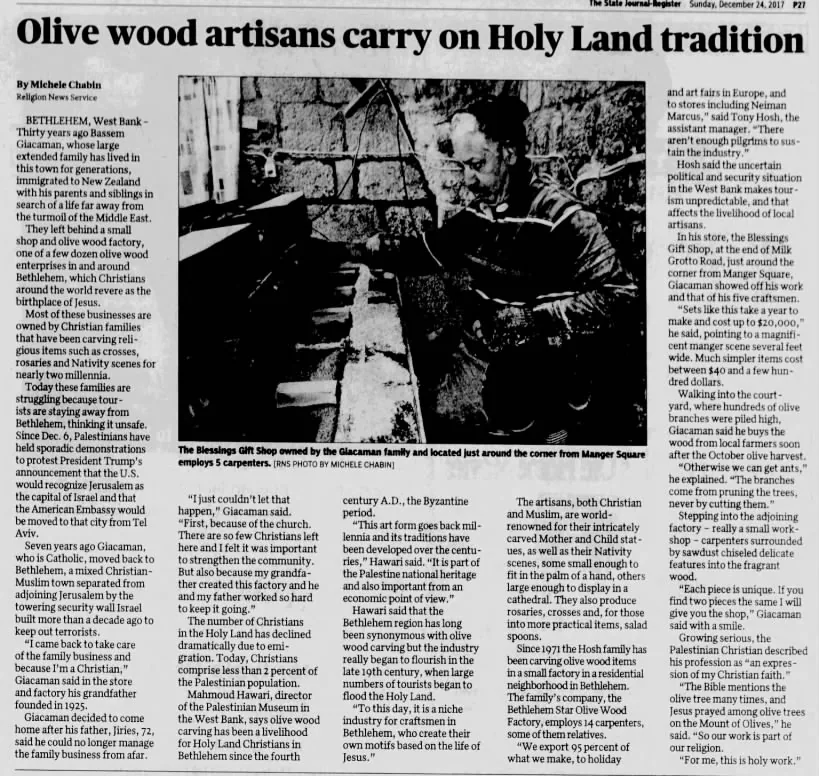
“BETHLEHEM, West Bank — Thirty years ago Bassem Giacaman, whose large extended family has lived in this town for generations, immigrated to New Zealand with his parents and siblings in search of a life far away from the turmoil of the Middle East. They left behind a small shop and olive wood factory, one of a few dozen olive wood enterprises in and around Bethlehem… Most of these businesses are owned by Christian families that have been carving religious items such as crosses, rosaries and Nativity scenes for nearly two millennia. Today these families are struggling because tourists are staying away from Bethlehem, thinking it unsafe… ‘I came back to take care of the family business and because I’m a Christian,’ Giacaman said in the store and factory his grandfather founded in 1925. Giacaman decided to come home after his father, Jiries, 72, said he could no longer manage the family business from afar. ‘I just couldn’t let that happen,’ Giacaman said. ‘First, because of the church. There are so few Christians left here and I felt it was important to strengthen the community. But also because my grandfather created this factory and me and my father worked so hard to keep it going.’ The number of Christians in the Holy Land has declined dramatically due to emigration. Today, Christians comprise less than 2 percent of the Palestinian population. Mahmoud Hawari, director of the Palestinian Museum in the West Bank, says olive wood carving has been a livelihood for Holy Land Christians in Bethlehem since the fourth century A.D., the Byzantine period. ‘This art form goes back millennia and its traditions have been developed over the centuries,’ Hawari said. ‘It is part of the Palestinian national heritage and also important from an economic point of view.’… ‘To this day, it is a niche industry for craftsmen in Bethlehem, who create their own motifs based on the life of Jesus.’ The artisans, both Christian and Muslim, are world-renowned for their intricately carved Mother and Child statues, as well as their Nativity scenes, some small enough to fit in the palm of a hand, others large enough to display in a cathedral. They also produce rosaries, crosses and, for those into more practical items, salad spoons. Since 1971 the Hosh family has been carving olive wood items in a small factory in a residential neighborhood in Bethlehem. The family’s company, the Bethlehem Star Olive Wood Factory, employs 14 carpenters, some of them relatives. ‘We export 95 percent of what we make, to holiday and art fairs in Europe, and to stores including Neiman Marcus,’ said Tony Hosh, the assistant manager. ‘There aren’t enough pilgrims to sustain the industry.’… ‘Sets like this take a year to make and cost up to $20,000,’ he said, pointing to a magnificent manger scene several feet wide. Much simpler items cost between $40 and a few hundred dollars. Walking into the courtyard, where hundreds of olive branches were piled high, Giacaman said he buys the wood from local farmers soon after the October olive harvest. ‘Otherwise we can get ants,’ he explained. ‘The branches come from pruning the trees, never by cutting them.’ Stepping into the adjoining factory — really a small workshop — carpenters surrounded by sawdust chiseled delicate features into the fragrant wood. ‘Each piece is unique. If you find two pieces the same I will give you the shop,’ Giacaman said with a smile. Growing serious, the Palestinian Christian described his profession as ‘an expression of my Christian faith.’ ‘The Bible mentions the olive tree many times, and Jesus prayed among olive trees on the Mount of Olives,’ he said. ‘So our work is part of our religion.’ ‘For me, this is holy work.’”
Photograph caption
“The Blessings Gift Shop owned by the Giacaman family and located just around the corner from Manger Square employs 5 carpenters.” · RNS photo by Michele Chabin
Context added by this archive
A trade story: four named Palestinians, a workshop founded in 1925, a craft dated to the fourth century, prices from forty dollars to twenty thousand, ninety-five per cent of output exported, and a rule about where the wood comes from — pruning, never cutting. The occupation appears as a wall, a shortage of tourists and a line about Trump and Jerusalem. The last words are a man describing what he does for a living as holy work.
Cite this item
"Olive wood artisans carry on Holy Land tradition," The State Journal-Register, 24 December 2017. Covering Palestine archive, CP-2017-009. https://coveringpalestine.org/archive/cp-2017-009
Elsewhere in the archive
- Israel has no ‘partners for peace’The State Journal-Register · 22 October 2000 · the same newspaper
- Arabs Forced To Evacuate HaifaThe State Journal-Register · 23 April 1948 · the same newspaper
- Partition Of PalestineThe State Journal-Register · 3 December 1947 · the same newspaper
- A Palestinian lightning rodLos Angeles Times · 11 January 2017 · the same year
- Palestinians fear Trump will put them on sidelinesDaily American Republic · 8 February 2017 · the same year
- 50 years after war, settlements blur future bordersNew Jersey Herald · 14 April 2017 · the same year
This record is part of Covering Palestine, an archive of American and Anglophone newspaper clippings about Palestinians, 1812 to 2022. Researched and assembled by Maria Robles.
The clipping belongs to the newspaper that printed it, or to the wire service that supplied the copy. It is reproduced here for research, criticism and commentary. The city is derived from the masthead, not read off the clipping.
Something wrong here, or something you know about this clipping? The archive is still being built and corrections are wanted: maria@rozumstudio.com, quoting CP-2017-009.
See it in the archive reel · Full text of every clipping · Dataset