Los Angeles Times · Los Angeles, California · 11 January 2017
CP-2017-010
A Palestinian lightning rod
Hip-hop artist who found solace in American rap angers Israel’s right and left with his movie
Joshua Mitnick, Lod
Transcribed from the clipping
“LOD, Israel — Tamer Nafar fell in love with hip-hop growing up amid the faded public housing blocks and garbage-strewn public parks of Ramat Eshkol, one of the poorest neighborhoods in the central Israeli city of Lod where life was punctuated by daily spurts of gunfire… Just a five-minute walk from his home, an upstairs neighbor was shot and killed in a gang [fight] that left multiple people injured. It took the police nearly an hour to arrive. ‘Just a month before, a Jewish guy was stabbed and they had a helicopter in the air,’ he said. ‘I found myself feeling [angry] about the police. At 18, my friends started dying.’ Against this backdrop, Nafar found solace in the lyrics of African American rappers like Public Enemy and Biggie Smalls, learning English and absorbing their social commentary as he listened… Scenes depicting confrontations between police and African American youths reminded them of Lod. ‘They would say, wow, they are talking about us,’ he said. ‘That’s exactly what happened yesterday.’ The audio samples in Tupac Shakur’s ‘White Man’z World’ introduced Nafar to Malcolm X and Spike Lee. ‘I found Palestinian heroes through African American ones,’ Nafar said. The nationalism of the Black Panthers, he said, prompted him to learn about the Palestine Liberation Organization; the verse of Maya Angelou led him to Palestinian national poet Mahmoud Darwish. ‘I had to go West so I could find my Eastern identity.’… Nafar and DAM threw the accusation back at Israel with the lyrics, ‘Who is the terrorist / You are a terrorist / You have taken everything I own in my land.’… ‘Kareem is at a junction — a crossroads. “Do I go with my girlfriend [in public], or not?” Am I Palestinian? Or do I sing at an Israeli club?’ Nafar said. ‘This whole junction and confusion started in 1948.’ On the eve of Israel’s war for independence, Lod was an Arab village on the railway to Jerusalem… Amid fighting there, the Israeli army killed hundreds of Arab civilians in the town and expelled tens of thousands more — part of a larger trauma of Arab displacement accompanying Israel’s birth that Palestinians refer to as the Nakba, or disaster.… Then, at the film awards ceremony, Miri Regev, Israel’s right-wing culture minister, left the auditorium in protest during a performance by Nafar because it featured a recitation of passages penned by Darwish. Regev later unsuccessfully tried to have Nafar’s concert at a festival canceled, alleging in a letter that ‘Nafar elects at every opportunity and on every stage to come out against the idea of the state of Israel and its existence as the state of the Jewish people.’ ‘I was educated in an Arab Israeli school. I was denied Mahmoud Darwish before I was 20,’ he said. ‘All they told us is that they saved the country. Nobody told us that they kicked out my grandfather. This whole piece is missing.’… ‘There is very strong self-criticism,’ he said. ‘The good guy in our movie is Palestinian and the bad guy in our movie is a Palestinian.’ Nafar has come out against honor killings in Lod, and he once was threatened by local hard-liners for performing with a woman… ‘Cultural figures are important, but they don’t sway the masses,’ said Jackie Khoury, the news director of the Arabic radio station A Shams… ‘Our movie is a solution,’ he said. ‘The solution is when the strong side, the privileged side, will be part of the story-telling of the oppressed side… When Jews and Palestinians work together to tell the story of the oppressed, that’s where hope comes.’”
Photograph caption
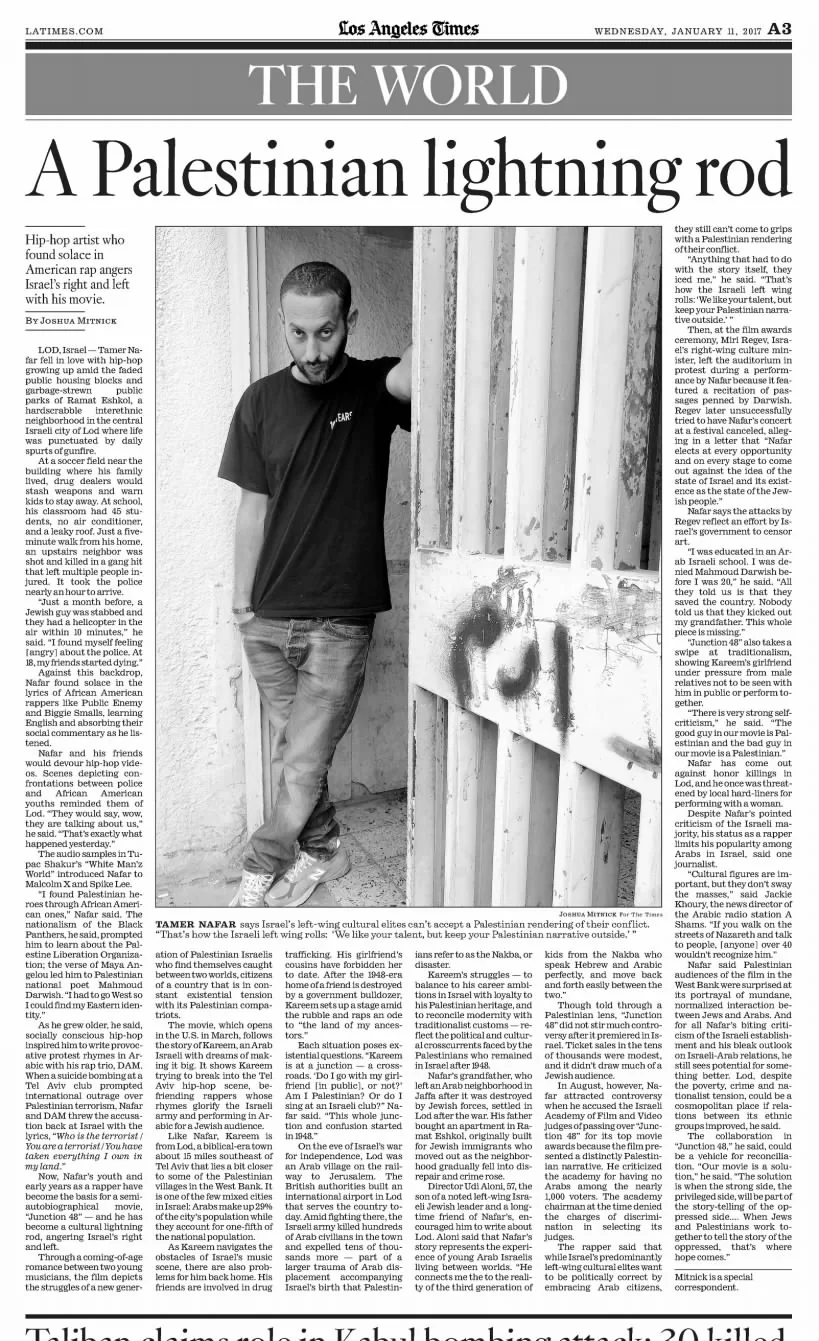
“TAMER NAFAR says Israel’s left-wing cultural elites can’t accept a Palestinian rendering of their conflict. ‘That’s how the Israeli left wing rolls: We like your talent, but keep your Palestinian narrative outside.’” · Joshua Mitnick / For The Times
Context added by this archive
A rapper from Lod who found his own history through Public Enemy and Maya Angelou: I had to go West so I could find my Eastern identity. It joins to the Darwish material in this archive at two points. He says he was denied Darwish until he was twenty, having been taught only that the country had been saved and not that his grandfather was expelled from it. And at a film awards ceremony Israel’s culture minister walked out of his performance because it included a recitation of Darwish — seventeen years after the archive’s clippings on the row over teaching five of the same poems in schools. The line the paper puts under his photograph is the section’s whole subject in one sentence: we like your talent, but keep your Palestinian narrative outside. He also says the bad guy in his own film is a Palestinian.
Cite this item
"A Palestinian lightning rod," Los Angeles Times, 11 January 2017. Covering Palestine archive, CP-2017-010. https://coveringpalestine.org/archive/cp-2017-010
Elsewhere in the archive
- On edge over Trump’s threatLos Angeles Times · 8 January 2018 · the same newspaper
- PALESTINIANS run as Israeli troops fire tear gas into Gaza City on Friday, the first fatality-free protest day since the Great March of Return effort began March 30Los Angeles Times · 6 May 2018 · the same newspaper
- The front-runnersLos Angeles Times · 23 February 2014 · the same newspaper
- Palestinians fear Trump will put them on sidelinesDaily American Republic · 8 February 2017 · the same year
- 50 years after war, settlements blur future bordersNew Jersey Herald · 14 April 2017 · the same year
- Plight of Palestinian refugees now spans 5 generationsHickory Daily Record · 24 April 2017 · the same year
This record is part of Covering Palestine, an archive of American and Anglophone newspaper clippings about Palestinians, 1812 to 2022. Researched and assembled by Maria Robles.
The clipping belongs to the newspaper that printed it, or to the wire service that supplied the copy. It is reproduced here for research, criticism and commentary. The city is derived from the masthead, not read off the clipping.
Something wrong here, or something you know about this clipping? The archive is still being built and corrections are wanted: maria@rozumstudio.com, quoting CP-2017-010.
See it in the archive reel · Full text of every clipping · Dataset