Los Angeles Times · 21 October 1984
CP-1984-055
UCLA Jewish Groups Ask Palestinian Ban
But Israel Organization Fails to Persuade University That Recent Speech Was ‘Political’
By KENNETH J. FANUCCHI, Times Staff Writer
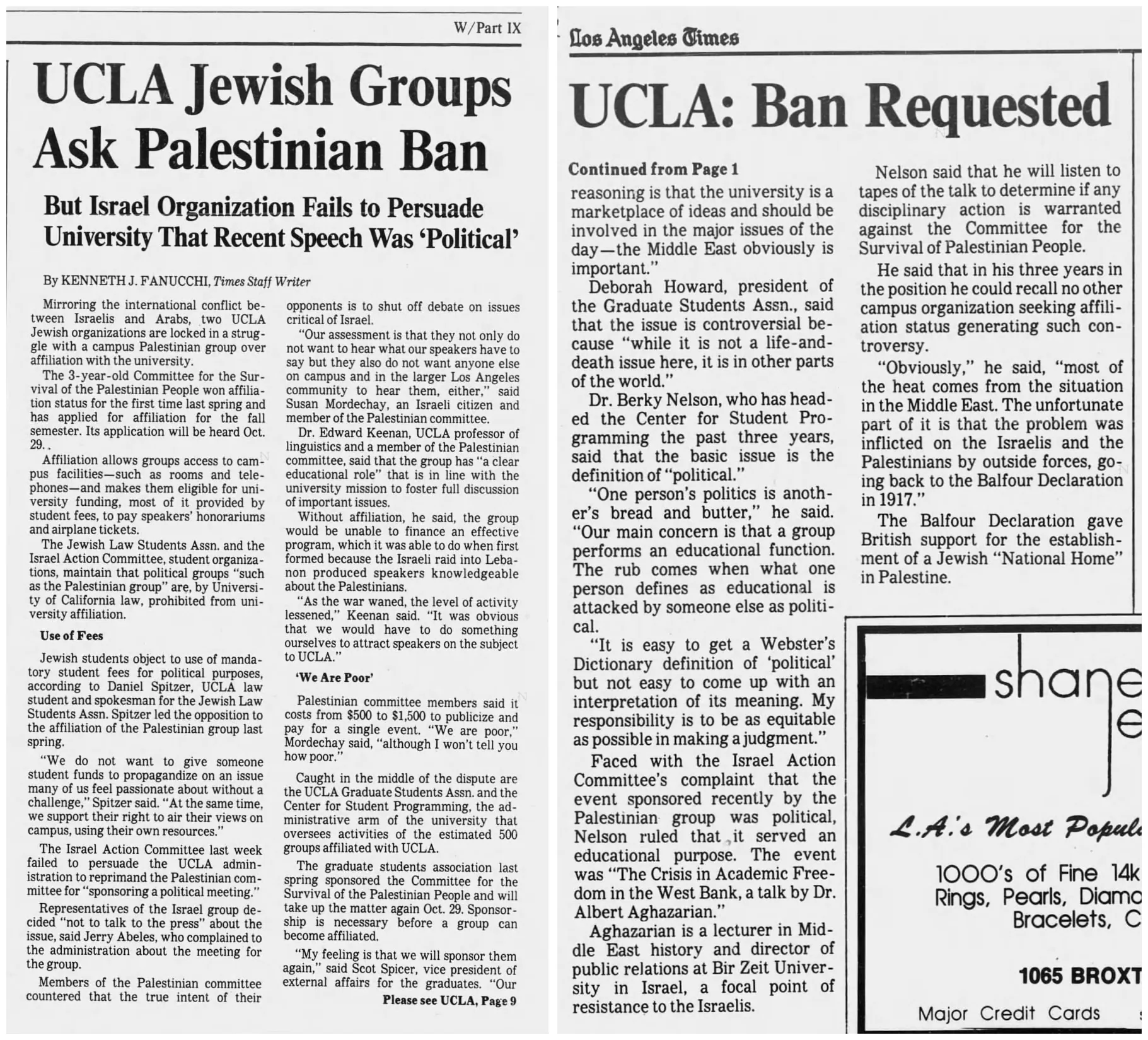
Transcribed from the clipping
Mirroring the international conflict between Israelis and Arabs, two UCLA Jewish organizations are locked in a struggle with a campus Palestinian group over affiliation with the university. The 3-year-old Committee for the Survival of the Palestinian People won affiliation status for the first time last spring and has applied for affiliation for the fall semester.
Its application will be heard Oct. 29. Affiliation allows groups access to campus facilities—such as rooms and telephones—and makes them eligible for university funding, most of it provided by student fees, to pay speakers' honorariums and airplane tickets.
The Jewish Law Students Assn. and the Israel Action Committee, student organizations, maintain that political groups “such as the Palestinian group” are, by University of California law, prohibited from university affiliation.
Jewish students object to use of mandatory student fees for political purposes, according to Daniel Spitzer, UCLA law student and spokesman for the Jewish Law Students Assn. Spitzer led the opposition to the affiliation of the Palestinian group last spring.
“We do not want to give someone student funds to propagandize on an issue many of us feel passionate about without a challenge,” Spitzer said. “At the same time, we support their right to air their views on campus, using their own resources.”
The Israel Action Committee last week failed to persuade the UCLA administration to reprimand the Palestinian committee for “sponsoring a political meeting.” Representatives of the Israel group decided “not to talk to the press” about the issue, said Jerry Abeles, who complained to the administration about the meeting for the group.
Members of the Palestinian committee countered that the true intent of their opponents is to shut off debate on issues critical of Israel.
“Our assessment is that they not only do not want to hear what our speakers have to say but they also do not want anyone else on campus and in the larger Los Angeles community to hear them, either,” said Susan Mordechay, an Israeli citizen and member of the Palestinian committee.
How this transcription was made
Read from the scan Maria supplied on 17 November 2026, at magnification, band by band. NEITHER PAGE CARRIES A DATE. Image _a has only the folio “W/Part IX” at the top right; image _b has the Los Angeles Times nameplate as a running head and no date line. So I cannot test the label date 1984-10-21 against the page. What is on the page is consistent with autumn 1984: the group “has applied for affiliation for the fall semester” and the application “will be heard Oct. 29”, which is in the future, so the paper is dated before 29 October. The label's 21 October 1984 was a Sunday, which fits a Westside section. Consistency, not confirmation. Column order: image _a is the section front — headline, deck, byline, and the jump line “Please see UCLA, Page 9” at the foot. Image _b is page 9, headed “UCLA: Ban Requested” with “Continued from Page 1”. So _a precedes _b, established from the jump lines. label_uncertain was true here, and it stays partly unresolved: the paper is confirmed, the date is not. The nameplate on the jump page reads “Los Angeles Times” in the blackletter, with no leading “The” — exactly the archive's spelling. The deck caption's “The Los Angeles Times” is not what the page shows. `pub` as supplied is correct. The folio “W/Part IX” marks this as the Westside edition, Part IX — a zoned section, not the main news section. Worth recording, because a Westside-only story may not appear in other editions of the same day's paper. THIS IS THE CLIPPING IN THE BATCH FOR THE CONSORTIUM FOR PALESTINE STUDIES AT UCLA. It is entirely about an organised Palestinian presence on the UCLA campus in autumn 1984, two and a half years before the LA 8 arrests. Named on the page: the Committee for the Survival of the Palestinian People, three years old, which won university affiliation for the first time in spring 1984 and whose renewed application was to be heard 29 October; the Jewish Law Students Assn. and the Israel Action Committee, which sought to bar it; the UCLA Graduate Students Assn., which sponsored it; and the Center for Student Programming, the administrative arm overseeing some 500 affiliated groups. Individuals: Daniel Spitzer, Jerry Abeles, Susan Mordechay, Dr. Edward Keenan, Scot Spicer, Deborah Howard, Dr. Berky Nelson. The speech at issue was “The Crisis in Academic Freedom in the West Bank, a talk by Dr. Albert Aghazarian”, a Bir Zeit University lecturer. Nothing here concerns Alex Odeh, the ADC, Santa Ana or Orange County, but it is the campus half of the same story. SIDE ASSIGNMENT I AM NOT CERTAIN OF, and I would rather flag it than file it quietly. Susan Mordechay is described by the paper as “an Israeli citizen and member of the Palestinian committee”, and she is the person who speaks for the Palestinian group in this story. Dr. Edward Keenan is a UCLA professor of linguistics and also “a member of the Palestinian committee”. Neither is described as Palestinian. I have given both side “w” rather than “p”, because the archive's “p” should mean a Palestinian, not a member of a Palestinian solidarity committee; but it means that the two voices speaking FOR the Palestinian side on this page are not counted on it. If the archive's convention is the other way, these two should move. No Palestinian is quoted anywhere in the story. Daniel Spitzer is given side “w” as well. He is a UCLA law student and spokesman for the Jewish Law Students Assn., which the page does not describe as an Israeli or Zionist organisation; the Israel Action Committee, which does carry that name, declined to speak to the press. The crossheads “Use of Fees” and “‘We Are Poor’” sit inside the body on page one. They are crossheads, not deks, and are left out of the excerpt. The deck recorded in `dek` is the two-line italic-free bold line under the main headline, which does summarise the story. The jump page carries a different, shorter head, “UCLA: Ban Requested”. I have taken the section-front head as the headline. Quotations beyond the end of the excerpt, recorded here so they are not lost. Keenan: “As the war waned, the level of activity lessened.” and “It was obvious that we would have to do something ourselves to attract speakers on the subject to UCLA.” Mordechay, on the $500 to $1,500 cost of a single event: “We are poor, although I won't tell you how poor.” Scot Spicer: “My feeling is that we will sponsor them again.” and “Our reasoning is that the university is a marketplace of ideas and should be involved in the major issues of the day—the Middle East obviously is important.” Deborah Howard, on why the issue is controversial: “while it is not a life-and-death issue here, it is in other parts of the world.” Berky Nelson: “One person's politics is another's bread and butter.” and “Our main concern is that a group performs an educational function. The rub comes when what one person defines as educational is attacked by someone else as political.” and “Obviously, most of the heat comes from the situation in the Middle East. The unfortunate part of it is that the problem was inflicted on the Israelis and the Palestinians by outside forces, going back to the Balfour Declaration in 1917.”. Nelson is also reported as saying he will listen to tapes of Aghazarian's talk to determine whether any disciplinary action is warranted against the Committee for the Survival of Palestinian People, and that in his three years in the post he could recall no other campus organization seeking affiliation status generating such controversy. Note that the jump page drops the “the” from the group's name there — “the Committee for the Survival of Palestinian People” — against “the Committee for the Survival of the Palestinian People” on page one. Both transcribed as printed. The lower right of the jump page is a jewellery advertisement (“L.A.'s Most Popul[ar]”, “1065 BROXT[ON]”). Excluded.
Cite this clipping
"UCLA Jewish Groups Ask Palestinian Ban," Los Angeles Times, 21 October 1984, p. W/Part IX page 1, jump page 9. Covering Palestine archive, CP-1984-055. https://coveringpalestine.org/archive/cp-1984-055
More from Los Angeles Times
- The Palestinians’ EvolutionLos Angeles Times · 21 March 1969
- Bomb Victim Had Expected DeathLos Angeles Times · 10 July 1972
- Mrs. Meir's Safety StudiedLos Angeles Times · 11 January 1973
- Show of Artists from PalestineLos Angeles Times · 24 June 1977
- UCLA Renews Rival Groups' StatusLos Angeles Times · 1 November 1984
- Palestinians and Politics at UCLALos Angeles Times · 4 November 1984
- 60 more from this paper in the full text →
More from the 1980s
- Israeli Arabs Take Complaints to Prime MinisterThe New York Times · 5 January 1984
- Cultural-hatred roots run deep in West BankThe Oregonian · 5 January 1984
- A Palestinian Professor Unqualified to Be Called a ‘Moderate’The New York Times · 12 January 1984
- Bedouin Herdsmen Arrested In Negev Stabbing IncidentThe New York Times · 17 January 1984
- Israeli police stoned; Palestinian killedJackson Citizen Patriot · 29 January 1984
- Zionists attack Palestinian busThe Columbian · 5 March 1984
- All 571 clippings from the 1980s →
Last updated 17 November 2026
This record is part of Covering Palestine, an archive of American newspaper clippings about Palestinians, 1724 to 2023. Researched and assembled by Maria Robles.
The clipping belongs to the newspaper that printed it, or to the news agency that supplied the copy. It is reproduced here for research, criticism and commentary. A city here is where the newspaper was published, not where the story came from, and on most records it was taken from the masthead.
Something wrong here, or something you know about this clipping? The archive is still being built and corrections are wanted: maria@rozumstudio.com, quoting CP-1984-055.
Everything printed in 1984 · Printed on this day · See it in the archive reel · Full text of every clipping · Dataset