 The dish, the thread, the woodFood, dress and craft, and what happens to the names · 1973 to 2023
1973 to 2023
The dish, the thread, the wood
Almost everything else in this archive reaches an American reader as a casualty figure, a suspect or a delegation. These pages do not. They are about dinner, about a dress, about wood and paper and beer — and they behave differently, in one measurable way, which is at the end.
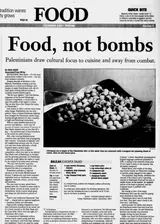
In January 2008 a food page in Missouri opened with a sentence that states the subject of this whole archive, and then answered it.
Diaa Hadid, Associated Press, Bethlehem · Columbia Daily Tribune, 16 January 2008
It’s the most talked-about conflict in the world — but the food remains a mystery.
The organizer of the Second Palestinian Culinary Competition in Bethlehem put it to the reporter plainly. We do have fighters
, Fadi Kattan said. But we also have other things that make us Palestinian.
A sidebar on that page defines maqluba, which means upside down, and which is cooked in one pot and turned out onto a plate at the table.
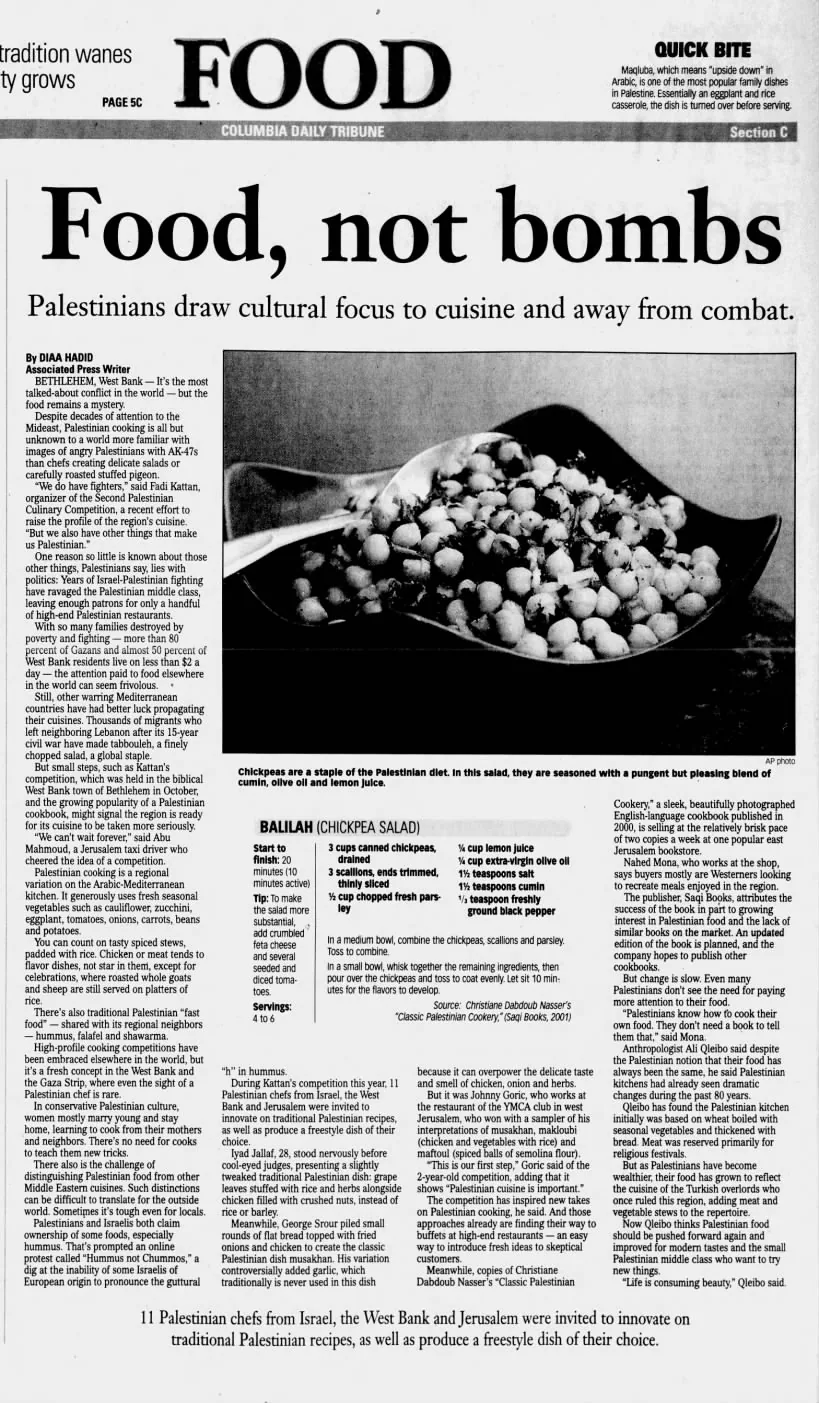
Over the next fourteen years that dish is printed in five more American papers, in five more states, and each time somebody different is making it.
A travel page in Jaffa
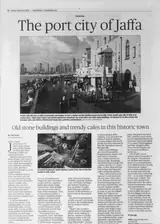 CP-2018-010
A cookbook review
Fethie Abowaznah Loutfi, eighty-five, who walked out of Jaffa barefoot, raised eight children in New York and cooked on the United Nations maintenance staff. The Nakba, printed in a food column.
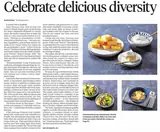 CP-2019-007
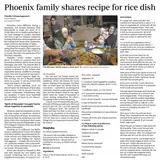
Ramadan in Phoenix
Salmah Monsour’s recipe, with weights and timings. The photograph is the family at the table, laughing.
 CP-2021-007
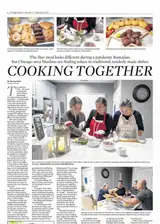
Rotating iftars
Nadia Labadi, twenty-nine, hosting her first. Eleven days after Phoenix, in a story that is not otherwise about Palestinians at all.
 CP-2021-008
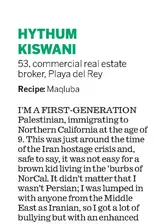
Thanksgiving
Hythum Kiswani, who arrived at nine during the Iran hostage crisis, was bullied as Iranian, and begged his parents for turkey and mashed potatoes. Sure, we’ll have turkey, but we’ll still have traditional Arabic meals meant for celebrations.
 CP-2022-048
The thread
On 10 September 2023, twenty-six days before the line this archive stops at, two American papers ran the same New York Times dispatch by Raja Abdulrahim, filed from Birzeit. The Santa Fe New Mexican cut it; the Buffalo News ran it long.
“In every stitch, there is a story. Like layers of history, the hand-stitched Palestinian embroidery known as tatreez, traditionally used to ornament Palestinian dress, tells of towns and villages lost, old customs abandoned, past lives and survival.”
Raja Abdulrahim, The New York Times, Birzeit · 10 September 2023 · CP-2023-074 CP-2023-075
The stitched designs once worked almost as an identification card. A rooster, an old Christian symbol, told you the wearer’s faith. A red bird on a blue-threaded robe worn by a widow meant she was ready to remarry. The argument one of the women makes in that story is the presence case put through needlework: there is a Jaffa thobe and an Akka thobe and a Beersheba thobe, and those garments are from those places. UNESCO recognized tatreez in 2021.
Four years earlier the Associated Press had run the dress as politics. When Rashida Tlaib was sworn in wearing her mother’s red-and-black thobe, the hashtag #TweetYourThobe followed; she wrote that she wanted to bring to Congress “an unapologetic display of the fabric of the people in this country.” The AP story names six Palestinian women — a museum curator, three designers, an exhibition director, and Maha Saca of the Palestinian Heritage Center in Bethlehem, who gets the last line. The paper that printed it misspelled political in its own headline. CP-2019-005
The wood, the paper, the beer
Olive wood, Bethlehem
A workshop founded in 1925, a craft dated to the fourth century, prices from forty dollars to twenty thousand, ninety-five per cent of it exported, and a rule about where the wood comes from: pruning, never cutting. Four Palestinians named.
CP-2017-009Origami, Gaza City
Ahmed Humaid, twenty-nine, folding paper in a studio of scrap-metal sculpture. Filed by Wafaa Shurafa, a Palestinian reporter for the Associated Press in Gaza. The blockade appears once, as the reason he cannot travel.
CP-2019-004Beer, Taybeh
Nadim Khoury, forty-one, who put $1.5 million into a West Bank brewery in 1994 on the prospect of peace, and who by 2001 was taping over his own label so that the people drinking it would not know who made it.
CP-2001-007The oldest one
The earliest page of this kind in the collection is from 1973, a Sunday feature in the Corpus Christi Caller about the Arabic-speaking families of that city. The Palestinian family gets its own standing head: Palestinian food, music survive. What survives, in the story, is a wedding — nights of parties before the day, songs composed on the spot in Arabic naming the bride and groom, bamboo flutes and the durbaeque. CP-1973-006
Twenty years on, four inches in an Oregon daily announce Emily Shihadeh performing her own life in an engineering auditorium in Corvallis, free, with comedy and songs in it. The piece is called Grapes and Figs are in Season: A Palestinian Woman’s Story. CP-1993-009
These pages name people. The 2008 food page names seven Palestinians. The 2019 dress story names six women. The olive-wood trade story names four. The tatreez dispatch names four, three of them women. The 1973 wedding feature names the family. Nobody in any of them is a casualty, a suspect or a delegation.
None of these pages is about the war, and that is the only thing they have in common. When an American paper wrote about Palestinians doing something other than dying, it turned out to have room for their names.
The next time you read a page about Palestinians, look at what the writer thought needed explaining and what they thought could be assumed — and count the names.