Pittsburgh Post-Gazette · Pittsburgh, Pennsylvania · 14 August 2005
CP-2005-007
Send in the Gowns
Antiochian museum displays Palestinian wedding dresses
By Rebekah Scott, Pittsburgh Post-Gazette
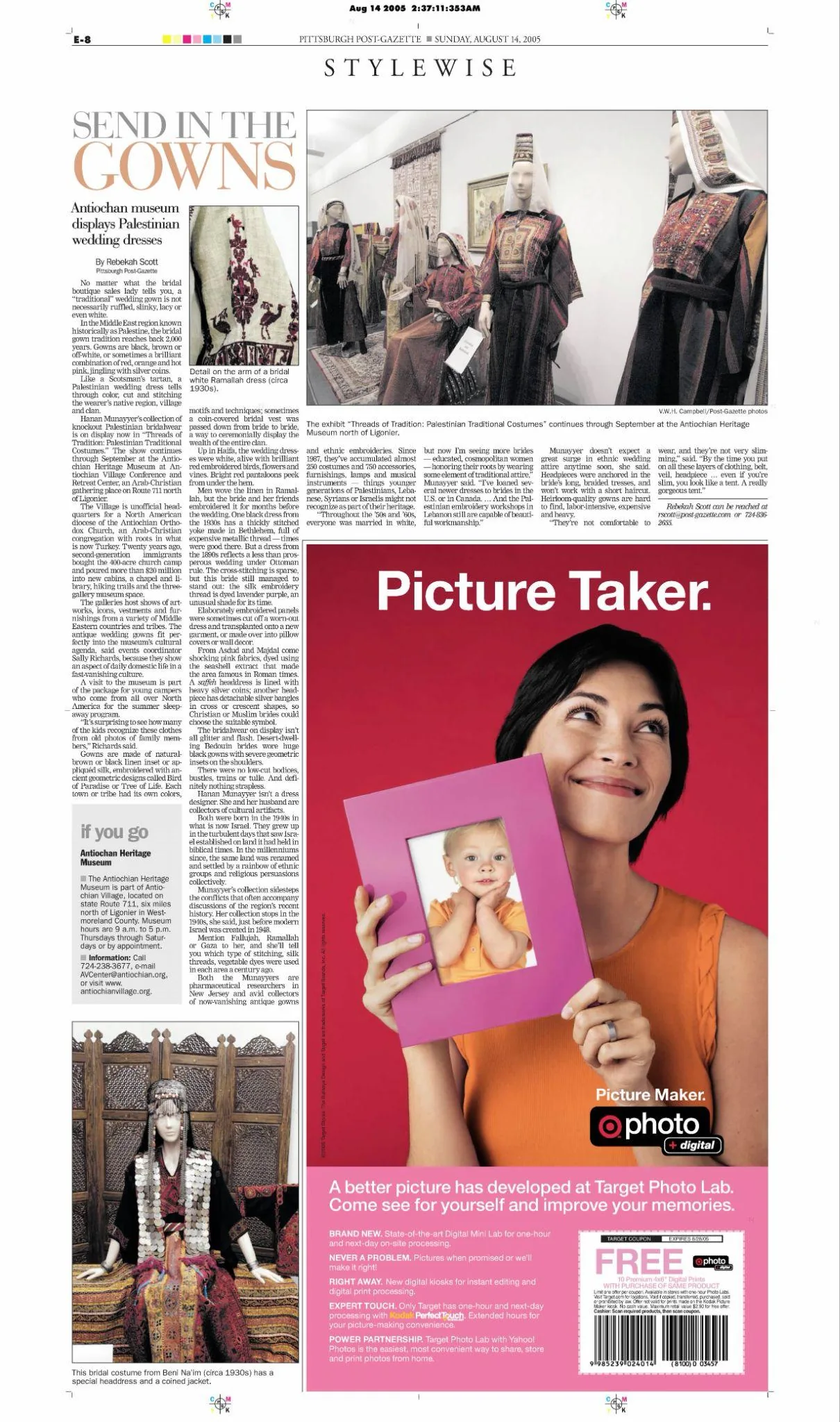
Transcribed from the clipping
“No matter what the bridal boutique sales lady tells you, a ‘traditional’ wedding gown is not necessarily ruffled, slinky, lacy or even white. In the Middle East region known historically as Palestine, the bridal gown tradition reaches back 2,000 years.
Gowns are black, brown or off-white, or sometimes a brilliant combination of red, orange and hot pink, jingling with silver coins. Like a Scotsman’s tartan, a Palestinian wedding dress tells through color, cut and stitching the wearer’s native region, village and clan.
Hanan Munayyer’s collection of knockout Palestinian bridalwear is on display now in ‘Threads of Tradition: Palestinian Traditional Costumes.’ The show continues through September at the Antiochian Heritage Museum at Antiochian Village Conference and Retreat Center, an Arab-Christian gathering place on Route 711 north of Ligonier.
The Village is unofficial headquarters for a North American diocese of the Antiochian Orthodox Church, an Arab-Christian congregation with roots in what is now Turkey. The antique wedding gowns fit perfectly into the museum’s cultural agenda, said events coordinator Sally Richards, because they show an aspect of daily domestic life in a fast-vanishing culture.
‘It’s surprising to see how many of the kids recognize these clothes from old photos of family members,’ Richards said. Gowns are made of natural-brown or black linen inset or appliquéd silk, embroidered with ancient geometric designs called Bird of Paradise or Tree of Life.
Each town or tribe had its own colors, motifs and techniques; sometimes a coin-covered bridal vest was passed down from bride to bride, a way to ceremonially display the wealth of the entire clan. Up in Haifa, the wedding dresses were white, alive with brilliant red embroidered birds, flowers and vines. Bright red pantaloons peek from under the hem.
Men wove the linen in Ramallah, but the bride and her friends embroidered it for months before the wedding. One black dress from the 1930s has a thickly stitched yoke made in Bethlehem, full of expensive metallic thread — times were good there. But a dress from the 1890s reflects a less than prosperous wedding under Ottoman rule.
The cross-stitching is sparse, but this bride still managed to stand out: the silk embroidery thread is dyed lavender purple, an unusual shade for its time. Elaborately embroidered panels were sometimes cut off a worn-out dress and transplanted onto a new garment, or made over into pillow covers or wall decor.
From Asdud and Majdal come shocking pink fabrics, dyed using the seashell extract that made the area famous in Roman times. A saffeh headdress is lined with heavy silver coins; another headpiece has detachable silver bangles in cross or crescent shapes, so Christian or Muslim brides could choose the suitable symbol.
The bridalwear on display isn’t all glitter and flash. Desert-dwelling Bedouin brides wore huge black gowns with severe geometric insets on the shoulders. There were no low-cut bodices, bustles, trains or tulle. And definitely nothing strapless. Hanan Munayyer isn’t a dress designer. She and her husband are collectors of cultural artifacts.
Both were born in the 1940s in what is now Israel. They grew up in the turbulent days that saw Israel established on land it had held in biblical times. In the millenniums since, the same land was renamed and settled by a rainbow of ethnic groups and religious persuasions collectively.
Munayyer’s collection sidesteps the conflicts that often accompany discussions of the region’s recent history. Her collection stops in the 1940s, she said, just before modern Israel was created in 1948. Mention Fallujah, Ramallah or Gaza to her, and she’ll tell you which type of stitching, silk threads, vegetable dyes were used in each area a century ago.
Both the Munayyers are pharmaceutical researchers in New Jersey and avid collectors of now-vanishing antique gowns and ethnic embroideries.
Since 1987, they’ve accumulated almost 250 costumes and 750 accessories, furnishings, lamps and musical instruments — things younger generations of Palestinians, Lebanese, Syrians or Israelis might not recognize as part of their heritage.
‘Throughout the ’50s and ’60s, everyone was married in white, but now I’m seeing more brides — educated, cosmopolitan women — honoring their roots by wearing some element of traditional attire,’ Munayyer said. ‘I’ve loaned several newer dresses to brides in the U.S. or in Canada.
… And the Palestinian embroidery workshops in Lebanon still are capable of beautiful workmanship.’ Munayyer doesn’t expect a great surge in ethnic wedding attire anytime soon, she said. Headpieces were anchored in the bride’s long, braided tresses, and won’t work with a short haircut.
Heirloom-quality gowns are hard to find, labor-intensive, expensive and heavy. ‘They’re not comfortable to wear, and they’re not very slimming,’ she said. ‘By the time you put on all these layers of clothing, belt, veil, headpiece … even if you’re slim, you look like a tent. A really gorgeous tent.’”
Context added by this archive
A Palestinian wedding dress is a map. The sentence that says so is the third one:
like a Scotsman’s tartan, it tells through color, cut and stitching the wearer’s native region, village and clan. The article then reads the map — white with red birds in Haifa, linen woven by the men in Ramallah and embroidered by the bride and her friends for months, metallic thread from Bethlehem in the 1930s when times were good there, sparse cross-stitching on an 1890s dress from a poorer wedding under the Ottomans, shocking pink from Asdud and Majdal dyed with the seashell extract the coast was famous for in Roman times.
One headdress has detachable silver bangles in cross or crescent shapes, so a Christian or a Muslim bride could pick the symbol she wanted. The collector, Hanan Munayyer, is a pharmaceutical researcher in New Jersey who was born in what is now Israel.
Her collection deliberately stops in the 1940s, just before modern Israel was created in 1948 — the villages it maps are the ones that stopped existing, and the way to exhibit them in an American museum is to end before the year they ended.
Cite this item
"Send in the Gowns," Pittsburgh Post-Gazette, 14 August 2005. Covering Palestine archive, CP-2005-007. https://coveringpalestine.org/archive/cp-2005-007
More from Pittsburgh Post-Gazette
- Two Strongholds Fall to Israelis’ Jerusalem DrivePittsburgh Post-Gazette · 13 July 1948
- UN Ignores Tragic Plight Of Palestine’s ChristiansPittsburgh Post-Gazette · 25 January 1950
- A casualty in the war on journalismPittsburgh Post-Gazette · May 2022
- Israel, Palestinians aim to curb violence as holiday nearsPittsburgh Post-Gazette · 20 March 2023
- Palestinian attacker opens fire at West Bank gas station, kills 4Pittsburgh Post-Gazette · 21 June 2023
- Israel begins withdrawal from Jenin refugee campPittsburgh Post-Gazette · 5 July 2023
More from the 2000s
- A solemn anniversary for someDetroit Free Press · 16 May 2005
- Settlers resist as Israel completes Gaza pulloutBangor Daily News · 23 August 2005
- The making of a human bombThe Journal News · 27 October 2005
- A Mideast ‘Paradise’ apocalypseNewsday · 28 October 2005
- ‘Paradise’ examines terroristsThe Selma Times-Journal · 14 November 2005
- Gazans pass through first Palestinian-run borderStaten Island Advance · 27 November 2005
- All 143 clippings from the 2000s →
This record is part of Covering Palestine, an archive of American and Anglophone newspaper clippings about Palestinians, 1799 to 2023. Researched and assembled by Maria Robles.
The clipping belongs to the newspaper that printed it, or to the news agency that supplied the copy. It is reproduced here for research, criticism and commentary. The city is derived from the masthead, not read off the clipping.
Something wrong here, or something you know about this clipping? The archive is still being built and corrections are wanted: maria@rozumstudio.com, quoting CP-2005-007.
See it in the archive reel · Full text of every clipping · Dataset