 What a wedding dress is forA dress that records which village she came from · 1993 to 2018
1993 to 2018
What a wedding dress is for
Of the records in this archive, fewer than thirty touch on a wedding, a birth or a family occasion. Four of them are here. They are worth reading together because they are almost the only place an American newspaper looks at Palestinians doing something other than dying, protesting or being discussed.
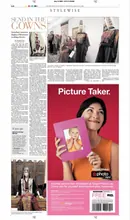
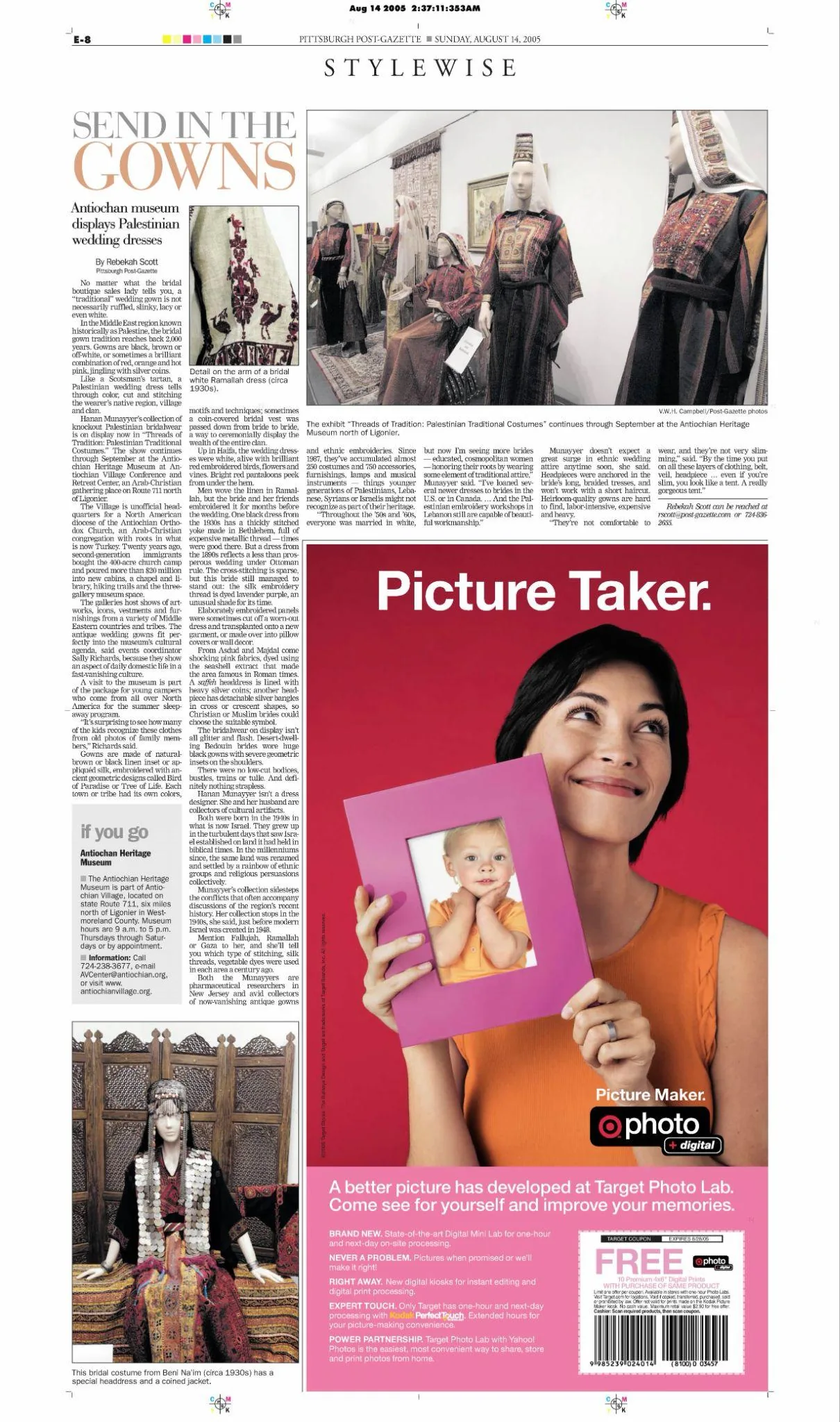
“Like a Scotsman’s tartan, a Palestinian wedding dress tells through color, cut and stitching the wearer’s native region, village and clan.”
A style page, on a Sunday, next to a full-page advertisement for a photo lab. It then reads the map: white with red embroidered birds in Haifa; linen woven by the men in Ramallah and embroidered by the bride and her friends for months; metallic thread from Bethlehem in the 1930s, when times were good there; sparse cross-stitching on an 1890s dress from a poorer wedding under the Ottomans; shocking pink from Asdud and Majdal, dyed with the seashell extract that made the coast famous in Roman times. One headdress carries detachable silver bangles in cross or crescent shapes, so a Christian or a Muslim bride could choose her symbol.
CP-2005-007The collector is Hanan Munayyer, a pharmaceutical researcher in New Jersey, born in the 1940s in what is now Israel. Her collection stops in the 1940s on purpose, the paper reports, just before modern Israel was created in 1948. The villages the dresses map are largely the villages that stopped existing, and the way to show them in an American museum is to end before the year they ended.
What the wedding costs
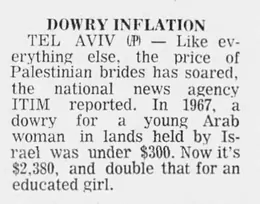
“In 1967, a dowry for a young Arab woman in lands held by Israel was under $300. Now it’s $2,380, and double that for an educated girl.”
Fifty-one words, filed under an economics pun. Thirty-three years before the Associated Press spent a full page discovering that a Palestinian bride’s degree is worth an extra salary, a paper printed the same fact as a brief about inflation.
 CP-1974-010
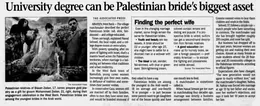
“The new generation would not agree to marry without love.”
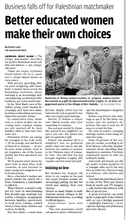
Nafeza, 36, who was married off at fifteen by her father and uncles over her mother’s objections and says it took her ten years to accept it. Her mother, Nawal Sehwel, 57, is the village matchmaker in Abween and has made about two hundred marriages, none of which she says has broken. Her trade is dying because nearly as many women as men now attend the territories’ forty colleges — which is also why the headline is about a degree. The occupation appears in this story as economics: poverty after six years of fighting, and a wife’s degree worth an extra salary.
 CP-2007-008
“Better educated women make their own choices”
The same dispatch ran in at least five American papers that week, and the five headlines do not agree about who the story is about. Four of them make the woman the asset: best asset, biggest asset, adding college to marital assets, brides’ assets evolve — to a degree. This one makes her the subject of the sentence. It is also the fullest printing, and the only one that keeps the clause explaining why twelve percent of Palestinian women never marry at all: so many young men emigrate or are in Israeli prisons. The shorter printings keep the matchmaker and drop the prisons.
 CP-2007-009
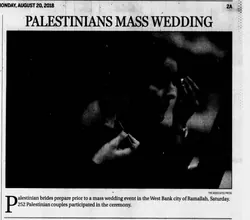
“PALESTINIANS MASS WEDDING”
A photograph of brides waiting, and a caption that counts them: 252 couples in one ceremony. No story runs beneath it, so the reason for holding a wedding two hundred and fifty-two at a time is left to the reader.
 CP-2018-011
And what can happen at one
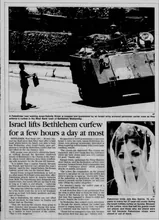
Palestinian bride Jala Abu Ajamia, 16, prepares to marry her 27-year-old cousin during the Israeli military curfew on Sunday. Because of the curfew, more that half the guests could not attend, and those who did attend were not fed because Palestinian shops were closed or out of stock.
The whole caption, as printed. On the same page is the funeral of Mounir Sansuor, 39, who lay unburied for more than three days while his family sought permission to carry him to the Church of the Nativity; fifty people were allowed to attend. A wedding and a funeral, and the curfew reached both.
 CP-2002-030
“Israeli soldiers raid wedding party”
Undercover soldiers at a reception. The army would not say whether the target was the wedding, nor whether its soldiers were in civilian dress. Two Palestinians are named and both are named by their relation to the bride: her father Yousef Kabaha, shot in the leg, and her brother Marouf, 28, arrested. The bride is not named. It is her wedding, and she is the fixed point the others are measured from.
 CP-1993-012
Put together, the four say something the archive rarely gets to say. A dress that records which village a woman came from. A matchmaker whose business is failing because women are going to university. Two hundred and fifty-two couples marrying at once. And a reception that four men leave in handcuffs or bleeding.
The next time a report describes Palestinians only in the week something happened to them, the useful question is what the rest of the year looked like. American papers did occasionally go and find out, and when they did, the people in the story got their names.