St. Louis Post-Dispatch · St. Louis, Missouri · 21 January 2007
CP-2007-009
Better educated women make their own choices
Business falls off for Palestinian matchmaker
By Karin Laub, The Associated Press
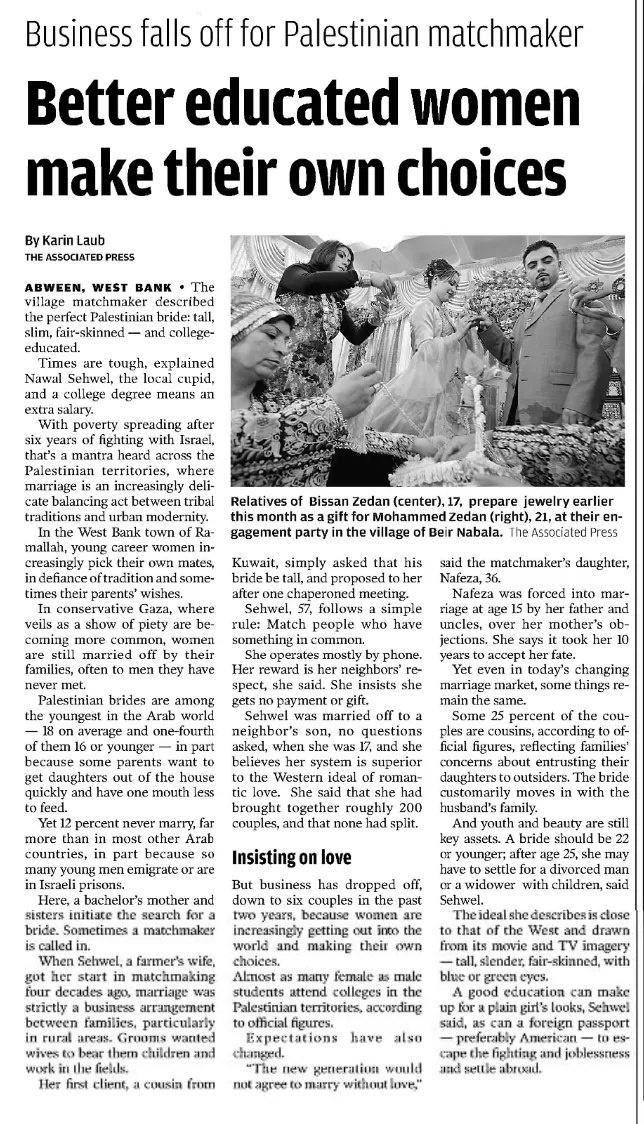
Transcribed from the clipping
“ABWEEN, WEST BANK — The village matchmaker described the perfect Palestinian bride: tall, slim, fair-skinned — and college-educated. Times are tough, explained Nawal Sehwel, the local cupid, and a college degree means an extra salary.
With poverty spreading after six years of fighting with Israel, that’s a mantra heard across the Palestinian territories, where marriage is an increasingly delicate balancing act between tribal traditions and urban modernity.
In the West Bank town of Ramallah, young career women increasingly pick their own mates, in defiance of tradition and sometimes their parents’ wishes. In conservative Gaza, where veils as a show of piety are becoming more common, women are still married off by their families, often to men they have never met.
Palestinian brides are among the youngest in the Arab world — 18 on average and one-fourth of them 16 or younger — in part because some parents want to get daughters out of the house quickly and have one mouth less to feed. Yet 12 percent never marry, far more than in most other Arab countries, in part because so many young men emigrate or are in Israeli prisons.
Here, a bachelor’s mother and sisters initiate the search for a bride. Sometimes a matchmaker is called in. When Sehwel, a farmer’s wife, got her start in matchmaking four decades ago, marriage was strictly a business arrangement between families, particularly in rural areas. Grooms wanted wives to bear them children and work in the fields.
Her first client, a cousin from Kuwait, simply asked that his bride be tall, and proposed to her after one chaperoned meeting. Sehwel, 57, follows a simple rule: Match people who have something in common. She operates mostly by phone. Her reward is her neighbors’ respect, she said. She insists she gets no payment or gift.
Sehwel was married off to a neighbor’s son, no questions asked, when she was 17, and she believes her system is superior to the Western ideal of romantic love. She said that she had brought together roughly 200 couples, and that none had split. INSISTING ON LOVE.
But business has dropped off, down to six couples in the past two years, because women are increasingly getting out into the world and making their own choices. Almost as many female as male students attend colleges in the Palestinian territories, according to official figures. Expectations have also changed.
‘The new generation would not agree to marry without love,’ said the matchmaker’s daughter, Nafeza, 36. Nafeza was forced into marriage at age 15 by her father and uncles, over her mother’s objections. She says it took her 10 years to accept her fate. Yet even in today’s changing marriage market, some things remain the same.
Some 25 percent of the couples are cousins, according to official figures, reflecting families’ concerns about entrusting their daughters to outsiders. The bride customarily moves in with the husband’s family. And youth and beauty are still key assets.
A bride should be 22 or younger; after age 25, she may have to settle for a divorced man or a widower with children, said Sehwel. The ideal she describes is close to that of the West and drawn from its movie and TV imagery — tall, slender, fair-skinned, with blue or green eyes.
A good education can make up for a plain girl’s looks, Sehwel said, as can a foreign passport — preferably American — to escape the fighting and joblessness and settle abroad.”
Context added by this archive
One of five American printings of Karin Laub’s dispatch held here, all from the same week, and the five headlines do not agree about who the story is about. This is the only one of the five whose headline makes the women the subject of a sentence rather than the asset in it. It is also the fullest printing, and it carries a clause the others cut:
12 percent never marry, far more than in most other Arab countries, in part because so many young men emigrate or are in Israeli prisons. The shorter printings keep the matchmaker and drop the prisons.
Cite this item
"Better educated women make their own choices," St. Louis Post-Dispatch, 21 January 2007. Covering Palestine archive, CP-2007-009. https://coveringpalestine.org/archive/cp-2007-009
More from St. Louis Post-Dispatch
- U.N. Starts On-the-Spot Inquiry In Israeli Shooting of 30 ArabsSt. Louis Post-Dispatch · 18 November 1956
- U.S. Nurse Tells Israelis Of Sabra Camp MassacreSt. Louis Post-Dispatch · 2 November 1982
- Nothing says 'peace' like dead PalestiniansSt. Louis Post-Dispatch · 16 May 2018
More from the 2000s
- No one seeks to wipe out PalestiniansThe Birmingham News · 2 January 2007
- University degree can be Palestinian bride’s best assetGoldsboro News-Argus · 21 January 2007
- Palestinian women adding college to marital assetsLansing State Journal · 21 January 2007
- University degree can be Palestinian bride’s biggest assetThe Island Packet · 21 January 2007
- Palestinian brides’ assets evolve — to a degreeThe Roanoke Times · 28 January 2007
- Hamas takeover of GazaChicago Tribune · 17 June 2007
- All 149 clippings from the 2000s →
This record is part of Covering Palestine, an archive of American and Anglophone newspaper clippings about Palestinians, 1799 to 2023. Researched and assembled by Maria Robles.
The clipping belongs to the newspaper that printed it, or to the news agency that supplied the copy. It is reproduced here for research, criticism and commentary. The city is derived from the masthead, not read off the clipping.
Something wrong here, or something you know about this clipping? The archive is still being built and corrections are wanted: maria@rozumstudio.com, quoting CP-2007-009.
See it in the archive reel · Full text of every clipping · Dataset