Columbia Daily Tribune · Columbia, Missouri · 16 January 2008
CP-2008-008
Food, not bombs
Palestinians draw cultural focus to cuisine and away from combat.
Diaa Hadid, Associated Press Writer, Bethlehem
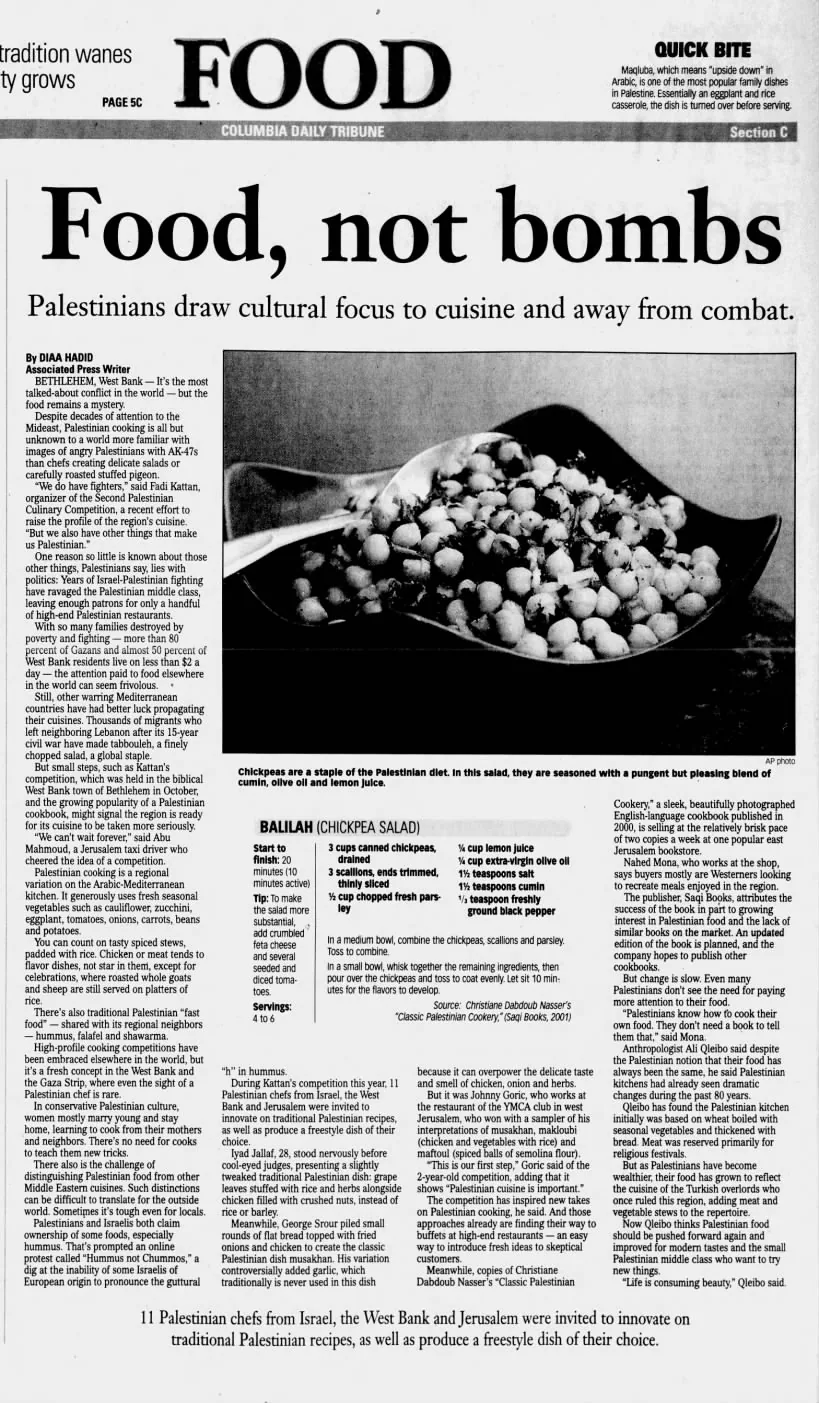
Transcribed from the clipping
“BETHLEHEM, West Bank — It’s the most talked-about conflict in the world — but the food remains a mystery. Despite decades of attention to the Mideast, Palestinian cooking is all but unknown to a world more familiar with images of angry Palestinians with AK-47s than chefs creating delicate salads or carefully roasted stuffed pigeon. ‘We do have fighters,’ said Fadi Kattan, organizer of the Second Palestinian Culinary Competition, a recent effort to raise the profile of the region’s cuisine. ‘But we also have other things that make us Palestinian.’ One reason so little is known about those other things, Palestinians say, lies with politics: Years of Israel-Palestinian fighting have ravaged the Palestinian middle class, leaving enough patrons for only a handful of high-end Palestinian restaurants. With so many families destroyed by poverty and fighting — more than 80 percent of Gazans and almost 50 percent of West Bank residents live on less than $2 a day — the attention paid to food elsewhere in the world can seem frivolous… ‘We can’t wait forever,’ said Abu Mahmoud, a Jerusalem taxi driver who cheered the idea of a competition. Palestinian cooking is a regional variation on the Arabic-Mediterranean kitchen. It generously uses fresh seasonal vegetables such as cauliflower, zucchini, eggplant, tomatoes, onions, carrots, beans and potatoes. You can count on tasty spiced stews, padded with rice. Chicken or meat tends to flavor dishes, not star in them, except for celebrations, where roasted whole goats and sheep are still served on platters of rice. There’s also traditional Palestinian ‘fast food’ — shared with its regional neighbors — hummus, falafel and shawarma… In conservative Palestinian culture, women mostly marry young and stay home, learning to cook from their mothers and neighbors. There’s no need for cooks to teach them new tricks… Palestinians and Israelis both claim ownership of some foods, especially hummus. That’s prompted an online protest called ‘Hummus not Chummos,’ a dig at the inability of some Israelis of European origin to pronounce the guttural ‘h’ in hummus. During Kattan’s competition this year, 11 Palestinian chefs from Israel, the West Bank and Jerusalem were invited to innovate on traditional Palestinian recipes, as well as produce a freestyle dish of their choice. Iyad Jallaf, 28, stood nervously before cool-eyed judges, presenting a slightly tweaked traditional Palestinian dish: grape leaves stuffed with rice and herbs alongside chicken filled with crushed nuts, instead of rice or barley. Meanwhile, George Srour piled small rounds of flat bread topped with fried onions and chicken to create the classic Palestinian dish musakhan… ‘This is our first step,’ Goric said of the 2-year-old competition, adding that it shows ‘Palestinian cuisine is important’… Nahed Mona, who works at the shop, says buyers mostly are Westerners looking to recreate meals enjoyed in the region… Anthropologist Ali Qleibo said despite the Palestinian notion that their food has always been the same, he said Palestinian kitchens had already seen dramatic changes during the past 80 years… ‘Palestinians know how to cook their own food. They don’t need a book to tell them that,’ said Mona.… Now Qleibo thinks Palestinian food should be pushed forward again and improved for modern tastes and the small Palestinian middle class who want to try new things. ‘Life is consuming beauty,’ Qleibo said.… BALILAH (Chickpea Salad). Start to finish: 20 minutes (10 minutes active). Servings: 4 to 6. 3 cups canned chickpeas, drained · 3 scallions, ends trimmed, thinly sliced · ½ cup chopped fresh parsley · ¼ cup lemon juice · ¼ cup extra-virgin olive oil · 1½ teaspoons salt · 1½ teaspoons cumin · ⅓ teaspoon freshly ground black pepper. In a medium bowl, combine the chickpeas, scallions and parsley. Toss to combine. In a small bowl, whisk together the remaining ingredients, then pour over the chickpeas and toss to coat evenly. Let sit 10 minutes for the flavors to develop. Source: Christiane Dabdoub Nasser’s ‘Classic Palestinian Cookery,’ (Saqi Books, 2001)”
Photograph caption
“Chickpeas are a staple of the Palestinian diet. In this salad, they are seasoned with a pungent but pleasing blend of cumin, olive oil and lemon juice.” · AP photo. Quick Bite box: “Maqluba, which means ‘upside down’ in Arabic, is one of the most popular family dishes in Palestine. Essentially an eggplant and rice casserole, the dish is turned over before serving.”
Context added by this archive
A food page that states this archive’s subject in its first sentence and then answers it: the most talked-about conflict in the world, and the food remains a mystery. Seven Palestinians are named, a recipe is printed with a source, and the sidebar defines maqluba — the dish that turns up in three more American papers over the next fourteen years. Diaa Hadid, who filed this, also wrote the Associated Press obituary of Mahmoud Darwish seven months later, and Ali Qleibo is quoted in both.
Cite this item
"Food, not bombs," Columbia Daily Tribune, 16 January 2008. Covering Palestine archive, CP-2008-008. https://coveringpalestine.org/archive/cp-2008-008
Elsewhere in the archive
- Palestinians mourn Israel’s anniversary as the ‘Nakba’The Day · 16 May 2008 · the same year
- Remembering the Nakba on Israel’s 60th anniversaryWisconsin State Journal · 16 May 2008 · the same year
- Israel-Palestinian coverage is a matter of perceptionThe Miami Herald · 18 May 2008 · the same year
This record is part of Covering Palestine, an archive of American and Anglophone newspaper clippings about Palestinians, 1812 to 2022. Researched and assembled by Maria Robles.
The clipping belongs to the newspaper that printed it, or to the wire service that supplied the copy. It is reproduced here for research, criticism and commentary. The city is derived from the masthead, not read off the clipping.
Something wrong here, or something you know about this clipping? The archive is still being built and corrections are wanted: maria@rozumstudio.com, quoting CP-2008-008.
See it in the archive reel · Full text of every clipping · Dataset