The Charlotte Observer · 4 February 2008
CP-2008-028
Gaza siege takes terrible toll
Now Israel is blocking even humanitarian supplies residents need
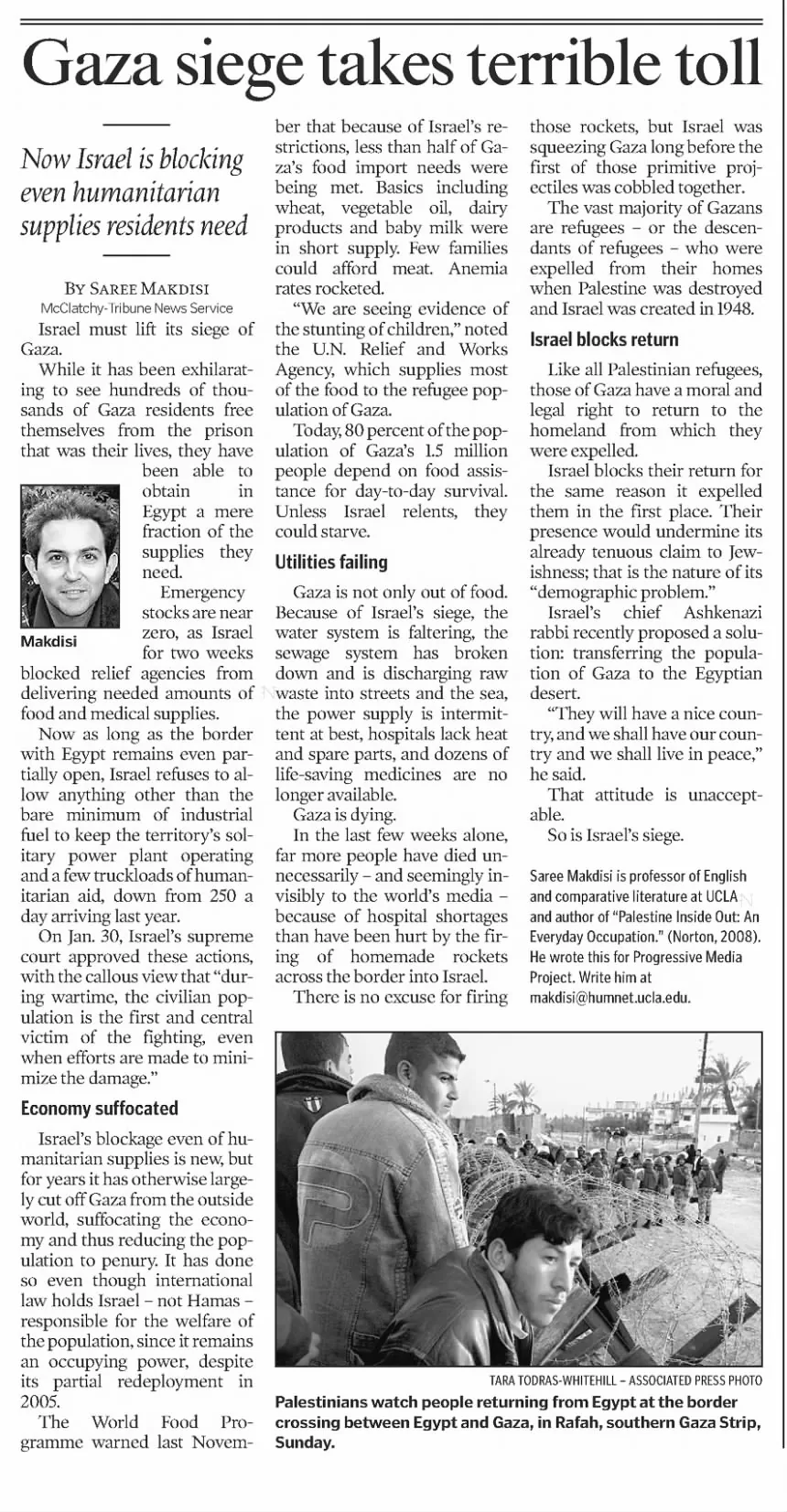
Transcribed from the clipping
Israel must lift its siege of Gaza. While it has been exhilarating to see hundreds of thousands of Gaza residents free themselves from the prison that was their lives, they have been able to obtain in Egypt a mere fraction of the supplies they need.
Emergency stocks are near zero, as Israel for two weeks blocked relief agencies from delivering needed amounts of food and medical supplies.
Now as long as the border with Egypt remains even partially open, Israel refuses to allow anything other than the bare minimum of industrial fuel to keep the territory’s solitary power plant operating and a few truckloads of humanitarian aid, down from 250 a day arriving last year. On Jan.
30, Israel’s supreme court approved these actions, with the callous view that “during wartime, the civilian population is the first and central victim of the fighting, even when efforts are made to minimize the damage.”
Economy suffocated Israel’s blockage even of humanitarian supplies is new, but for years it has otherwise largely cut off Gaza from the outside world, suffocating the economy and thus reducing the population to penury.
It has done so even though international law holds Israel – not Hamas – responsible for the welfare of the population, since it remains an occupying power, despite its partial redeployment in 2005. The World Food Programme warned last November that because of Israel’s restrictions, less than half of Gaza’s food import needs were being met.
Basics including wheat, vegetable oil, dairy products and baby milk were in short supply. Few families could afford meat. Anemia rates rocketed. “We are seeing evidence of the stunting of children,” noted the U.N. Relief and Works Agency, which supplies most of the food to the refugee population of Gaza.
Today, 80 percent of the population of Gaza’s 1.5 million people depend on food assistance for day-to-day survival. Unless Israel relents, they could starve. Utilities failing Gaza is not only out of food.
Because of Israel’s siege, the water system is faltering, the sewage system has broken down and is discharging raw waste into streets and the sea, the power supply is intermittent at best, hospitals lack heat and spare parts, and dozens of life-saving medicines are no longer available. Gaza is dying.
In the last few weeks alone, far more people have died unnecessarily – and seemingly invisibly to the world’s media – because of hospital shortages than have been hurt by the firing of homemade rockets across the border into Israel.
There is no excuse for firing those rockets, but Israel was squeezing Gaza long before the first of those primitive projectiles was cobbled together. The vast majority of Gazans are refugees – or the descendants of refugees – who were expelled from their homes when Palestine was destroyed and Israel was created in 1948.
Israel blocks return Like all Palestinian refugees, those of Gaza have a moral and legal right to return to the homeland from which they were expelled. Israel blocks their return for the same reason it expelled them in the first place. Their presence would undermine its already tenuous claim to Jewishness; that is the nature of its “demographic problem.”
Israel’s chief Ashkenazi rabbi recently proposed a solution: transferring the population of Gaza to the Egyptian desert. “They will have a nice country, and we shall have our country and we shall live in peace,” he said. That attitude is unacceptable. So is Israel’s siege.
How this transcription was made
Read from the scan Maria supplied on 17 November 2026, at magnification, band by band. No masthead, no folio line and no date on this clipping; it is cropped to the op-ed package, with a double rule above the headline and white space below the caption. So the label date 2008-02-04 cannot be confirmed from the page. Internal evidence fits it: the piece says “On Jan. 30, Israel’s supreme court approved these actions”, and the photo caption is dated “Sunday”. 3 February 2008 was a Sunday, so a Monday 4 February 2008 paper is the expected fit. UNIVERSITY — the clearest UCLA attribution in the deck, in the paper’s own voice rather than a letter writer’s. The tagline at the foot of the third column reads: “Saree Makdisi is professor of English and comparative literature at UCLA and author of ‘Palestine Inside Out: An Everyday Occupation.’ (Norton, 2008). He wrote this for Progressive Media Project. Write him at makdisi@humnet.ucla.edu.” A ucla.edu address is printed in full in a North Carolina newspaper. Note also that the tagline says “He”, which settles the gender error in la089 from the same archive deck: two years earlier an LA Times letter writer called Makdisi “she” and praised UCLA for having “her” on its faculty. SAME MAN, TWO CLIPPINGS. la089 (letters answering his LA Times op-ed, 2006) and la090 (his own op-ed, 2008) both turn on Saree Makdisi of UCLA. For the Consortium search these two should be read together: the 2006 letters are Los Angeles readers arguing about a UCLA professor, and the 2008 piece is that professor syndicated out of Los Angeles into the national press. No masthead on this clipping, so I cannot check the page against pub “The Charlotte Observer”. Flagging the spelling anyway: the archive carries the leading “The”, the deck caption reads “Charlotte Observer Feb 4 2008” without it, and the page itself shows neither. The byline is set on two lines, “BY SAREE MAKDISI” in small caps over “McClatchy-Tribune News Service”. I recorded the name line as the byline; the syndication credit is noted here. The piece ran as an opinion column, not a news report, and has no dateline. The italic line under the rule, “Now Israel is blocking even humanitarian supplies residents need”, is a true deck: it is set in italic in the first column, bracketed by short rules above and below, directly under the headline and above the byline. Three bold subheads break the text — “Economy suffocated”, “Utilities failing”, “Israel blocks return”. They are kept in the excerpt on their own lines, in the positions where the paper set them. A mug shot of the author runs in the first column, labelled in bold “Makdisi”. That is a photo label, not a caption; photo_caption holds the caption under the main news photograph. That photograph’s credit, set flush right above its caption, reads “TARA TODRAS-WHITEHILL – ASSOCIATED PRESS PHOTO”. The paper sets en dashes, not em dashes, in the parenthetical breaks (“refugees – or the descendants of refugees – who were expelled”; “Israel – not Hamas –”; “died unnecessarily – and seemingly invisibly to the world’s media –”). Transcribed as – to match. “The World Food Programme” is set with the British spelling “Programme”. Transcribed as printed. Israel’s chief Ashkenazi rabbi is quoted but not named on the page. Nothing on this page touches Los Angeles or Southern California except through Makdisi’s UCLA affiliation in the tagline — which is, for this search, the point.
Cite this clipping
"Gaza siege takes terrible toll," The Charlotte Observer, 4 February 2008. Covering Palestine archive, CP-2008-028. https://coveringpalestine.org/archive/cp-2008-028
More from The Charlotte Observer
- Bernadotte Would Permit Arab Refugees To Return To Homes In Jewish-Held AreasThe Charlotte Observer · 2 August 1948
- Israeli forces kill two PalestiniansThe Charlotte Observer · 30 January 2003
- The White House calls for aid to Gaza but doesn't criticize Israel's use of deadly force.The Charlotte Observer · 2 June 2010
- Both Jews and Palestinians belong on landThe Charlotte Observer · 17 June 2010
- Israeli army kills 4 Palestinians trying to cross Gaza fenceThe Charlotte Observer · 11 August 2019
More from the 2000s
- Food, not bombsColumbia Daily Tribune · 16 January 2008
- Gaza falls into darkness as fuel cut offCentre Daily Times · 21 January 2008
- Breakout from GazaGreat Falls Tribune · 24 January 2008
- Egypt works to restore borderChicago Tribune · 28 January 2008
- Punishing the people in Gaza feeds extremismDaily Herald · 4 February 2008
- Siege is taking terrible tollModesto Bee · 5 February 2008
- All 527 clippings from the 2000s →
Last updated 17 November 2026
This record is part of Covering Palestine, an archive of American newspaper clippings about Palestinians, 1724 to 2023. Researched and assembled by Maria Robles.
The clipping belongs to the newspaper that printed it, or to the news agency that supplied the copy. It is reproduced here for research, criticism and commentary. A city here is where the newspaper was published, not where the story came from, and on most records it was taken from the masthead.
Something wrong here, or something you know about this clipping? The archive is still being built and corrections are wanted: maria@rozumstudio.com, quoting CP-2008-028.
Everything printed in 2008 · Printed on this day · See it in the archive reel · Full text of every clipping · Dataset