Columbia Daily Tribune · 4 February 2013
CP-2013-017
U.S. funds study on Palestinian, Israeli textbooks
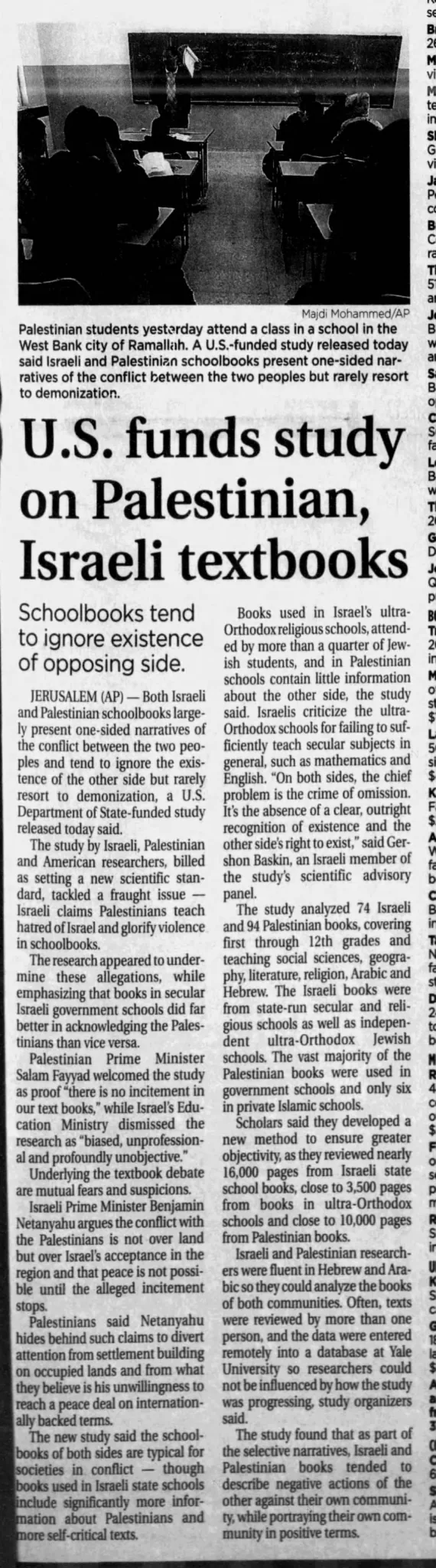
Shown from the top. The whole column is in the enlargement.
Transcribed from the clipping
SI M a Majdi Mohammed/AP Palestinian students yesterday attend a class in a school in the West Bank city of Ramallah. A U.S.-funded study released today said Israeli and Palestinian schoolbooks present one-sided narratives of the conflict between the two peoples but rarely resort to demonization.
B J G P Books used in Israel's ultraB Schoolbooks tend Orthodox religious schools, attendto ignore existence ed by more than a quarter of Jewish students, and in Palestinian of opposing side. schools contain little information about the other side, the study JERUSALEM (AP) — Both Israeli said.
Israelis criticize the ultraand Palestinian schoolbooks largeOrthodox schools for failing to sufly present one-sided narratives of ficiently teach secular subjects in the conflict between the two peoples and tend to ignore the exisgeneral, such as mathematics and tence of the other side but rarely English.
"On both sides, the chief resort to demonization, a U.S. problem is the crime of omission. It's the absence of a clear, outright Department of State-funded study $ recognition of existence and the released today said.
A The study by Israeli, Palestinian other side's right to exist," said Gerand American researchers, billed shon Baskin, an Israeli member of the study's scientific advisory as setting a new scientific stanpanel. dard, tackled a fraught issue — The study analyzed 74 Israeli Israeli claims Palestinians teach and 94 Palestinian books, covering hatred of Israel and glorify violence in schoolbooks. first through 12th grades and teaching social sciences, geograThe research appeared to underphy, literature, religion, Arabic and mine these allegations, while Hebrew.
The Israeli books were emphasizing that books in secular from state-run secular and reliIsraeli government schools did far better in acknowledging the Palesgious schools as well as independent ultra-Orthodox Jewish tinians than vice versa. schools.
The vast majority of the Palestinian Prime Minister Palestinian books were used in Salam Fayyad welcomed the study government schools and only six as proof "there is no incitement in our text books," while Israel's Eduin private Islamic schools. cation Ministry dismissed the Scholars said they developed a $ new method to ensure greater research as "biased, unprofessionobjectivity, as they reviewed nearly al and profoundly unobjective." 16,000 pages from Israeli state Underlying the textbook debate are mutual fears and suspicions. school books, close to 3,500 pages from books in ultra-Orthodox Israeli Prime Minister Benjamin schools and close to 10,000 pages Netanyahu argues the conflict with from Palestinian books. the Palestinians is not over land Israeli and Palestinian researchbut over Israel's acceptance in the ers were fluent in Hebrew and Araregion and that peace is not possibic so they could analyze the books ble until the alleged incitement of both communities.
Often, texts stops. were reviewed by more than one Palestinians said Netanyahu person, and the data were entered hides behind such claims to divert remotely into a database at Yale attention from settlement building University so researchers could on occupied lands and from what not be influenced by how the study they believe is his unwillingness to was progressing, study organizers reach a peace deal on internationally backed terms.
The study found that as part of The new study said the schoolthe selective narratives, Israeli and books of both sides are typical for Palestinian books tended to societies in conflict - though books used in Israeli state schools describe negative actions of the other against their own communiinclude significantly more information about Palestinians and ty, while portraying their own community in positive terms. more self-critical texts.
Cite this item
"U.S. funds study on Palestinian, Israeli textbooks," Columbia Daily Tribune, 4 February 2013. Covering Palestine archive, CP-2013-017. https://coveringpalestine.org/archive/cp-2013-017
More from Columbia Daily Tribune
- Food, not bombsColumbia Daily Tribune · 16 January 2008
More from the 2010s
- State of Palestine name change shows limitationsThe Globe · 8 January 2013
- WHAT’S IN A NAME?The Monitor · 8 January 2013
- Palestinians evacuated, Netanyahu affirms plansThe Philadelphia Inquirer · 14 January 2013
- U.S. protests ‘State of Palestine’ placard in U.N.Press of Atlantic City · 24 January 2013
- Bus service for Palestinians raises charges of racismSanta Barbara News-Press · 5 March 2013
- Obama: Palestinians deserve a negotiated stateCourier Post · 22 March 2013
- All 144 clippings from the 2010s →
This record is part of Covering Palestine, an archive of American and Anglophone newspaper clippings about Palestinians, 1799 to 2023. Researched and assembled by Maria Robles.
The clipping belongs to the newspaper that printed it, or to the news agency that supplied the copy. It is reproduced here for research, criticism and commentary. The city is derived from the masthead, not read off the clipping.
Something wrong here, or something you know about this clipping? The archive is still being built and corrections are wanted: maria@rozumstudio.com, quoting CP-2013-017.
See it in the archive reel · Full text of every clipping · Dataset