The Buffalo News · Buffalo, New York · 10 September 2023
CP-2023-075
The threads of identity show in Palestinian handmade dresses
Raja Abdulrahim, New York Times, Birzeit
Transcribed from the clipping
“BIRZEIT, West Bank — In every stitch, there is a story… In 2019, when Rep. Rashida Tlaib, D-Mich., was sworn in as the first Palestinian American woman to serve in Congress, she wore a red-and-black thobe that once belonged to her mother. That led to a hashtag, #TweetYourThobe, that encouraged other Palestinian women to share photographs of themselves in their own thobes. At the time, Tlaib wrote that she wanted to bring to Congress ‘an unapologetic display of the fabric of the people in this country.’… In 1948, about 700,000 Palestinians were forced to flee their homes in the war surrounding the creation of Israel, a period that Palestinians call the nakba, or catastrophe. Most ended up in refugee camps in neighboring countries and across the West Bank and Gaza. Suddenly uprooted from their homes, lands and sources of income, women began to sell one of their few possessions of value: their thobes. The nakba — and, nearly two decades later, the naksa, which is what Palestinians call the mass displacement around the Arab-Israeli war of 1967 — forced many women to become the breadwinners in their families. Embroidery was a major skill, transformed from a personal craft to one driven by trade. The designs and colors of the embroidery began to change because women were away from the lands and local inspirations they once drew from. The embroidery became more homogenized and less of an identity card.… ‘We prove our presence here for thousands of years through our heritage,’ she said. ‘How do we have a Jaffa thobe and an Akka thobe and a Beersheba thobe if we were not there?’… She was referring to the phrase ‘a land without a people for a people without a land,’ used by some Zionists before the establishment of Israel to contend that the land of historical Palestine was uninhabited. At the Surif Women’s Cooperative, in a small town on the outskirts of the West Bank city of Hebron, Halima Fareed, 58, put the final touches on a green-and-black embroidered pillowcase. Sitting near a wall covered in colorful rolls of thread and fabric, she sewed on a label: Palestinian needlework. West Bank. Made in Hebron. Around the edges were little cypress trees that resembled the tall cypress that stands outside the cooperative. It is one of the few local symbols that the cooperative, which makes embroidered household items but not thobes, still preserves in its designs, which now tend toward the Christmas candles, camels and Canaanite stars favored by customers. The embroidery of Hebron and its surrounding towns used to be marked primarily by reds and purples. Now, many of the cooperative’s pillowcases, place mats and stoles are dominated by the more popular blues and greens. As the handicraft evolves, its practitioners see it in the context of history. ‘This is not the old heritage,’ Fareed said as she sewed the edges of a multicolored pillowcase. ‘It is our heritage, but it has been modernized.’ The director of the cooperative, Taghrid Hudoosh, 55, nodded. ‘We are a continuation of our heritage,’ she said.”
Photograph caption
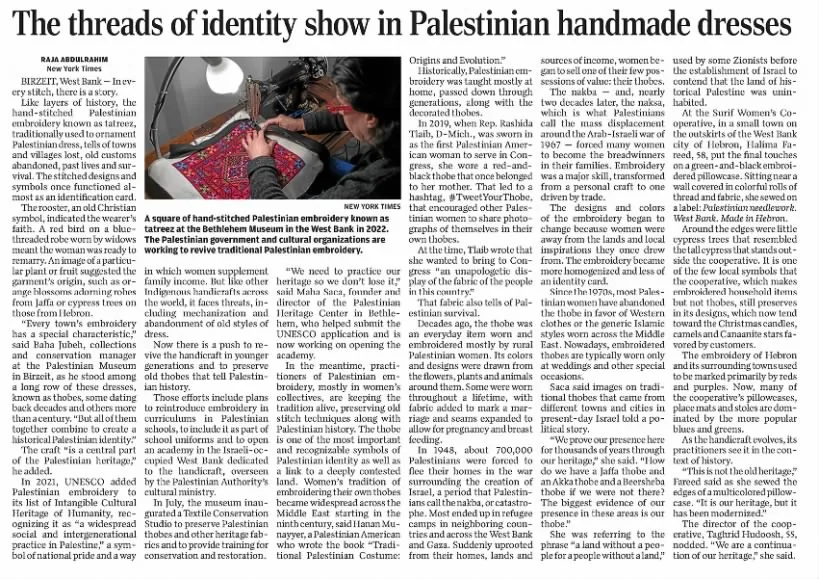
“A square of hand-stitched Palestinian embroidery known as tatreez at the Bethlehem Museum in the West Bank in 2022. The Palestinian government and cultural organizations are working to revive traditional Palestinian embroidery.” · New York Times
Context added by this archive
The same New York Times story the Santa Fe New Mexican ran the same day, printed longer, and what the shorter version lost is the heart of it. The 1948 figure, and what displacement did to the craft: seven hundred thousand people uprooted, women selling the thobes that were among their few things of value, and embroidery turning from a personal record into a trade. The phrase a land without a people for a people without a land, named and attributed. Rashida Tlaib sworn into Congress in her mother’s dress. And the closing scene, which needs no argument at all: Halima Fareed, 58, sewing a label onto a pillowcase that reads Palestinian needlework, West Bank, Made in Hebron, and her director saying we are a continuation of our heritage.
Cite this item
"The threads of identity show in Palestinian handmade dresses," The Buffalo News, 10 September 2023. Covering Palestine archive, CP-2023-075. https://coveringpalestine.org/archive/cp-2023-075
Elsewhere in the archive
- Israeli settlers attack Palestinian town after killingsThe Buffalo News · 28 February 2023 · the same newspaper
- Palestinians demonstrate at the Damascus GateThe Buffalo News · 8 December 2017 · the same newspaper
- PALESTINE FACES NEW BLOODSHEDThe Buffalo News · 29 July 1938 · the same newspaper
- Israeli minister defies leadership with visit to Jerusalem flash pointThe Philadelphia Inquirer · 4 January 2023 · the same year
- Visit to Jerusalem holy site stokes angerLos Angeles Times · 4 January 2023 · the same year
- Israel official’s site visit assailedNew Jersey Herald · 4 January 2023 · the same year
This record is part of Covering Palestine, an archive of American and Anglophone newspaper clippings about Palestinians, 1812 to 2022. Researched and assembled by Maria Robles.
The clipping belongs to the newspaper that printed it, or to the wire service that supplied the copy. It is reproduced here for research, criticism and commentary. The city is derived from the masthead, not read off the clipping.
Something wrong here, or something you know about this clipping? The archive is still being built and corrections are wanted: maria@rozumstudio.com, quoting CP-2023-075.
See it in the archive reel · Full text of every clipping · Dataset