 Palestinian women have been organizing since 1929The press counted the cars, not the women · 1929 to 2023
1929 to 2023
Palestinian women have been organizing since 1929
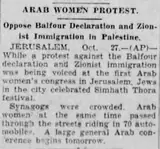
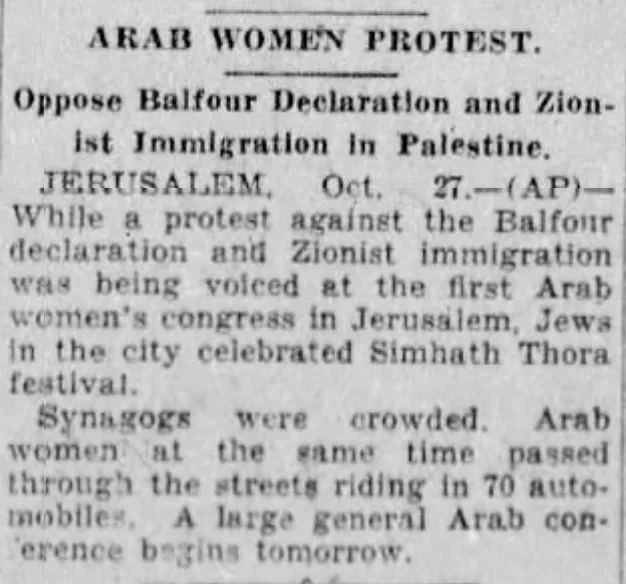
In October 1929 several hundred Palestinian women held the first Arab Women’s Congress in Jerusalem. They elected an executive, passed resolutions, and drove through the city in a motorcade. The Associated Press gave American readers five sentences, and what it counted was the cars.
Associated Press, Jerusalem · The Plain Dealer, 28 October 1929
Arab women at the same time passed through the streets riding in 70 automobiles.
No woman is named. No resolution is printed. Nobody is quoted. The paragraph is balanced by a note on what the Jews of the city were doing that day, and the headline is two words and a full stop: “Arab Women Protest.”
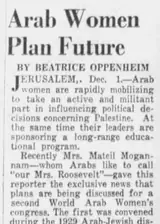
Sixteen years later a woman reporter in Jerusalem filed on the same movement and did the opposite.
“Arab Women Plan Future”
Matiel Mogannam, who organized the 1929 congress, is named, her book is cited and she is quoted: Zionism has given the world a false impression of the Arab.
Seven Arab women leaders, Christian and Muslim, are reading European and American feminist programs. All agree that Arab women must have a voice in the settlement of Palestine’s tangled racial problem.
 CP-1945-011
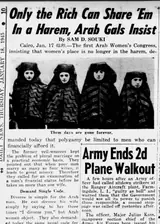
“Only the Rich Can Share ’Em In a Harem, Arab Gals Insist”
A hundred women demand the vote, seats in parliament, one penal code for both sexes and custody of their own children, and cable Roosevelt and Churchill about Palestine. The ladies of the harem demanded the right to vote and run for parliament and to hold public office.
The photograph of four of them is captioned Them days are gone forever.
 CP-1945-012
Forty years on, five Palestinian women were invited to the United Nations Decade for Women conference in Nairobi and refused permits to travel to it. The dispatch names six of them. It is the earliest clipping in this archive to carry the phrase security reasons
, and it already carries it inside quotation marks.
In Gaza in 1993 a reporter found Ayshe Abu Maghaseeb, who was thirty. Through the six years of the first intifada she had commanded an underground cell, stoned and firebombed soldiers, and carried messages from the PLO leadership abroad. She was interrogated by Israeli agents who she says tried to make her talk by threatening rape. Fifty Palestinian women were killed in those six years and about 3,000 were detained. She was wearing a head scarf she says she puts on reluctantly, to avoid being harassed by Muslim militants.
Asked what she expected from self-rule, she did not answer about Palestine. She answered about Algeria, where women fought the French for eight years.
Ayshe Abu Maghaseeb, 30, Gaza City · Wisconsin State Journal, 7 December 1993 · CP-1993-007
She is describing the thing this whole section is a record of, and she is describing it as a risk she can see coming.
Ninety-four years after the motorcade, a wire story about embroidery reaches Birzeit and finds the Surif Women’s Cooperative still going. Its director, Taghrid Hudoosh, is fifty-five, and she is named. We are a continuation of our heritage.
The organizing never stopped. What changed, slowly and not evenly, is whether the paper wrote anybody’s name down.