Corpus Christi Caller-Times · Corpus Christi, Texas · 20 February 1994
CP-1994-014
Palestinian women seek protection against warped moralists
Being raped is just the start; next comes blame, perhaps murder, by the family
By Karin Laub, Associated Press
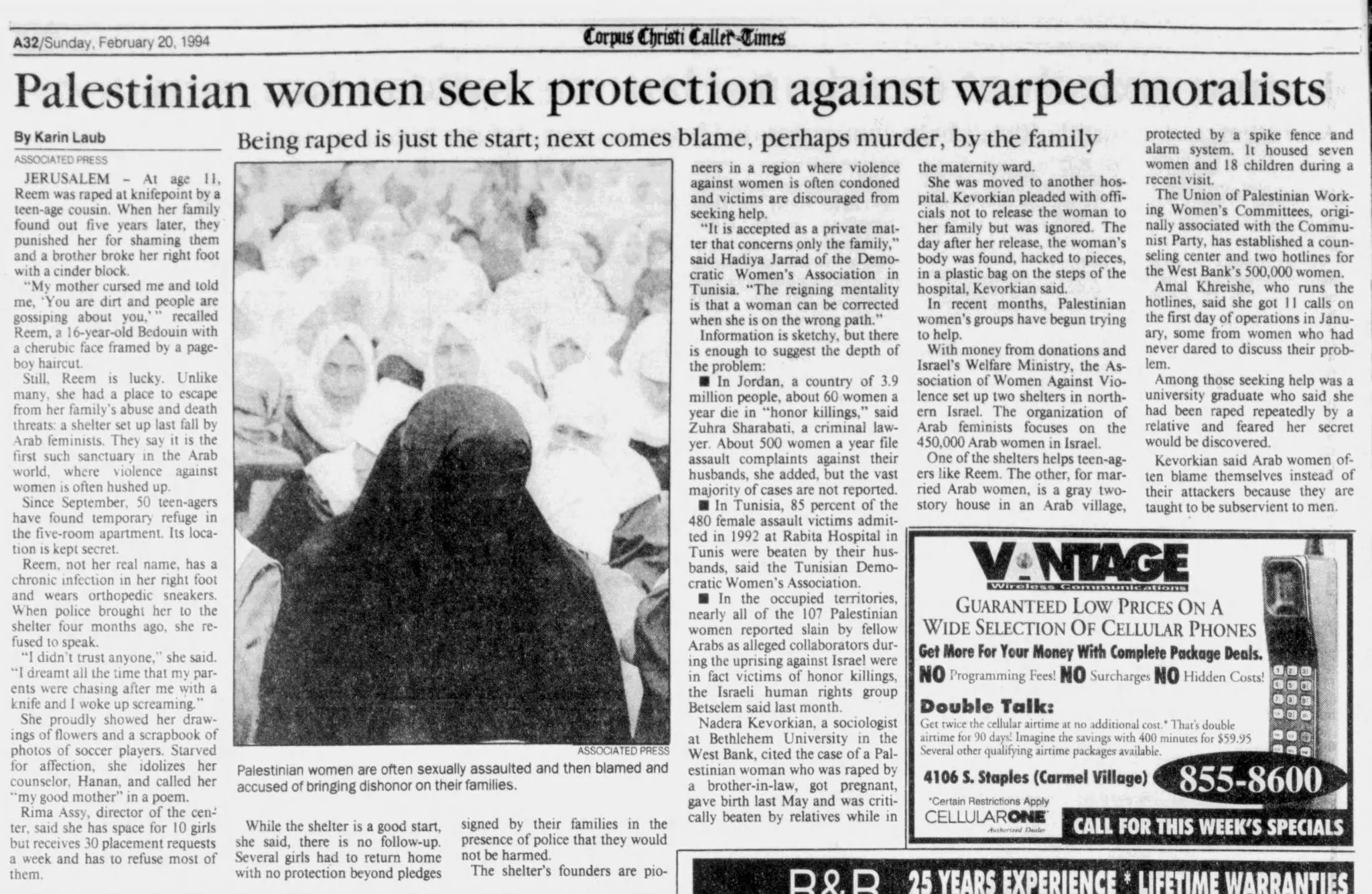
Transcribed from the clipping
JERUSALEM — At age 11, Reem was raped at knifepoint by a teen-age cousin. When her family found out five years later, they punished her for shaming them and a brother broke her right foot with a cinder block.
“My mother cursed me and told me, ‘You are dirt and people are gossiping about you,’” recalled Reem, a 16-year-old Bedouin with a cherubic face framed by a pageboy haircut. Still, Reem is lucky. Unlike many, she had a place to escape from her family's abuse and death threats: a shelter set up last fall by Arab feminists.
They say it is the first such sanctuary in the Arab world, where violence against women is often hushed up. Since September, 50 teen-agers have found temporary refuge in the five-room apartment. Its location is kept secret. Reem, not her real name, has a chronic infection in her right foot and wears orthopedic sneakers.
When police brought her to the shelter four months ago, she refused to speak. “I didn't trust anyone,” she said. “I dreamt all the time that my parents were chasing after me with a knife and I woke up screaming.” She proudly showed her drawings of flowers and a scrapbook of photos of soccer players.
Starved for affection, she idolizes her counselor, Hanan, and called her “my good mother” in a poem. Rima Assy, director of the center, said she has space for 10 girls but receives 30 placement requests a week and has to refuse most of them. While the shelter is a good start, she said, there is no follow-up.
Several girls had to return home with no protection beyond pledges signed by their families in the presence of police that they would not be harmed. The shelter's founders are pioneers in a region where violence against women is often condoned and victims are discouraged from seeking help.
“It is accepted as a private matter that concerns only the family,” said Hadiya Jarrad of the Democratic Women's Association in Tunisia. “The reigning mentality is that a woman can be corrected when she is on the wrong path.”
Information is sketchy, but there is enough to suggest the depth of the problem: ■ In Jordan, a country of 3.9 million people, about 60 women a year die in “honor killings,” said Zuhra Sharabati, a criminal lawyer.
About 500 women a year file assault complaints against their husbands, she added, but the vast majority of cases are not reported. ■ In Tunisia, 85 percent of the 480 female assault victims admitted in 1992 at Rabita Hospital in Tunis were beaten by their husbands, said the Tunisian Democratic Women's Association. ■ In the occupied territories, nearly all of the 107 Palestinian women reported slain by fellow Arabs as alleged collaborators during the uprising against Israel were in fact victims of honor killings, the Israeli human rights group Betselem said last month.
Nadera Kevorkian, a sociologist at Bethlehem University in the West Bank, cited the case of a Palestinian woman who was raped by a brother-in-law, got pregnant, gave birth last May and was critically beaten by relatives while in the maternity ward. She was moved to another hospital. Kevorkian pleaded with officials not to release the woman to her family but was ignored.
The day after her release, the woman's body was found, hacked to pieces, in a plastic bag on the steps of the hospital, Kevorkian said. In recent months, Palestinian women's groups have begun trying to help. With money from donations and Israel's Welfare Ministry, the Association of Women Against Violence set up two shelters in northern Israel.
The organization of Arab feminists focuses on the 450,000 Arab women in Israel. One of the shelters helps teen-agers like Reem. The other, for married Arab women, is a gray two-story house in an Arab village, protected by a spike fence and alarm system. It housed seven women and 18 children during a recent visit.
The Union of Palestinian Working Women's Committees, originally associated with the Communist Party, has established a counseling center and two hotlines for the West Bank's 500,000 women. Amal Khreishe, who runs the hotlines, said she got 11 calls on the first day of operations in January, some from women who had never dared to discuss their problem.
Among those seeking help was a university graduate who said she had been raped repeatedly by a relative and feared her secret would be discovered. Kevorkian said Arab women often blame themselves instead of their attackers because they are taught to be subservient to men.
Context added by this archive
The same dispatch The Monitor ran five days earlier under the headline Palestinian women establish shelters, rape hotlines. This printing is longer by a third, and everything it adds is Palestinian women running things: a sociologist at Bethlehem University, a counselling centre and two hotlines, and the woman who answers them.
Cite this item
"Palestinian women seek protection against warped moralists," Corpus Christi Caller-Times, 20 February 1994. Covering Palestine archive, CP-1994-014. https://coveringpalestine.org/archive/cp-1994-014
More from the 1990s
- Palestinian photographer beaten by Israeli troopsThe Bay City Times · 29 January 1994
- Israelis shoot 12-year-oldSunday Telegraph · 6 February 1994
- Palestinian women establish shelters, rape hotlinesThe Monitor · 15 February 1994
- Political correctness stifles Palestinian artistsThe Record · 2 April 1994
- A Palestinian woman interrupts an Israeli soldier aiming at stone-throwers to request safe passage in the Gaza town of Deir El BalahChicago Tribune · 5 April 1994
- Joyful Gazans anticipate era of peaceThe Philadelphia Inquirer · 5 May 1994
- All 111 clippings from the 1990s →
This record is part of Covering Palestine, an archive of American and Anglophone newspaper clippings about Palestinians, 1799 to 2023. Researched and assembled by Maria Robles.
The clipping belongs to the newspaper that printed it, or to the news agency that supplied the copy. It is reproduced here for research, criticism and commentary. The city is derived from the masthead, not read off the clipping.
Something wrong here, or something you know about this clipping? The archive is still being built and corrections are wanted: maria@rozumstudio.com, quoting CP-1994-014.
See it in the archive reel · Full text of every clipping · Dataset