The New York Times · 24 January 1994
CP-1994-069
To Read All About It, Palestinians Scan the Walls
By CHRIS HEDGES
Transcribed from the clipping
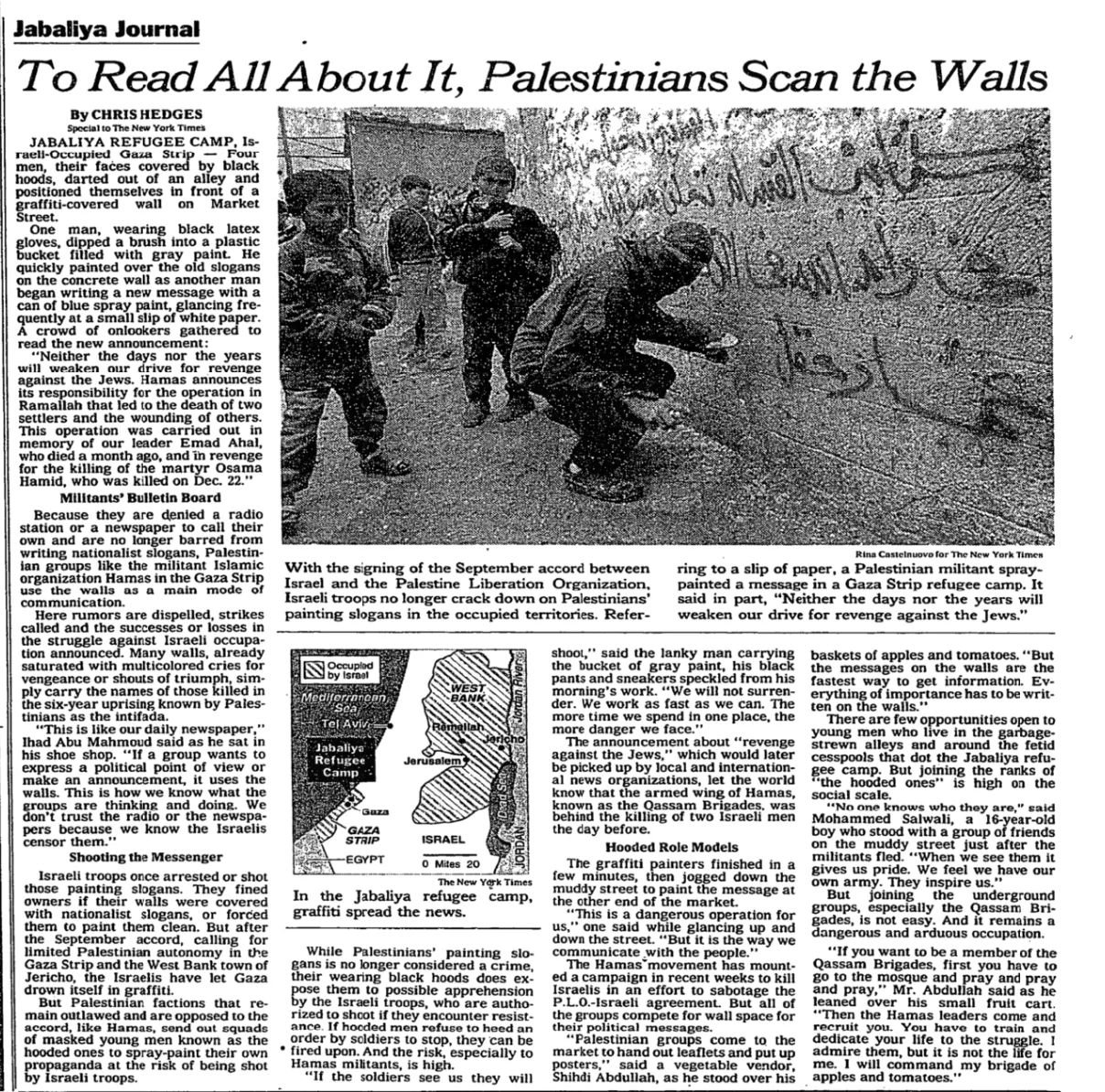
JABALIYA REFUGEE CAMP, Israeli-Occupied Gaza Strip — Four men, their faces covered by black hoods, darted out of an alley and positioned themselves in front of a graffiti-covered wall on Market Street. One man, wearing black latex gloves, dipped a brush into a plastic bucket filled with gray paint.
He quickly painted over the old slogans on the concrete wall as another man began writing a new message with a can of blue spray paint, glancing frequently at a small slip of white paper. A crowd of onlookers gathered to read the new announcement: “Neither the days nor the years will weaken our drive for revenge against the Jews.
Hamas announces its responsibility for the operation in Ramallah that led to the death of two settlers and the wounding of others. This operation was carried out in memory of our leader Emad Ahal, who died a month ago, and in revenge for the killing of the martyr Osama Hamid, who was killed on Dec. 22.”
Militants' Bulletin Board Because they are denied a radio station or a newspaper to call their own and are no longer barred from writing nationalist slogans, Palestinian groups like the militant Islamic organization Hamas in the Gaza Strip use the walls as a main mode of communication.
Here rumors are dispelled, strikes called and the successes or losses in the struggle against Israeli occupation announced. Many walls, already saturated with multicolored cries for vengeance or shouts of triumph, simply carry the names of those killed in the six-year uprising known by Palestinians as the intifada.
“This is like our daily newspaper,” Ihad Abu Mahmoud said as he sat in his shoe shop. “If a group wants to express a political point of view or make an announcement, it uses the walls. This is how we know what the groups are thinking and doing. We don't trust the radio or the newspapers because we know the Israelis censor them.”
Shooting the Messenger Israeli troops once arrested or shot those painting slogans. They fined owners if their walls were covered with nationalist slogans, or forced them to paint them clean. But after the September accord, calling for limited Palestinian autonomy in the Gaza Strip and the West Bank town of Jericho, the Israelis have let Gaza drown itself in graffiti.
But Palestinian factions that remain outlawed and are opposed to the accord, like Hamas, send out squads of masked young men known as the hooded ones to spray-paint their own propaganda at the risk of being shot by Israeli troops.
While Palestinians' painting slogans is no longer considered a crime, their wearing black hoods does expose them to possible apprehension by the Israeli troops, who are authorized to shoot if they encounter resistance. If hooded men refuse to heed an order by soldiers to stop, they can be fired upon. And the risk, especially to Hamas militants, is high.
“If the soldiers see us they will shoot,” said the lanky man carrying the bucket of gray paint, his black pants and sneakers speckled from his morning's work. “We will not surrender. We work as fast as we can. The more time we spend in one place, the more danger we face.”
The announcement about “revenge against the Jews,” which would later be picked up by local and international news organizations, let the world know that the armed wing of Hamas, known as the Qassam Brigades, was behind the killing of two Israeli men the day before.
Hooded Role Models The graffiti painters finished in a few minutes, then jogged down the muddy street to paint the message at the other end of the market. “This is a dangerous operation for us,” one said while glancing up and down the street. “But it is the way we communicate with the people.”
The Hamas movement has mounted a campaign in recent weeks to kill Israelis in an effort to sabotage the P.L.O.-Israeli agreement. But all of the groups compete for wall space for their political messages.
“Palestinian groups come to the market to hand out leaflets and put up posters,” said a vegetable vendor, Shihdi Abdullah, as he stood over his baskets of apples and tomatoes. “But the messages on the walls are the fastest way to get information. Everything of importance has to be written on the walls.”
There are few opportunities open to young men who live in the garbage-strewn alleys and around the fetid cesspools that dot the Jabaliya refugee camp. But joining the ranks of “the hooded ones” is high on the social scale. “No one knows who they are,” said Mohammed Salwali, a 16-year-old boy who stood with a group of friends on the muddy street just after the militants fled.
“When we see them it gives us pride. We feel we have our own army. They inspire us.” But joining the underground groups, especially the Qassam Brigades, is not easy. And it remains a dangerous and arduous occupation. “If you want to be a member of the Qassam Brigades, first you have to go to the mosque and pray and pray and pray,” Mr.
Abdullah said as he leaned over his small fruit cart. “Then the Hamas leaders come and recruit you. You have to train and dedicate your life to the struggle. I admire them, but it is not the life for me. I will command my brigade of apples and tomatoes.”
How this transcription was made
Confirmed three times on the page: 'Special to The New York Times' under the byline, 'Rina Castelnuovo for The New York Times' on the photograph, and 'The New York Times' as the credit on the locator map. — No masthead or printed date on the cut. Internal evidence puts it in January 1994: 'the September accord' between Israel and the P.L.O. (Oslo, Sept. 1993) is already signed, the intifada is 'the six-year uprising' (begun Dec. 1987), and the graffiti names a man 'killed on Dec. 22'. That is consistent with Maria's Jan 24 1994 label, not with the Nov 5 1988 label she wrote first for this slide. — Maria's slide label reads 'New York TImes Nov 5 1988 / New York TImes Jan 24 1994' but the images are in the opposite order: this is s070_1 and it is the 1994 piece. The 1988 piece is s070_2. The same swap appears on slide 54. — The whole article, read at magnification across four columns. The vendor is 'Shihdi Abdullah' on first reference and 'Mr. Abdullah' after; the boy is 'Mohammed Salwali'; the shoe-shop owner is 'Ihad Abu Mahmoud'. All three spellings read clearly at 8x. — Above the headline, ruled off, runs the standing column flag 'Jabaliya Journal' — the Times's Journal series slug. It is a standing head, not a deck, so dek is left empty.
Cite this clipping
"To Read All About It, Palestinians Scan the Walls," The New York Times, 24 January 1994. Covering Palestine archive, CP-1994-069. https://coveringpalestine.org/archive/cp-1994-069
More from The New York Times
- The Maine Colony in PalestineThe New York Times · 12 November 1866
- Jewish Colonization in PalestineThe New York Times · 9 December 1883
- Jewish State in Palestine OpposedThe New York Times · 9 July 1897
- ZIONIST CONGRESS IN BASELThe New York Times · 31 August 1897
- ROME FEARS THE ZIONISTSThe New York Times · 12 September 1897
- PROGRESS OF ZIONISMThe New York Times · 16 December 1901
- 852 more from this paper in the full text →
More from the 1990s
- Gaza life after darkThe Town Talk · 8 January 1994
- Building Peace in Palestinian SchoolsThe New York Times · 9 January 1994
- Medicine in Gaza lags behind IsraelThe Houston Post · 16 January 1994
- Palestinian photographer beaten by Israeli troopsThe Bay City Times · 29 January 1994
- Israelis shoot 12-year-oldSunday Telegraph · 6 February 1994
- Palestinian women establish shelters, rape hotlinesThe Monitor · 15 February 1994
- All 374 clippings from the 1990s →
Last updated 2 November 2026
This record is part of Covering Palestine, an archive of American newspaper clippings about Palestinians, 1724 to 2023. Researched and assembled by Maria Robles.
The clipping belongs to the newspaper that printed it, or to the news agency that supplied the copy. It is reproduced here for research, criticism and commentary. A city here is where the newspaper was published, not where the story came from, and on most records it was taken from the masthead.
Something wrong here, or something you know about this clipping? The archive is still being built and corrections are wanted: maria@rozumstudio.com, quoting CP-1994-069.
Everything printed in 1994 · Printed on this day · See it in the archive reel · Full text of every clipping · Dataset