 What it costs to give birthA checkpoint, a delay, and a birth that came too early · 1993 to 2008
1993 to 2008
What it costs to give birth
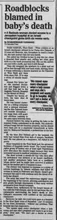
In April 1996 soldiers at an Israeli checkpoint refused to let Fayza Abu Dahouk through on her way to a hospital in Jerusalem. She was 22, from Nabi Samuel, and her baby was born six weeks early and died. A paper in Tucson, Arizona printed her name.
Six clippings here follow what it took for a Palestinian woman to have a child, and they do not all point the same way. Two of them are about the occupation. Two of them are about her own family and her own society. One of them is about both at once, and one is eight words long.
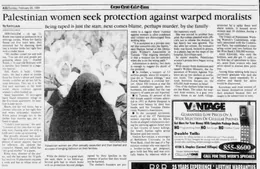
“The center only dispenses contraceptives to women whose husbands consent, and advises that they be used only for spacing between pregnancies, not to limit the number of children. It does not perform sterilizations.”
Mirray Jhniem of the Women’s Resource Center, the main source of contraceptives in the occupied territories, explaining her own clinic’s rules to an American wire reporter. She gives two reasons: the center has to stay clear of Muslim fundamentalists and political activists, and the PLO encourages childbirth to compete demographically with Israel. Palestinian women are being pressed from inside and outside at once, and this is the inside.
 CP-1993-014
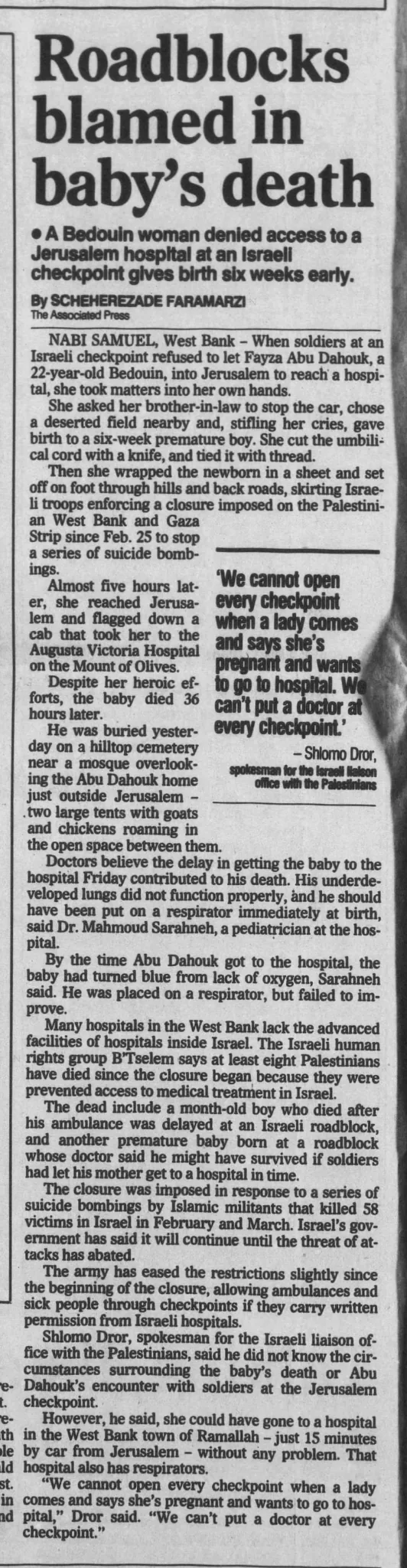
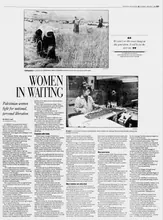
“A Palestinian woman who was raped by a brother-in-law, got pregnant, gave birth last May and was critically beaten by relatives while in the maternity ward.”
Nadera Kevorkian, a sociologist at Bethlehem University, speaking as the first women’s shelter in the Arab world opened. The ward is where the beating happened.
 CP-1994-014
“A Bedouin woman denied access to a Jerusalem hospital at an Israeli checkpoint gives birth six weeks early.”
Fayza Abu Dahouk, 22, of Nabi Samuel. Soldiers at the checkpoint refused to let her through; the baby came six weeks early and died. The headline blames roadblocks, which is more agency than most headlines in this archive assign. She is named, which almost none of them are.
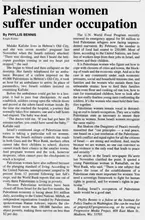
CP-1996-014“Malake Kafishe lives in Hebron’s Old City, and she was seven months’ pregnant last November when the Israeli military attacked.”
A Florida paper, under a headline that says what it is about: Palestinian women suffer under occupation. The specificity is the seven months.
 CP-2001-019
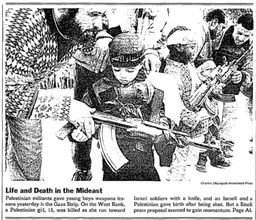
“An Israeli and a Palestinian gave birth after being shot.”
One clause, in a front-page summary box, between a weapons lesson in Gaza and a fifteen-year-old girl killed running at soldiers with a knife. Two women were shot and then gave birth, and they share eight words and no names.
 CP-2002-057
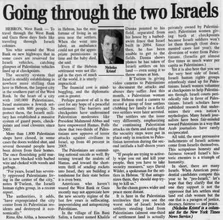
“Palestinian women giving birth at checkpoints because Israeli soldiers won’t let them through (four documented cases last year).”
Twelve years after Tucson printed one of these with a name on it, a traveller’s column from Hebron counts them. The count sits inside a parenthesis, in a list, between a barbed-wire fence built in 2004 and the diversion of water.
 CP-2008-016
Read in order they make an argument that is harder than the one either side usually offers. The checkpoint is real: a named woman lost a baby at one in 1996, and a column counted four more documented cases in a single year twelve years later. The pressure from inside is also real: a clinic that would not give a woman contraceptives without her husband’s signature, a national movement that wanted higher birth rates, and a woman beaten by her own relatives in a maternity ward. The same decade holds all of it.
What the archive does not hold is any evidence for the claim that circulates most: that Palestinian women were sterilized against their will. Nothing here supports it, and the one clipping in this collection that uses the word says the opposite — that the clinic did not perform the procedure at all. The documented reproductive harm in these pages is a checkpoint, a delay, and a birth that came too early.
So when somebody tells you what was done to Palestinian women, the useful question is the same one this archive asks of everything else: which page, which day, whose name. For one of them the answer is Fayza Abu Dahouk, Nabi Samuel, 9 April 1996, the Tucson Citizen.