The Journal Times · Racine, Wisconsin · 23 January 1993
CP-1993-016
Careful sips of freedom
Palestinian women slipping free from old tyrannies—but slowly
Stories and photos by the Associated Press
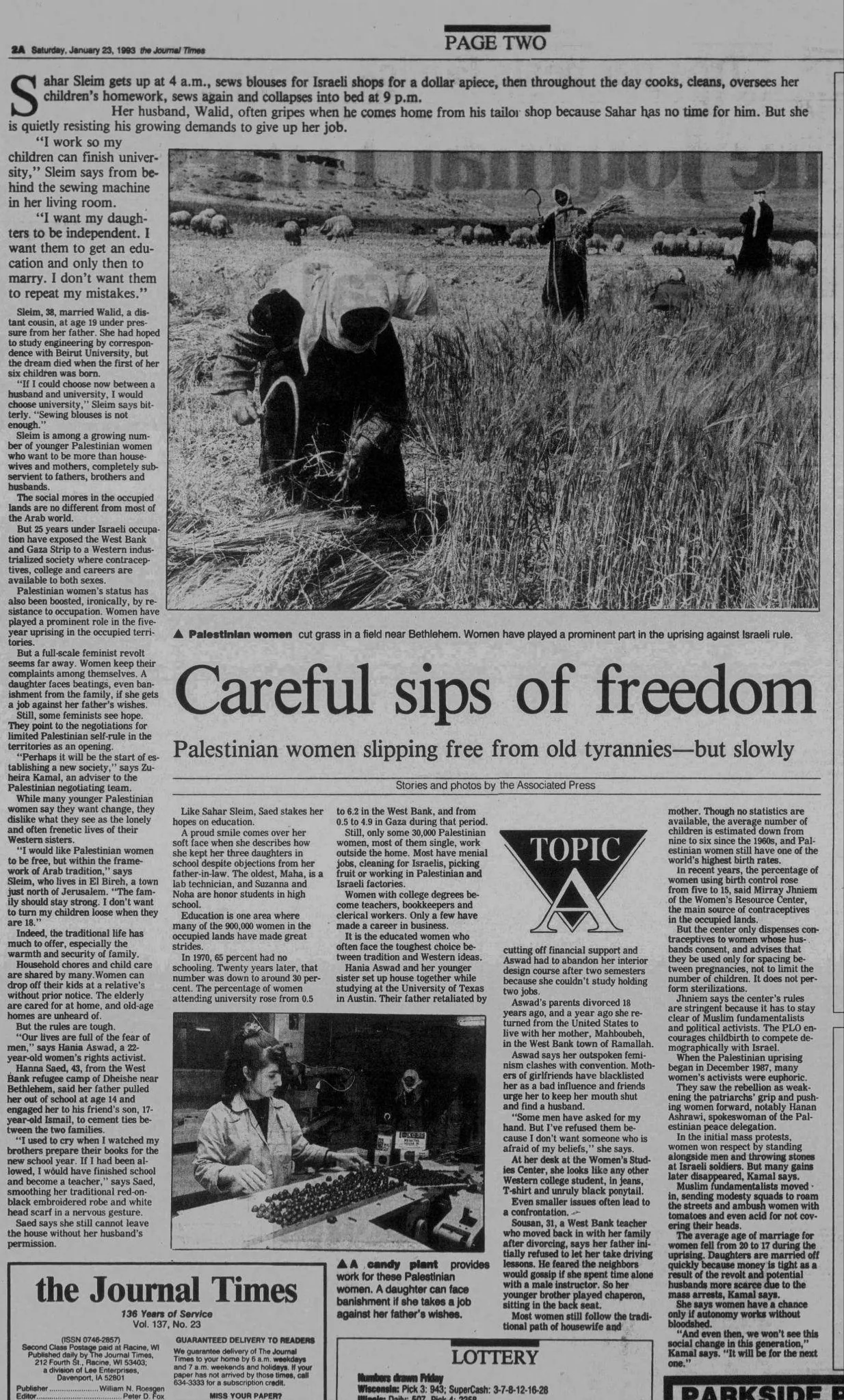
Transcribed from the clipping
Sahar Sleim gets up at 4 a.m., sews blouses for Israeli shops for a dollar apiece, then throughout the day cooks, cleans, oversees her children's homework, sews again and collapses into bed at 9 p.m. Her husband, Walid, often gripes when he comes home from his tailor shop because Sahar has no time for him. But she is quietly resisting his growing demands to give up her job.
“I work so my children can finish university,” Sleim says from behind the sewing machine in her living room. “I want my daughters to be independent. I want them to get an education and only then to marry. I don't want them to repeat my mistakes.” Sleim, 38, married Walid, a distant cousin, at age 19 under pressure from her father.
She had hoped to study engineering by correspondence with Beirut University, but the dream died when the first of her six children was born. “If I could choose now between a husband and university, I would choose university,” Sleim says bitterly. “Sewing blouses is not enough.”
Sleim is among a growing number of younger Palestinian women who want to be more than housewives and mothers, completely subservient to fathers, brothers and husbands. The social mores in the occupied lands are no different from most of the Arab world.
But 25 years under Israeli occupation have exposed the West Bank and Gaza Strip to a Western industrialized society where contraceptives, college and careers are available to both sexes. Palestinian women's status has also been boosted, ironically, by resistance to occupation. Women have played a prominent role in the five-year uprising in the occupied territories.
But a full-scale feminist revolt seems far away. Women keep their complaints among themselves. A daughter faces beatings, even banishment from the family, if she gets a job against her father's wishes. Still, some feminists see hope. They point to the negotiations for limited Palestinian self-rule in the territories as an opening.
“Perhaps it will be the start of establishing a new society,” says Zuheira Kamal, an adviser to the Palestinian negotiating team. While many younger Palestinian women say they want change, they dislike what they see as the lonely and often frenetic lives of their Western sisters.
“I would like Palestinian women to be free, but within the framework of Arab tradition,” says Sleim, who lives in El Bireh, a town just north of Jerusalem. “The family should stay strong. I don't want to turn my children loose when they are 18.” Indeed, the traditional life has much to offer, especially the warmth and security of family.
Household chores and child care are shared by many. Women can drop off their kids at a relative's without prior notice. The elderly are cared for at home, and old-age homes are unheard of. But the rules are tough. “Our lives are full of the fear of men,” says Hania Aswad, a 22-year-old women's rights activist.
Hanna Saed, 43, from the West Bank refugee camp of Dheishe near Bethlehem, said her father pulled her out of school at age 14 and engaged her to his friend's son, 17-year-old Ismail, to cement ties between the two families. “I used to cry when I watched my brothers prepare their books for the new school year.
If I had been allowed, I would have finished school and become a teacher,” says Saed, smoothing her traditional red-on-black embroidered robe and white head scarf in a nervous gesture. Saed says she still cannot leave the house without her husband's permission. Like Sahar Sleim, Saed stakes her hopes on education.
A proud smile comes over her soft face when she describes how she kept her three daughters in school despite objections from her father-in-law. The oldest, Maha, is a lab technician, and Suzanna and Noha are honor students in high school. Education is one area where many of the 900,000 women in the occupied lands have made great strides. In 1970, 65 percent had no schooling.
Twenty years later, that number was down to around 30 percent. The percentage of women attending university rose from 0.5 to 6.2 in the West Bank, and from 0.5 to 4.9 in Gaza during that period. Still, only some 30,000 Palestinian women, most of them single, work outside the home.
Most have menial jobs, cleaning for Israelis, picking fruit or working in Palestinian and Israeli factories. Women with college degrees become teachers, bookkeepers and clerical workers. Only a few have made a career in business. It is the educated women who often face the toughest choice between tradition and Western ideas.
Hania Aswad and her younger sister set up house together while studying at the University of Texas in Austin. Their father retaliated by cutting off financial support and Aswad had to abandon her interior design course after two semesters because she couldn't study holding two jobs.
Aswad's parents divorced 18 years ago, and a year ago she returned from the United States to live with her mother, Mahboubeh, in the West Bank town of Ramallah. Aswad says her outspoken feminism clashes with convention. Mothers of girlfriends have blacklisted her as a bad influence and friends urge her to keep her mouth shut and find a husband.
“Some men have asked for my hand. But I've refused them because I don't want someone who is afraid of my beliefs,” she says. At her desk at the Women's Studies Center, she looks like any other Western college student, in jeans, T-shirt and unruly black ponytail. Even smaller issues often lead to a confrontation.
Sousan, 31, a West Bank teacher who moved back in with her family after divorcing, says her father initially refused to let her take driving lessons. He feared the neighbors would gossip if she spent time alone with a male instructor. So her younger brother played chaperon, sitting in the back seat. Most women still follow the traditional path of housewife and mother.
Though no statistics are available, the average number of children is estimated down from nine to six since the 1960s, and Palestinian women still have one of the world's highest birth rates.
In recent years, the percentage of women using birth control rose from five to 15, said Mirray Jhniem of the Women's Resource Center, the main source of contraceptives in the occupied lands. But the center only dispenses contraceptives to women whose husbands consent, and advises that they be used only for spacing between pregnancies, not to limit the number of children.
It does not perform sterilizations. Jhniem says the center's rules are stringent because it has to stay clear of Muslim fundamentalists and political activists. The PLO encourages childbirth to compete demographically with Israel. When the Palestinian uprising began in December 1987, many women's activists were euphoric.
They saw the rebellion as weakening the patriarchs' grip and pushing women forward, notably Hanan Ashrawi, spokeswoman of the Palestinian peace delegation. In the initial mass protests, women won respect by standing alongside men and throwing stones at Israeli soldiers. But many gains later disappeared, Kamal says.
Muslim fundamentalists moved in, sending modesty squads to roam the streets and ambush women with tomatoes and even acid for not covering their heads. The average age of marriage for women fell from 20 to 17 during the uprising.
Daughters are married off quickly because money is tight as a result of the revolt and potential husbands more scarce due to the mass arrests, Kamal says. She says women have a chance only if autonomy works without bloodshed. “And even then, we won't see this social change in this generation,” Kamal says. “It will be for the next one.”
Context added by this archive
The third printing of this Associated Press dispatch in the archive, run under the standing label TOPIC A. Karin Laub is not credited here. This version alone carries the modesty squads, the acid, Hanan Ashrawi and the line about the PLO encouraging childbirth.
It does not carry the 47 women killed and 3,000 detained by the army, which The Grand Rapids Press printed on 7 January.
Cite this item
"Careful sips of freedom," The Journal Times, 23 January 1993. Covering Palestine archive, CP-1993-016. https://coveringpalestine.org/archive/cp-1993-016
More from the 1990s
- Women in waitingThe Grand Rapids Press · 7 January 1993
- Status of Palestinian women is changing ever so slowlyThe Jonesboro Sun · 10 January 1993
- Situation of Palestinian women slowly changingDaily Chronicle · 24 January 1993
- Israeli soldiers raid wedding partyThe Journal Star · 13 February 1993
- Palestinian woman to perform at OSUAlbany Democrat-Herald · 2 March 1993
- Palestinian women on the brink of changeSarasota Herald-Tribune · 4 April 1993
- All 111 clippings from the 1990s →
This record is part of Covering Palestine, an archive of American and Anglophone newspaper clippings about Palestinians, 1799 to 2023. Researched and assembled by Maria Robles.
The clipping belongs to the newspaper that printed it, or to the news agency that supplied the copy. It is reproduced here for research, criticism and commentary. The city is derived from the masthead, not read off the clipping.
Something wrong here, or something you know about this clipping? The archive is still being built and corrections are wanted: maria@rozumstudio.com, quoting CP-1993-016.
See it in the archive reel · Full text of every clipping · Dataset