Detroit Free Press · Detroit, Michigan · 29 December 1989
CP-1989-016
Palestinian women's fight is largely ignored
By GHADA TALHAMI
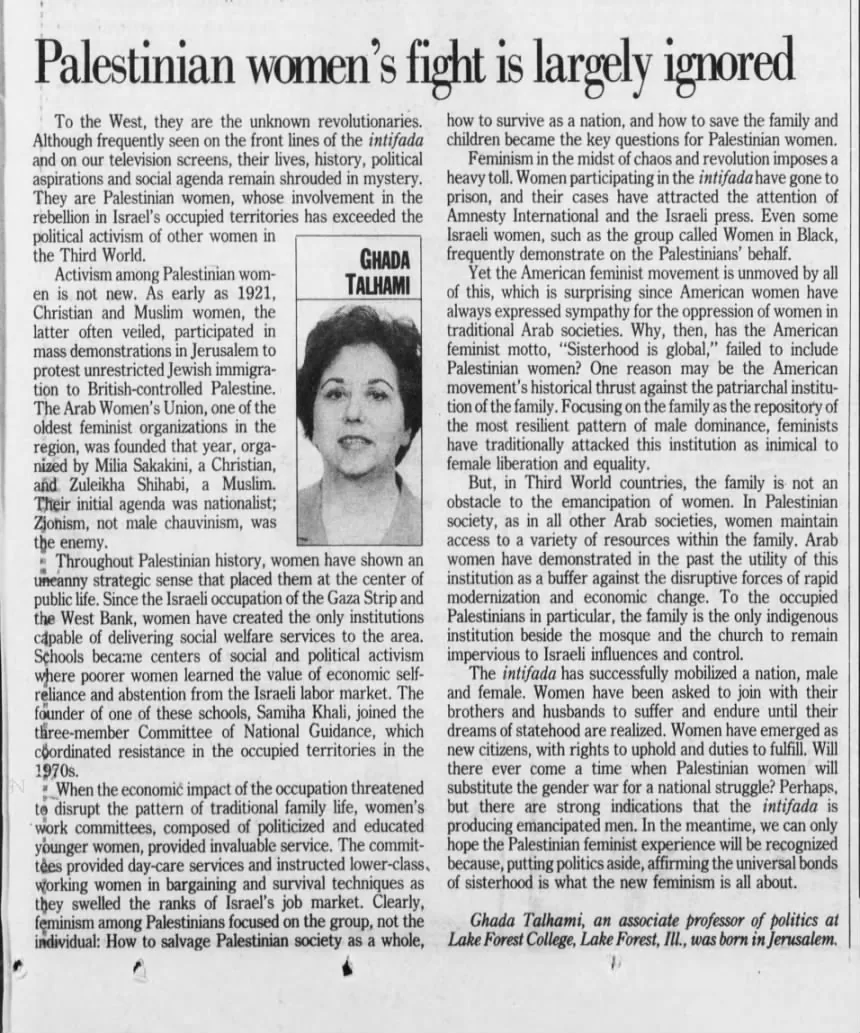
Transcribed from the clipping
To the West, they are the unknown revolutionaries. Although frequently seen on the front lines of the intifada and on our television screens, their lives, history, political aspirations and social agenda remain shrouded in mystery.
They are Palestinian women, whose involvement in the rebellion in Israel's occupied territories has exceeded the political activism of other women in the Third World. Activism among Palestinian women is not new.
As early as 1921, Christian and Muslim women, the latter often veiled, participated in mass demonstrations in Jerusalem to protest unrestricted Jewish immigration to British-controlled Palestine. The Arab Women's Union, one of the oldest feminist organizations in the region, was founded that year, organized by Milia Sakakini, a Christian, and Zuleikha Shihabi, a Muslim.
Their initial agenda was nationalist; Zionism, not male chauvinism, was the enemy. Throughout Palestinian history, women have shown an uncanny strategic sense that placed them at the center of public life. Since the Israeli occupation of the Gaza Strip and the West Bank, women have created the only institutions capable of delivering social welfare services to the area.
Schools became centers of social and political activism where poorer women learned the value of economic self-reliance and abstention from the Israeli labor market. The founder of one of these schools, Samiha Khali, joined the three-member Committee of National Guidance, which coordinated resistance in the occupied territories in the 1970s.
When the economic impact of the occupation threatened to disrupt the pattern of traditional family life, women's work committees, composed of politicized and educated younger women, provided invaluable service.
The committees provided day-care services and instructed lower-class, working women in bargaining and survival techniques as they swelled the ranks of Israel's job market.
Clearly, feminism among Palestinians focused on the group, not the individual: How to salvage Palestinian society as a whole, how to survive as a nation, and how to save the family and children became the key questions for Palestinian women. Feminism in the midst of chaos and revolution imposes a heavy toll.
Women participating in the intifada have gone to prison, and their cases have attracted the attention of Amnesty International and the Israeli press. Even some Israeli women, such as the group called Women in Black, frequently demonstrate on the Palestinians' behalf.
Yet the American feminist movement is unmoved by all of this, which is surprising since American women have always expressed sympathy for the oppression of women in traditional Arab societies. Why, then, has the American feminist motto, “Sisterhood is global,” failed to include Palestinian women?
One reason may be the American movement's historical thrust against the patriarchal institution of the family. Focusing on the family as the repository of the most resilient pattern of male dominance, feminists have traditionally attacked this institution as inimical to female liberation and equality.
But, in Third World countries, the family is not an obstacle to the emancipation of women. In Palestinian society, as in all other Arab societies, women maintain access to a variety of resources within the family. Arab women have demonstrated in the past the utility of this institution as a buffer against the disruptive forces of rapid modernization and economic change.
To the occupied Palestinians in particular, the family is the only indigenous institution beside the mosque and the church to remain impervious to Israeli influences and control. The intifada has successfully mobilized a nation, male and female. Women have been asked to join with their brothers and husbands to suffer and endure until their dreams of statehood are realized.
Women have emerged as new citizens, with rights to uphold and duties to fulfill. Will there ever come a time when Palestinian women will substitute the gender war for a national struggle? Perhaps, but there are strong indications that the intifada is producing emancipated men.
In the meantime, we can only hope the Palestinian feminist experience will be recognized because, putting politics aside, affirming the universal bonds of sisterhood is what the new feminism is all about. Ghada Talhami, an associate professor of politics at Lake Forest College, Lake Forest, Ill., was born in Jerusalem.
Context added by this archive
Signed op-ed. The tagline at the foot reads: Ghada Talhami, an associate professor of politics at Lake Forest College, Lake Forest, Ill., was born in Jerusalem.
Cite this item
"Palestinian women's fight is largely ignored," Detroit Free Press, 29 December 1989. Covering Palestine archive, CP-1989-016. https://coveringpalestine.org/archive/cp-1989-016
More from Detroit Free Press
- I did not speak to a single person - Israeli or Palestinian - who is optimistic about the future. Most feel that the worst is yet to come.Detroit Free Press · 21 June 1988
- Israel's iron fist policy deals a damaging blow to peace hopesDetroit Free Press · 21 June 1988
- A masked Palestinian waves the Israeli-banned PLO flag during a protest in the Gaza StripDetroit Free Press · 21 June 1988
- A solemn anniversary for someDetroit Free Press · 16 May 2005
More from the 1980s
- ArafatThe Times · 18 January 1989
- Israeli officials play down offer from Shamir to withdraw troopsMiami Herald · 3 February 1989
- Shamir offer not newWorcester Telegram · 3 February 1989
- This is what happens to an “occupied,” disarmed peopleThe Union · 24 March 1989
- As many as 7 Palestinians killedFort Worth Star Telegram · 14 April 1989
- Three Palestinians killed, 137 injuredHawaii Tribune Herald · 7 May 1989
- All 171 clippings from the 1980s →
This record is part of Covering Palestine, an archive of American and Anglophone newspaper clippings about Palestinians, 1799 to 2023. Researched and assembled by Maria Robles.
The clipping belongs to the newspaper that printed it, or to the news agency that supplied the copy. It is reproduced here for research, criticism and commentary. The city is derived from the masthead, not read off the clipping.
Something wrong here, or something you know about this clipping? The archive is still being built and corrections are wanted: maria@rozumstudio.com, quoting CP-1989-016.
See it in the archive reel · Full text of every clipping · Dataset