The Plain Dealer · 24 December 1989
CP-1989-046
Tutu will visit town in West Bank today
By Ben Lynfield
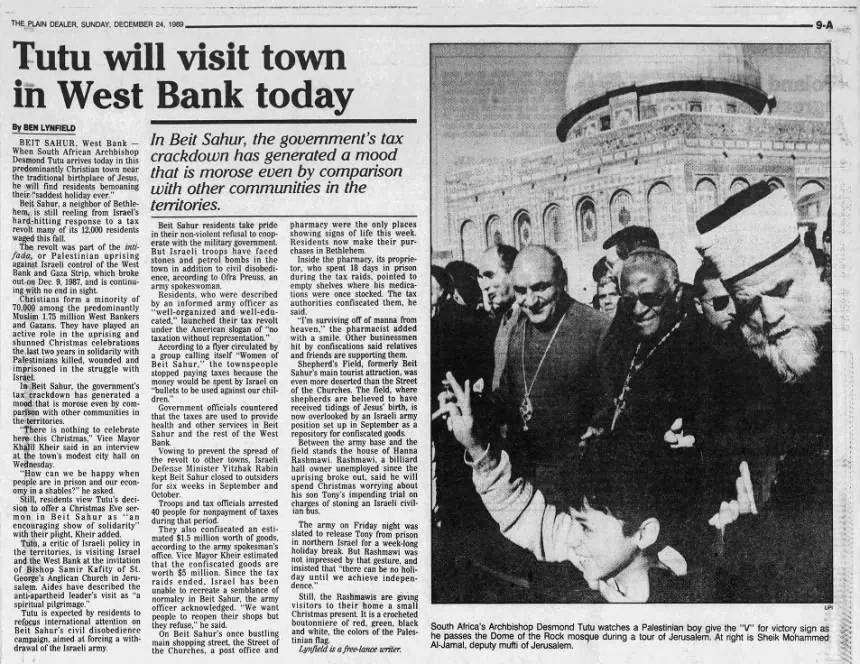
Transcribed from the clipping
BEIT SAHUR, West Bank — When South African Archbishop Desmond Tutu arrives today in this predominantly Christian town near the traditional birthplace of Jesus, he will find residents bemoaning their “saddest holiday ever.”
Beit Sahur, a neighbor of Bethlehem, is still reeling from Israel’s hard-hitting response to a tax revolt many of its 12,000 residents waged this fall. The revolt was part of the intifada, or Palestinian uprising against Israeli control of the West Bank and Gaza Strip, which broke out on Dec. 9, 1987, and is continuing with no end in sight.
Christians form a minority of 70,000 among the predominantly Muslim 1.75 million West Bankers and Gazans. They have played an active role in the uprising and shunned Christmas celebrations the last two years in solidarity with Palestinians killed, wounded and imprisoned in the struggle with Israel.
In Beit Sahur, the government’s tax crackdown has generated a mood that is morose even by comparison with other communities in the territories.
“There is nothing to celebrate here this Christmas,” Vice Mayor Khalil Kheir said in an interview at the town’s modest city hall on Wednesday. […] Still, residents view Tutu’s decision to offer a Christmas Eve sermon in Beit Sahur as “an encouraging show of solidarity” with their plight, Kheir added.
Tutu, a critic of Israeli policy in the territories, is visiting Israel and the West Bank at the invitation of Bishop Samir Kafity of St. George’s Anglican Church in Jerusalem. Aides have described the anti-apartheid leader’s visit as “a spiritual pilgrimage.”
Tutu is expected by residents to refocus international attention on Beit Sahur’s civil disobedience campaign, aimed at forcing a withdrawal of the Israeli army. Beit Sahur residents take pride in their non-violent refusal to cooperate with the military government.
But Israeli troops have faced stones and petrol bombs in the town in addition to civil disobedience, according to Ofra Preuss, an army spokeswoman. Residents, who were described by an informed army officer as “well-organized and well-educated,” launched their tax revolt under the American slogan of “no taxation without representation.”
According to a flyer circulated by a group calling itself “Women of Beit Sahur,” the townspeople stopped paying taxes because the money would be spent by Israel on “bullets to be used against our children.” Government officials countered that the taxes are used to provide health and other services in Beit Sahur and the rest of the West Bank.
Vowing to prevent the spread of the revolt to other towns, Israeli Defense Minister Yitzhak Rabin kept Beit Sahur closed to outsiders for six weeks in September and October. Troops and tax officials arrested 40 people for nonpayment of taxes during that period. They also confiscated an estimated $1.5 million worth of goods, according to the army spokesman’s office.
Vice Mayor Kheir estimated that the confiscated goods are worth $5 million. Since the tax raids ended, Israel has been unable to recreate a semblance of normalcy in Beit Sahur, the army officer acknowledged. “We want people to reopen their shops but they refuse,” he said.
On Beit Sahur’s once bustling main shopping street, the Street of the Churches, a post office and pharmacy were the only places showing signs of life this week. Residents now make their purchases in Bethlehem. Inside the pharmacy, its proprietor, who spent 18 days in prison during the tax raids, pointed to empty shelves where his medications were once stocked.
The tax authorities confiscated them, he said. “I’m surviving off of manna from heaven,” the pharmacist added with a smile. Other businessmen hit by confiscations said relatives and friends are supporting them. Shepherd’s Field, formerly Beit Sahur’s main tourist attraction, was even more deserted than the Street of the Churches.
The field, where shepherds are believed to have received tidings of Jesus’ birth, is now overlooked by an Israeli army position set up in September as a repository for confiscated goods. Between the army base and the field stands the house of Hanna Rashmawi.
Rashmawi, a billiard hall owner unemployed since the uprising broke out, said he will spend Christmas worrying about his son Tony’s impending trial on charges of stoning an Israeli civilian bus. The army on Friday night was slated to release Tony from prison in northern Israel for a week-long holiday break.
But Rashmawi was not impressed by that gesture, and insisted that “there can be no holiday until we achieve independence.” Still, the Rashmawis are giving visitors to their home a small Christmas present. It is a crocheted boutonniere of red, green, black and white, the colors of the Palestinian flag.
How this transcription was made
Transcribed by optical character recognition and read back against the scan by hand. One sentence is held out of the transcription above, marked […]: a second quotation from Vice Mayor Khalil Kheir turns on a word of seven letters that this scan cannot resolve. At 26× and again at 34× the word is about four pixels per letter, with ascenders in the second, fourth and fifth positions — which fits both “shables” and “stables” and rules out “shambles”, which has eight letters and an m. Rather than print a guess as a transcription, the sentence waits for a better image of this page.
Cite this clipping
"Tutu will visit town in West Bank today," The Plain Dealer, 24 December 1989, p. 9-A. Covering Palestine archive, CP-1989-046. https://coveringpalestine.org/archive/cp-1989-046
More from The Plain Dealer
- Arab Women Protest.The Plain Dealer · 28 October 1929
- Rabbi ‘Warns’ U.S. Jews About FundThe Plain Dealer · 23 October 1963
- Israel Integrating Druze AreasThe Plain Dealer · 1969
- Israel bars hunger strike by Arab mayors in GazaThe Plain Dealer · 18 November 1979
- Jordan no Palestine state, Hussein saysThe Plain Dealer · 3 August 1982
- Israeli says he attacked Palestinians for revengeThe Plain Dealer · 5 November 1984
- 9 more from this paper in the full text →
More from the 1980s
- ArafatThe Times · 18 January 1989
- Israeli officials play down offer from Shamir to withdraw troopsThe Miami Herald · 3 February 1989
- Shamir offer not newWorcester Telegram · 3 February 1989
- Israelis Study Devices In Blasts in West BankThe New York Times · 16 February 1989
- Can't rule, absorb, bar or expel PalestiniansSt. Louis Jewish Light · 3 March 1989
- THE AMBIGUOUS YASIR ARAFATThe New York Times · 12 March 1989
- All 527 clippings from the 1980s →
Last updated 2 November 2026
This record is part of Covering Palestine, an archive of American newspaper clippings about Palestinians, 1724 to 2023. Researched and assembled by Maria Robles.
The clipping belongs to the newspaper that printed it, or to the news agency that supplied the copy. It is reproduced here for research, criticism and commentary. A city here is where the newspaper was published, not where the story came from, and on most records it was taken from the masthead.
Something wrong here, or something you know about this clipping? The archive is still being built and corrections are wanted: maria@rozumstudio.com, quoting CP-1989-046.
Everything printed in 1989 · Printed on this day · See it in the archive reel · Full text of every clipping · Dataset