The Daily Astorian · Astoria, Oregon · 21 December 1993
CP-1993-020
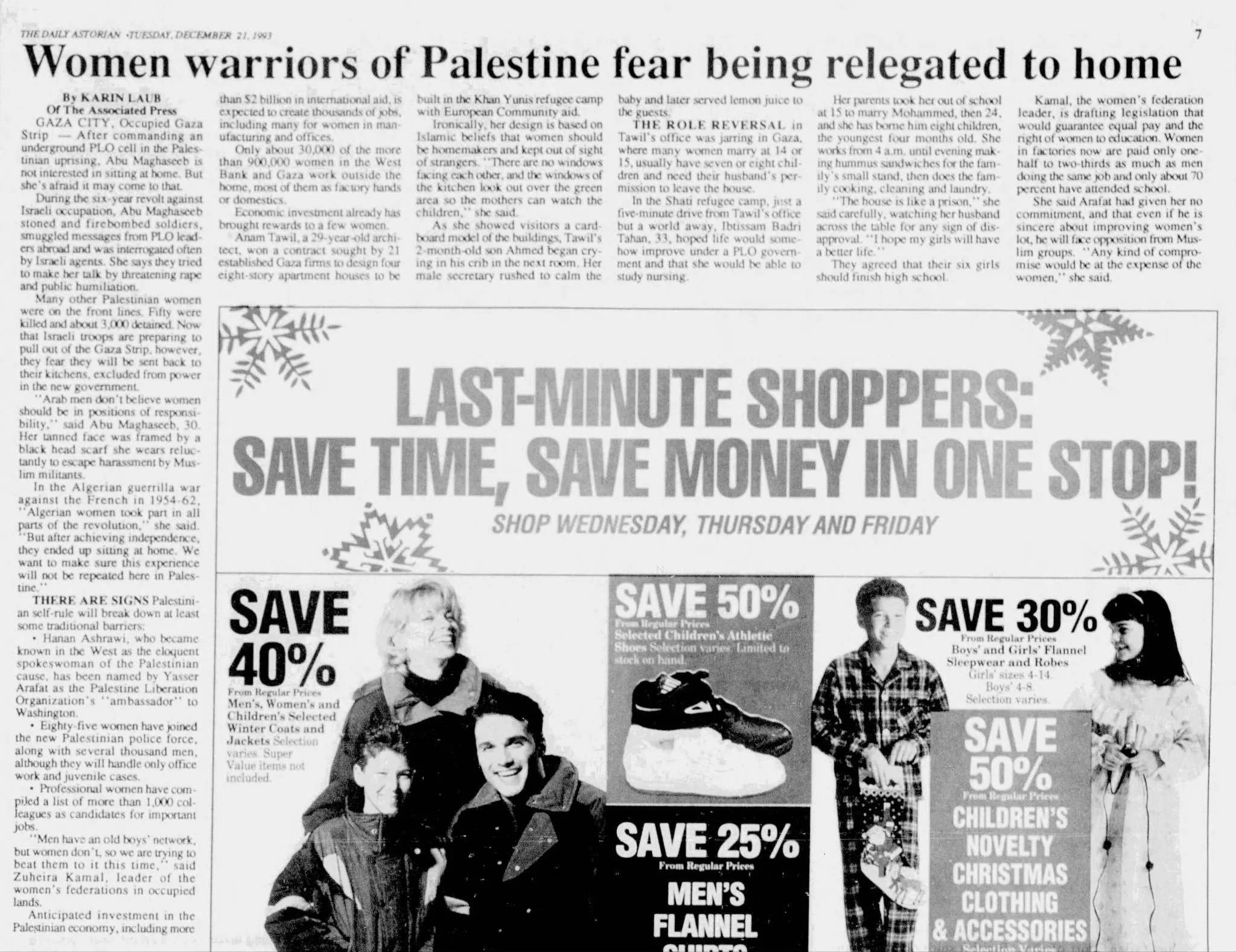
Women warriors of Palestine fear being relegated to home
By KARIN LAUB, Of The Associated Press
Transcribed from the clipping
GAZA CITY, Occupied Gaza Strip — After commanding an underground PLO cell in the Palestinian uprising, Abu Maghaseeb is not interested in sitting at home. But she's afraid it may come to that.
During the six-year revolt against Israeli occupation, Abu Maghaseeb stoned and firebombed soldiers, smuggled messages from PLO leaders abroad and was interrogated often by Israeli agents. She says they tried to make her talk by threatening rape and public humiliation. Many other Palestinian women were on the front lines. Fifty were killed and about 3,000 detained.
Now that Israeli troops are preparing to pull out of the Gaza Strip, however, they fear they will be sent back to their kitchens, excluded from power in the new government. “Arab men don't believe women should be in positions of responsibility,” said Abu Maghaseeb, 30.
Her tanned face was framed by a black head scarf she wears reluctantly to escape harassment by Muslim militants. In the Algerian guerrilla war against the French in 1954-62, “Algerian women took part in all parts of the revolution,” she said. “But after achieving independence, they ended up sitting at home.
We want to make sure this experience will not be repeated here in Palestine.”
THERE ARE SIGNS Palestinian self-rule will break down at least some traditional barriers: • Hanan Ashrawi, who became known in the West as the eloquent spokeswoman of the Palestinian cause, has been named by Yasser Arafat as the Palestine Liberation Organization's “ambassador” to Washington. • Eighty-five women have joined the new Palestinian police force, along with several thousand men, although they will handle only office work and juvenile cases. • Professional women have compiled a list of more than 1,000 colleagues as candidates for important jobs.
“Men have an old boys' network, but women don't, so we are trying to beat them to it this time,” said Zuheira Kamal, leader of the women's federations in occupied lands. Anticipated investment in the Palestinian economy, including more than $2 billion in international aid, is expected to create thousands of jobs, including many for women in manufacturing and offices.
Only about 30,000 of the more than 900,000 women in the West Bank and Gaza work outside the home, most of them as factory hands or domestics. Economic investment already has brought rewards to a few women.
Anam Tawil, a 29-year-old architect, won a contract sought by 21 established Gaza firms to design four eight-story apartment houses to be built in the Khan Yunis refugee camp with European Community aid. Ironically, her design is based on Islamic beliefs that women should be homemakers and kept out of sight of strangers.
“There are no windows facing each other, and the windows of the kitchen look out over the green area so the mothers can watch the children,” she said. As she showed visitors a cardboard model of the buildings, Tawil's 2-month-old son Ahmed began crying in his crib in the next room. Her male secretary rushed to calm the baby and later served lemon juice to the guests.
THE ROLE REVERSAL in Tawil's office was jarring in Gaza, where many women marry at 14 or 15, usually have seven or eight children and need their husband's permission to leave the house.
In the Shati refugee camp, just a five-minute drive from Tawil's office but a world away, Ibtissam Badri Tahan, 33, hoped life would somehow improve under a PLO government and that she would be able to study nursing. Her parents took her out of school at 15 to marry Mohammed, then 24, and she has borne him eight children, the youngest four months old.
She works from 4 a.m. until evening making hummus sandwiches for the family's small stand, then does the family cooking, cleaning and laundry. “The house is like a prison,” she said carefully, watching her husband across the table for any sign of disapproval. “I hope my girls will have a better life.” They agreed that their six girls should finish high school.
Kamal, the women's federation leader, is drafting legislation that would guarantee equal pay and the right of women to education. Women in factories now are paid only one-half to two-thirds as much as men doing the same job and only about 70 percent have attended school.
She said Arafat had given her no commitment, and that even if he is sincere about improving women's lot, he will face opposition from Muslim groups. “Any kind of compromise would be at the expense of the women,” she said.
Context added by this archive
The same dispatch the Wisconsin State Journal ran two weeks earlier under the headline Palestinian women hopeful self-rule will bring greater freedom for them. One headline says hopeful and the other says fear, over the same words. This printing carries the whole dispatch; it runs above a half-page Christmas sale advertisement.
Cite this item
"Women warriors of Palestine fear being relegated to home," The Daily Astorian, 21 December 1993. Covering Palestine archive, CP-1993-020. https://coveringpalestine.org/archive/cp-1993-020
More from the 1990s
- Women in waitingThe Grand Rapids Press · 7 January 1993
- Status of Palestinian women is changing ever so slowlyThe Jonesboro Sun · 10 January 1993
- Careful sips of freedomThe Journal Times · 23 January 1993
- Situation of Palestinian women slowly changingDaily Chronicle · 24 January 1993
- Israeli soldiers raid wedding partyThe Journal Star · 13 February 1993
- Palestinian woman to perform at OSUAlbany Democrat-Herald · 2 March 1993
- All 111 clippings from the 1990s →
This record is part of Covering Palestine, an archive of American and Anglophone newspaper clippings about Palestinians, 1799 to 2023. Researched and assembled by Maria Robles.
The clipping belongs to the newspaper that printed it, or to the news agency that supplied the copy. It is reproduced here for research, criticism and commentary. The city is derived from the masthead, not read off the clipping.
Something wrong here, or something you know about this clipping? The archive is still being built and corrections are wanted: maria@rozumstudio.com, quoting CP-1993-020.
See it in the archive reel · Full text of every clipping · Dataset