Midland Reporter-Telegram · Midland, Texas · 12 February 1997
CP-1997-009
Israel releases 7 Palestinian women prisoners after year of haggling
By Ethan Bronner, The Boston Globe
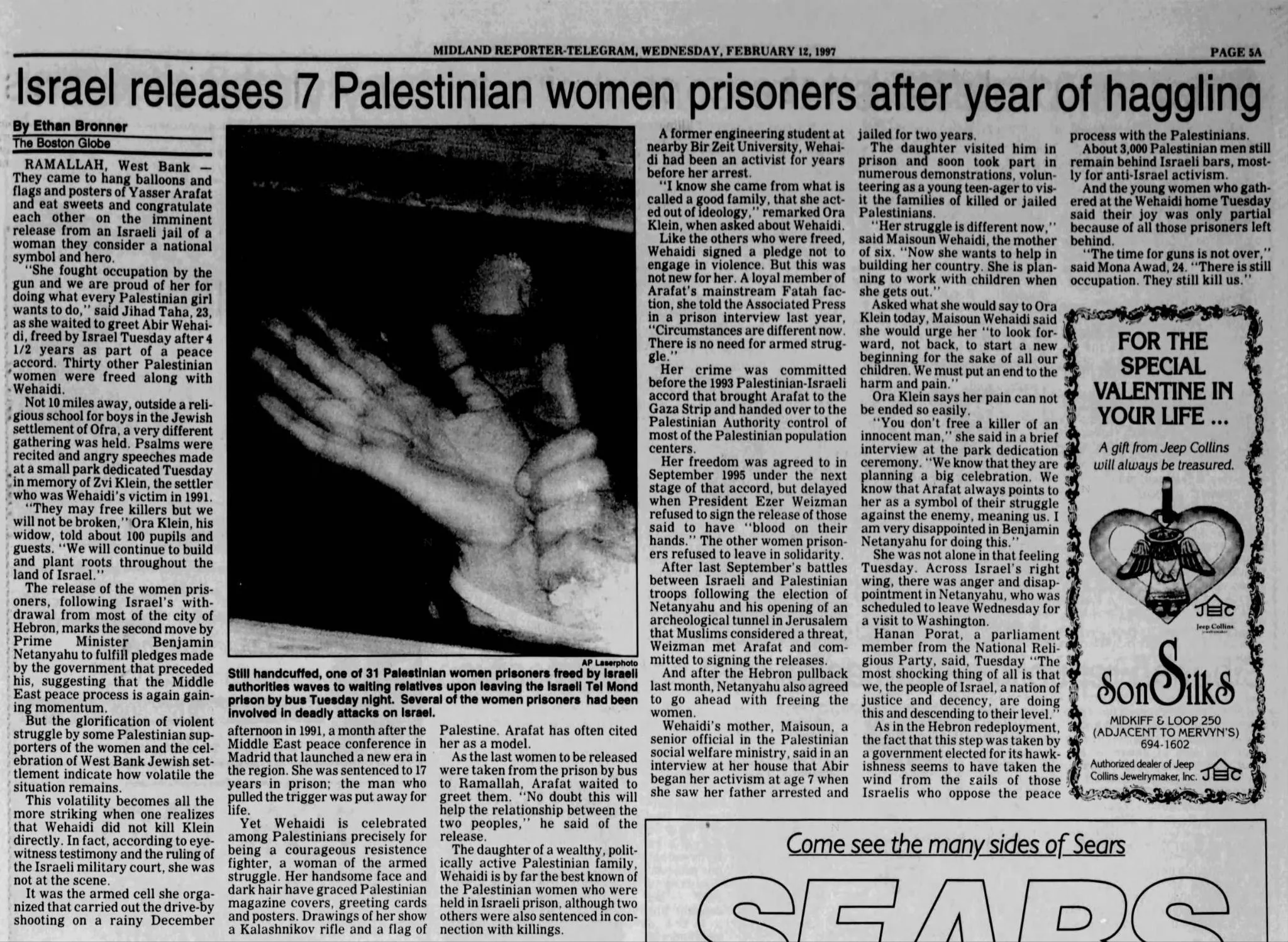
Transcribed from the clipping
RAMALLAH, West Bank — They came to hang balloons and flags and posters of Yasser Arafat and eat sweets and congratulate each other on the imminent release from an Israeli jail of a woman they consider a national symbol and hero.
“She fought occupation by the gun and we are proud of her for doing what every Palestinian girl wants to do,” said Jihad Taha, 23, as she waited to greet Abir Wehaidi, freed by Israel Tuesday after 4 1/2 years as part of a peace accord. Thirty other Palestinian women were freed along with Wehaidi.
Not 10 miles away, outside a religious school for boys in the Jewish settlement of Ofra, a very different gathering was held. Psalms were recited and angry speeches made at a small park dedicated Tuesday in memory of Zvi Klein, the settler who was Wehaidi's victim in 1991.
“They may free killers but we will not be broken,” Ora Klein, his widow, told about 100 pupils and guests. “We will continue to build and plant roots throughout the land of Israel.”
The release of the women prisoners, following Israel's withdrawal from most of the city of Hebron, marks the second move by Prime Minister Benjamin Netanyahu to fulfill pledges made by the government that preceded his, suggesting that the Middle East peace process is again gaining momentum.
But the glorification of violent struggle by some Palestinian supporters of the women and the celebration of West Bank Jewish settlement indicate how volatile the situation remains. This volatility becomes all the more striking when one realizes that Wehaidi did not kill Klein directly.
In fact, according to eyewitness testimony and the ruling of the Israeli military court, she was not at the scene. It was the armed cell she organized that carried out the drive-by shooting on a rainy December afternoon in 1991, a month after the Middle East peace conference in Madrid that launched a new era in the region.
She was sentenced to 17 years in prison; the man who pulled the trigger was put away for life. Yet Wehaidi is celebrated among Palestinians precisely for being a courageous resistence fighter, a woman of the armed struggle. Her handsome face and dark hair have graced Palestinian magazine covers, greeting cards and posters.
Drawings of her show a Kalashnikov rifle and a flag of Palestine. Arafat has often cited her as a model. As the last women to be released were taken from the prison by bus to Ramallah, Arafat waited to greet them. “No doubt this will help the relationship between the two peoples,” he said of the release.
The daughter of a wealthy, politically active Palestinian family, Wehaidi is by far the best known of the Palestinian women who were held in Israeli prison, although two others were also sentenced in connection with killings. A former engineering student at nearby Bir Zeit University, Wehaidi had been an activist for years before her arrest.
“I know she came from what is called a good family, that she acted out of ideology,” remarked Ora Klein, when asked about Wehaidi. Like the others who were freed, Wehaidi signed a pledge not to engage in violence. But this was not new for her.
A loyal member of Arafat's mainstream Fatah faction, she told the Associated Press in a prison interview last year, “Circumstances are different now. There is no need for armed struggle.”
Her crime was committed before the 1993 Palestinian-Israeli accord that brought Arafat to the Gaza Strip and handed over to the Palestinian Authority control of most of the Palestinian population centers.
Her freedom was agreed to in September 1995 under the next stage of that accord, but delayed when President Ezer Weizman refused to sign the release of those said to have “blood on their hands.” The other women prisoners refused to leave in solidarity.
After last September's battles between Israeli and Palestinian troops following the election of Netanyahu and his opening of an archeological tunnel in Jerusalem that Muslims considered a threat, Weizman met Arafat and committed to signing the releases. And after the Hebron pullback last month, Netanyahu also agreed to go ahead with freeing the women.
Wehaidi's mother, Maisoun, a senior official in the Palestinian social welfare ministry, said in an interview at her house that Abir began her activism at age 7 when she saw her father arrested and jailed for two years.
The daughter visited him in prison and soon took part in numerous demonstrations, volunteering as a young teen-ager to visit the families of killed or jailed Palestinians. “Her struggle is different now,” said Maisoun Wehaidi, the mother of six. “Now she wants to help in building her country. She is planning to work with children when she gets out.”
Asked what she would say to Ora Klein today, Maisoun Wehaidi said she would urge her “to look forward, not back, to start a new beginning for the sake of all our children. We must put an end to the harm and pain.” Ora Klein says her pain can not be ended so easily. “You don't free a killer of an innocent man,” she said in a brief interview at the park dedication ceremony.
“We know that they are planning a big celebration. We know that Arafat always points to her as a symbol of their struggle against the enemy, meaning us. I am very disappointed in Benjamin Netanyahu for doing this.” She was not alone in that feeling Tuesday.
Across Israel's right wing, there was anger and disappointment in Netanyahu, who was scheduled to leave Wednesday for a visit to Washington. Hanan Porat, a parliament member from the National Religious Party, said, Tuesday “The most shocking thing of all is that we, the people of Israel, a nation of justice and decency, are doing this and descending to their level.”
As in the Hebron redeployment, the fact that this step was taken by a government elected for its hawkishness seems to have taken the wind from the sails of those Israelis who oppose the peace process with the Palestinians. About 3,000 Palestinian men still remain behind Israeli bars, mostly for anti-Israel activism.
And the young women who gathered at the Wehaidi home Tuesday said their joy was only partial because of all those prisoners left behind. “The time for guns is not over,” said Mona Awad, 24. “There is still occupation. They still kill us.”
Context added by this archive
The headline says seven. The story and the photograph caption both say thirty-one. The discrepancy is logged, not resolved. This story also records what happened to the twenty-one women who refused release in October 1995.
Cite this item
"Israel releases 7 Palestinian women prisoners after year of haggling," Midland Reporter-Telegram, 12 February 1997. Covering Palestine archive, CP-1997-009. https://coveringpalestine.org/archive/cp-1997-009
More from the 1990s
- Israeli soldier shoots into a crowd in Hebron, injuring six PalestiniansThe Baltimore Sun · 2 January 1997
- Arabs celebrate Hebron self-ruleDaily News · 19 January 1997
- Israel: Women to go freeSouth Florida Sun Sentinel · 8 February 1997
- Israeli troops firebombedSouth Florida Sun Sentinel · 3 April 1997
- Israeli soldiers and Palestinian protesters clash at close range in Hebron, West Bank. The clash occurred after the funeral of a Palestinian killed Tuesday.South Florida Sun Sentinel · 10 April 1997
- Murders linked to land sales reopen an ugly chapter in Israeli-Palestinian historyThe Oregonian · 4 June 1997
- All 111 clippings from the 1990s →
This record is part of Covering Palestine, an archive of American and Anglophone newspaper clippings about Palestinians, 1799 to 2023. Researched and assembled by Maria Robles.
The clipping belongs to the newspaper that printed it, or to the news agency that supplied the copy. It is reproduced here for research, criticism and commentary. The city is derived from the masthead, not read off the clipping.
Something wrong here, or something you know about this clipping? The archive is still being built and corrections are wanted: maria@rozumstudio.com, quoting CP-1997-009.
See it in the archive reel · Full text of every clipping · Dataset