The Boston Globe · Boston, MA · 19 January 1997
CP-1997-036
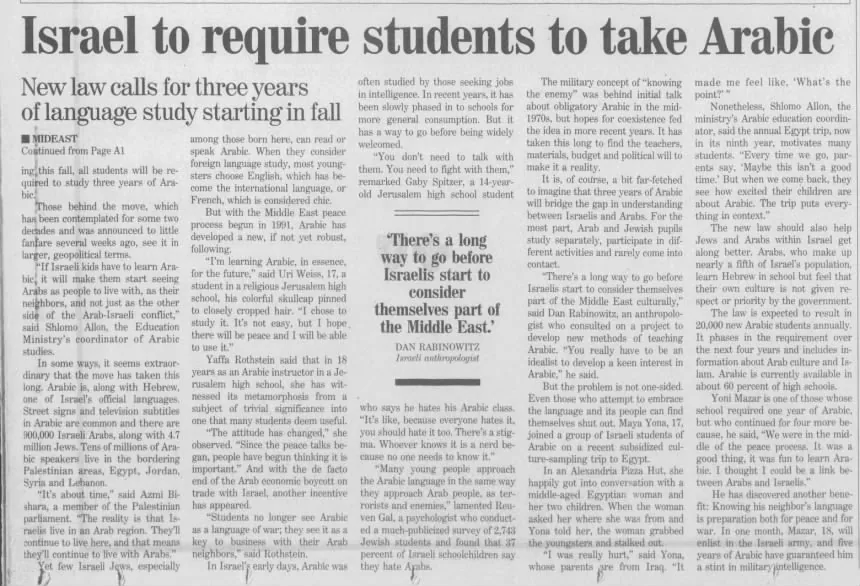
Israel to require students to take Arabic
New law calls for three years of language study starting in fall
Transcribed from the clipping
ing this fall, all students will be required to study three years of Arabic. Those behind the move, which has been contemplated for some two decades and was announced to little fanfare several weeks ago, see it in larger, geopolitical terms.
“If Israeli kids have to learn Arabic, it will make them start seeing Arabs as people to live with, as their neighbors, and not just as the other side of the Arab-Israeli conflict,” said Shlomo Allon, the Education Ministry’s coordinator of Arabic studies. In some ways, it seems extraordinary that the move has taken this long.
Arabic is, along with Hebrew, one of Israel’s official languages. Street signs and television subtitles in Arabic are common and there are 900,000 Israeli Arabs, along with 4.7 million Jews. Tens of millions of Arabic speakers live in the bordering Palestinian areas, Egypt, Jordan, Syria and Lebanon. “It’s about time,” said Azmi Bishara, a member of the Palestinian parliament.
“The reality is that Israelis live in an Arab region. They’ll continue to live here, and that means they’ll continue to live with Arabs.” Yet few Israeli Jews, especially among those born here, can read or speak Arabic. When they consider foreign language study, most youngsters choose English, which has become the international language, or French, which is considered chic.
But with the Middle East peace process begun in 1991, Arabic has developed a new, if not yet robust, following. “I’m learning Arabic, in essence, for the future,” said Uri Weiss, 17, a student in a religious Jerusalem high school, his colorful skullcap pinned to closely cropped hair. “I chose to study it.
It’s not easy, but I hope there will be peace and I will be able to use it.” Yaffa Rothstein said that in 18 years as an Arabic instructor in a Jerusalem high school, she has witnessed its metamorphosis from a subject of trivial significance into one that many students deem useful. “The attitude has changed,” she observed.
“Since the peace talks began, people have begun thinking it is important.” And with the de facto end of the Arab economic boycott on trade with Israel, another incentive has appeared. “Students no longer see Arabic as a language of war; they see it as a key to business with their Arab neighbors,” said Rothstein.
In Israel’s early days, Arabic was often studied by those seeking jobs in intelligence. In recent years, it has been slowly phased in to schools for more general consumption. But it has a way to go before being widely welcomed. “You don’t need to talk with them.
You need to fight with them,” remarked Gaby Spitzer, a 14-year-old Jerusalem high school student who says he hates his Arabic class. “It’s like, because everyone hates it, you should hate it too. There’s a stigma. Whoever knows it is a nerd because no one needs to know it.”
“Many young people approach the Arabic language in the same way they approach Arab people, as terrorists and enemies,” lamented Reuven Gal, a psychologist who conducted a much-publicized survey of 2,743 Jewish students and found that 37 percent of Israeli schoolchildren say they hate Arabs.
How this transcription was made
Date and publication rest on the collector's slide label; no masthead, folio or printed dateline appears on this clipping. Legibility fair; any passage that could not be read is omitted rather than reconstructed.
Context added by this archive
This is the richest terminology clipping in the batch and the clearest single answer to Maria’s question.
“Israeli Arabs” appears exactly once, as a population count — 900,000 of them, set against 4.7 million Jews — and then the article drops the compound entirely and says “Arabs” for the remaining seven uses, including in the sentence where it concedes they are a fifth of the country. The people counted are given one speaker, and the paper files him in the wrong legislature.
Cite this clipping
"Israel to require students to take Arabic," The Boston Globe, 19 January 1997, p. jump page from A1; page number not printed on the clipping. Covering Palestine archive, CP-1997-036. https://coveringpalestine.org/archive/cp-1997-036
More from The Boston Globe
- ON WAR-TRODDEN FIELDSThe Boston Globe · 27 December 1914
- Palestine and Its Problems: Keeping Jews and Arabs ApartThe Boston Globe · 9 August 1935
- 7 Syrians Killed in Rioting Over Palestine PartitionThe Boston Globe · 1 December 1947
- Jaffa Is a Dead CityThe Boston Globe · 14 May 1948
- Palestinian Arabs Ready to Live With Jewish “Cousins”The Boston Globe · 2 October 1948
- On UN resolution branding Zionism as racistThe Boston Globe · 17 November 1975
- 27 more from this paper in the full text →
More from the 1990s
- Israeli soldier shoots into a crowd in Hebron, injuring six PalestiniansThe Baltimore Sun · 2 January 1997
- Arabs celebrate Hebron self-ruleDaily News · 19 January 1997
- Palestinians celebrate in Hebron; settlers stay defiantConcord Monitor · 19 January 1997
- More than 200,000 at Al Aqsa Mosque for RamadanThe Winchester Sun · 1 February 1997
- Israel: Women to go freeSouth Florida Sun Sentinel · 8 February 1997
- Israel Frees 30 Arab Women In Long-Delayed Peace MoveThe New York Times · 12 February 1997
- All 374 clippings from the 1990s →
Last updated 2 November 2026
This record is part of Covering Palestine, an archive of American newspaper clippings about Palestinians, 1724 to 2023. Researched and assembled by Maria Robles.
The clipping belongs to the newspaper that printed it, or to the news agency that supplied the copy. It is reproduced here for research, criticism and commentary. A city here is where the newspaper was published, not where the story came from, and on most records it was taken from the masthead.
Something wrong here, or something you know about this clipping? The archive is still being built and corrections are wanted: maria@rozumstudio.com, quoting CP-1997-036.
Everything printed in 1997 · Printed on this day · See it in the archive reel · Full text of every clipping · Dataset