The Boston Globe · Boston, Massachusetts · 9 August 1935
CP-1935-003
Palestine and Its Problems: Keeping Jews and Arabs Apart
Pierre van Paassen
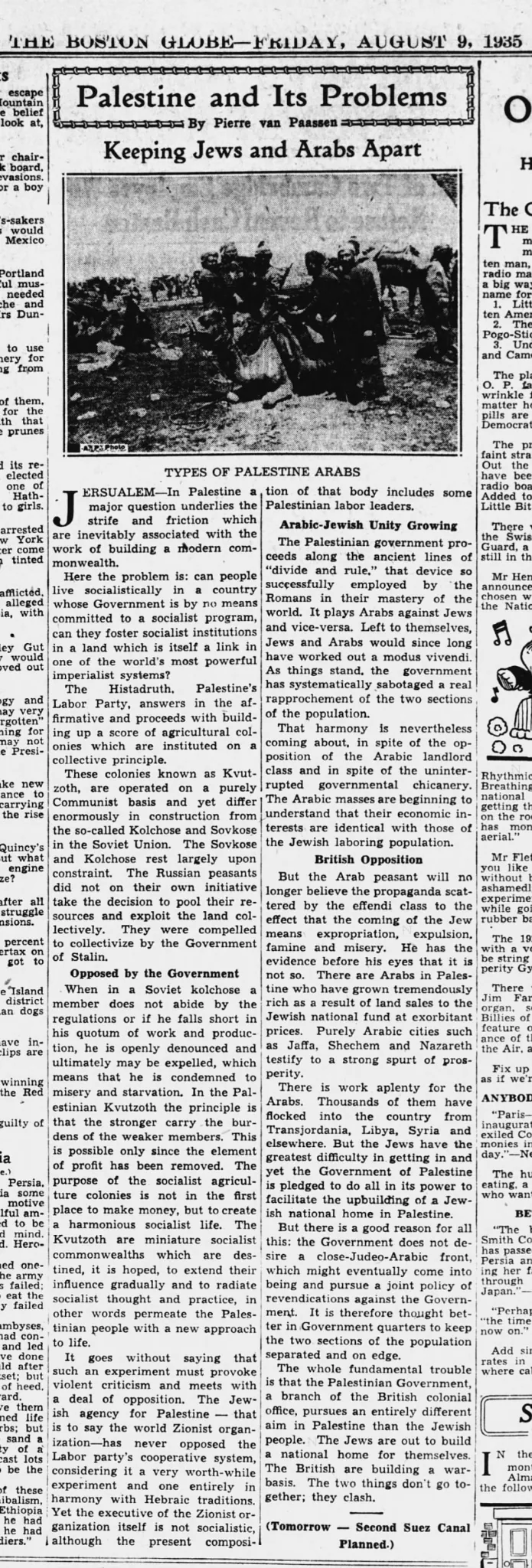
Transcribed from the clipping
JERSUALEM—In Palestine a major question underlies the strife and friction which are inevitably associated with the work of building a modern commonwealth.
Here the problem is: can people live socialistically in a country whose Government is by no means committed to a socialist program, can they foster socialist institutions in a land which is itself a link in one of the world’s most powerful imperialist systems?
The Histadruth, Palestine’s Labor Party, answers in the affirmative and proceeds with building up a score of agricultural colonies which are instituted on a collective principle. These colonies known as Kvutzoth, are operated on a purely Communist basis and yet differ enormously in construction from the so-called Kolchose and Sovkose in the Soviet Union.
The Sovkose and Kolchose rest largely upon constraint. The Russian peasants did not on their own initiative take the decision to pool their resources and exploit the land collectively. They were compelled to collectivize by the Government of Stalin.
When in a Soviet kolchose a member does not abide by the regulations or if he falls short in his quotum of work and production, he is openly denounced and ultimately may be expelled, which means that he is condemned to misery and starvation. In the Palestinian Kvutzoth the principle is that the stronger carry the burdens of the weaker members.
This is possible only since the element of profit has been removed. The purpose of the socialist agriculture colonies is not in the first place to make money, but to create a harmonious socialist life.
The Kvutzoth are miniature socialist commonwealths which are destined, it is hoped, to extend their influence gradually and to radiate socialist thought and practice, in other words permeate the Palestinian people with a new approach to life. It goes without saying that such an experiment must provoke violent criticism and meets with a deal of opposition.
The Jewish agency for Palestine — that is to say the world Zionist organization—has never opposed the Labor party’s cooperative system, considering it a very worth-while experiment and one entirely in harmony with Hebraic traditions.
Yet the executive of the Zionist organization itself is not socialistic, although the present composition of that body includes some Palestinian labor leaders Arabic-Jewish Unity Growing. The Palestinian government proceeds along the ancient lines of “divide and rule,” that device so successfully employed by the Romans in their mastery of the world.
It plays Arabs against Jews and vice-versa. Left to themselves, Jews and Arabs would since long have worked out a modus vivendi. As things stand, the government has systematically sabotaged a real rapprochement of the two sections of the population.
That harmony is nevertheless coming about, in spite of the opposition of the Arabic landlord class and in spite of the uninterrupted governmental chicanery. The Arabic masses are beginning to understand that their economic interests are identical with those of the Jewish laboring population. British Opposition.
But the Arab peasant will no longer believe the propaganda scattered by the effendi class to the effect that the coming of the Jew means expropriation, expulsion, famine and misery. He has the evidence before his eyes that it is not so. There are Arabs in Palestine who have grown tremendously rich as a result of land sales to the Jewish national fund at exorbitant prices.
Purely Arabic cities such as Jaffa, Shechem and Nazareth testify to a strong spurt of prosperity. There is work aplenty for the Arabs. Thousands of them have flocked into the country from Transjordania, Libya, Syria and elsewhere.
But the Jews have the greatest difficulty in getting in and yet the Government of Palestine is pledged to do all in its power to facilitate the upbuilding of a Jewish national home in Palestine.
But there is a good reason for all this: the Government does not desire a close-Judeo-Arabic front, which might eventually come into being and pursue a joint policy of revendications against the Government. It is therefore thought better in Government quarters to keep the two sections of the population separated and on edge.
The whole fundamental trouble is that the Palestinian Government, a branch of the British colonial office, pursues an entirely different aim in Palestine than the Jewish people. The Jews are out to build a national home for themselves. The British are building a war-basis. The two things don’t go together; they clash.”
How this transcription was made
Re-transcribed from the scan on 22 October 2026 after a labor-material pass found the stored text stopping short of what the page prints. The stored text was column one only; column two, restored here, is where the labor argument sits. “Arabic-Jewish Unity Growing” and “British Opposition” are bold subheadings on the page, run into the prose here. Two structural questions are open for Eva: the folio reads THE BOSTON GLOBE, not Boston Evening Globe as filed, and the stored headline welds the standing series flag “Palestine and Its Problems” onto the day’s headline “Keeping Jews and Arabs Apart”. Neither changed here. Filed as Boston Evening Globe until 23 October 2026 and merged into The Boston Globe, the name the folio prints: “THE BOSTON GLOBE—FRIDAY, AUGUST 9, 1935”. The archive had been counting one paper twice.
Cite this clipping
"Palestine and Its Problems: Keeping Jews and Arabs Apart," The Boston Globe, 9 August 1935. Covering Palestine archive, CP-1935-003. https://coveringpalestine.org/archive/cp-1935-003
More from The Boston Globe
- ON WAR-TRODDEN FIELDSThe Boston Globe · 27 December 1914
- 7 Syrians Killed in Rioting Over Palestine PartitionThe Boston Globe · 1 December 1947
- Jaffa Is a Dead CityThe Boston Globe · 14 May 1948
- Palestinian Arabs Ready to Live With Jewish “Cousins”The Boston Globe · 2 October 1948
- On UN resolution branding Zionism as racistThe Boston Globe · 17 November 1975
- The Mideast's other side: What the Palestinians wantThe Boston Globe · 24 July 1977
- 29 more from this paper in the full text →
More from the 1930s
- Jews Told to Ban ArabsThe New York Times · 3 February 1935
- Orange Growers Out to Keep Prices UpBuffalo Jewish Review · 7 June 1935
- The Jews Rebuild Their National Home in PalestineDetroit Free Press · 4 August 1935
- Arabs Would Fuse Near East LandsThe New York Times · 15 September 1935
- Palestine Arabs Protest SmugglingAkron Beacon Journal · 26 October 1935
- General Arab Strike in Palestine Is QuietThe New York Times · 27 October 1935
- All 218 clippings from the 1930s →
Last updated 17 November 2026
This record is part of Covering Palestine, an archive of American newspaper clippings about Palestinians, 1724 to 2023. Researched and assembled by Maria Robles.
The clipping belongs to the newspaper that printed it, or to the news agency that supplied the copy. It is reproduced here for research, criticism and commentary. A city here is where the newspaper was published, not where the story came from, and on most records it was taken from the masthead.
Something wrong here, or something you know about this clipping? The archive is still being built and corrections are wanted: maria@rozumstudio.com, quoting CP-1935-003.
Everything printed in 1935 · Printed on this day · See it in the archive reel · Full text of every clipping · Dataset