The Boston Globe · Boston, Massachusetts · 2 October 1948
CP-1948-044
Palestinian Arabs Ready to Live With Jewish “Cousins”
A Rabbi’s Report
Rabbi Aaron Decter
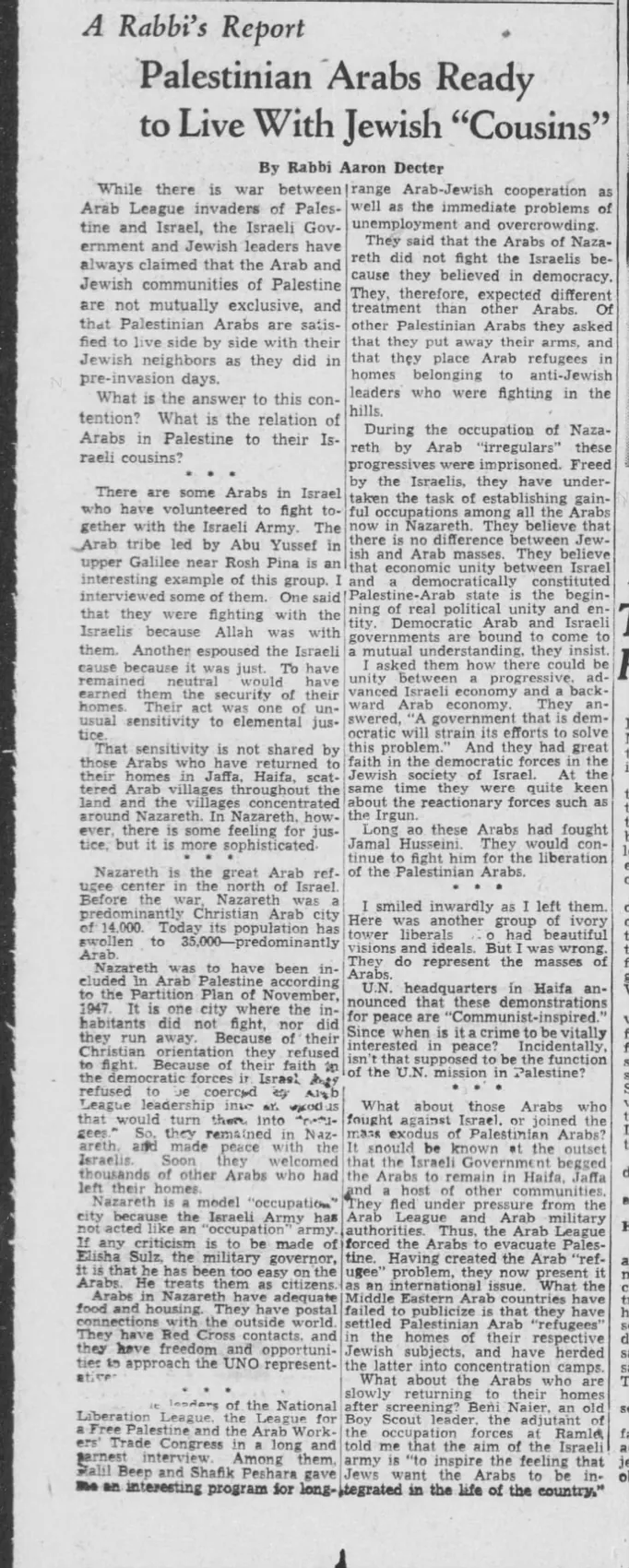
Transcribed from the clipping
“While there is war between Arab League invaders of Palestine and Israel, the Israeli Government and Jewish leaders have always claimed that the Arab and Jewish communities of Palestine are not mutually exclusive, and that Palestinian Arabs are satisfied to live side by side with their Jewish neighbors as they did in pre-invasion days.
What is the answer to this contention? What is the relation of Arabs in Palestine to their Israeli cousins? There are some Arabs in Israel who have volunteered to fight together with the Israeli Army. The Arab tribe led by Abu Yussef in upper Galilee near Rosh Pina is an interesting example of this group. I interviewed some of them.
One said that they were fighting with the Israelis because Allah was with them. Another espoused the Israeli cause because it was just. To have remained neutral would have earned them the security of their homes. Their act was one of unusual sensitivity to elemental justice… Nazareth is the great Arab refugee center in the north of Israel.
Before the war, Nazareth was a predominantly Christian Arab city of 14,000. Today its population has swollen to 35,000 — predominantly Arab. Nazareth was to have been included in Arab Palestine according to the Partition Plan of November, 1947. It is one city where the inhabitants did not fight, nor did they run away.
Because of their Christian orientation they refused to fight. Because of their faith in the democratic forces in Israel they refused to be coerced by Arab League leadership into an exodus that would turn them into refugees. So, they remained in Nazareth, and made peace with the Israelis. Soon they welcomed thousands of other Arabs who had left their homes.
Nazareth is a model ‘occupation’ city because the Israeli Army has not acted like an ‘occupation’ army. If any criticism is to be made of Elisha Sulz, the military governor, it is that he has been too easy on the Arabs. He treats them as citizens. Arabs in Nazareth have adequate food and housing. They have postal connections with the outside world.
They have Red Cross contacts, and they have freedom and opportunities to approach the UNO representatives… leaders of the National Liberation League, the League for a Free Palestine and the Arab Workers’ Trade Congress in a long and earnest interview.
Among them, Walil Beep and Shafik Peshara gave me an interesting program for long-range Arab-Jewish cooperation as well as the immediate problems of unemployment and overcrowding. They said that the Arabs of Nazareth did not fight the Israelis because they believed in democracy. They, therefore, expected different treatment than other Arabs.
Of other Palestinian Arabs they asked that they put away their arms, and that they place Arab refugees in homes belonging to anti-Jewish leaders who were fighting in the hills. During the occupation of Nazareth by Arab ‘irregulars’ these progressives were imprisoned.
Freed by the Israelis, they have undertaken the task of establishing gainful occupations among all the Arabs now in Nazareth. They believe that there is no difference between Jewish and Arab masses.
They believe that economic unity between Israel and a democratically constituted Palestine-Arab state is the beginning of real political unity and entity… I asked them how there could be unity between a progressive, advanced Israeli economy and a backward Arab economy.
They answered, ‘A government that is democratic will strain its efforts to solve this problem.’ And they had great faith in the democratic forces in the Jewish society of Israel. At the same time they were quite keen about the reactionary forces such as the Irgun. Long ago these Arabs had fought Jamal Husseini.
They would continue to fight him for the liberation of the Palestinian Arabs. I smiled inwardly as I left them. Here was another group of ivory tower liberals who had beautiful visions and ideals. But I was wrong. They do represent the masses of Arabs. U.N. headquarters in Haifa announced that these demonstrations for peace are ‘Communist-inspired.’
Since when is it a crime to be vitally interested in peace? Incidentally, isn’t that supposed to be the function of the U.N. mission in Palestine? What about those Arabs who fought against Israel, or joined the mass exodus of Palestinian Arabs?
It should be known at the outset that the Israeli Government begged the Arabs to remain in Haifa, Jaffa and a host of other communities. They fled under pressure from the Arab League and Arab military authorities. Thus, the Arab League forced the Arabs to evacuate Palestine. Having created the Arab ‘refugee’ problem, they now present it as an international issue.
What the Middle Eastern Arab countries have failed to publicize is that they have settled Palestinian Arab ‘refugees’ in the homes of their respective Jewish subjects, and have herded the latter into concentration camps. What about the Arabs who are slowly returning to their homes after screening?
Beni Naier, an old Boy Scout leader, the adjutant of the occupation forces at Ramle, told me that the aim of the Israeli army is ‘to inspire the feeling that Jews want the Arabs to be integrated in the life of the country.’”
How this transcription was made
Filed as Boston Evening Globe until 23 October 2026 and merged into The Boston Globe, the name the folio prints: “THE BOSTON GLOBE—FRIDAY, AUGUST 9, 1935”. The archive had been counting one paper twice.
Context added by this archive
An American rabbi reporting from Israel in 1948, interviewing Palestinian Arabs who stayed and naming them. He argues the Arab League forced the exodus, and in the same column records Nazareth’s people refusing to leave and refusing to fight. The Palestinian trade unionists he meets are quoted at length on a shared Arab-Jewish economy.
Two crops of one article. This page was clipped twice. The second crop was accessioned separately as CP-1948-058 and has since been merged into this record, which is where that number now redirects. It carries four passages this one does not — on Nazareth, on the National Liberation League, and on Arabs who refused to be coerced into leaving.
Neither transcription contains the whole column, so both are kept.
Cite this clipping
"Palestinian Arabs Ready to Live With Jewish “Cousins”," The Boston Globe, 2 October 1948, p. 1. Covering Palestine archive, CP-1948-044. https://coveringpalestine.org/archive/cp-1948-044
This clipping is read closely in the sections below
- The argument that Palestinians’ own leaders caused their expulsion
- When American papers started saying Palestinian
More from The Boston Globe
- ON WAR-TRODDEN FIELDSThe Boston Globe · 27 December 1914
- Palestine and Its Problems: Keeping Jews and Arabs ApartThe Boston Globe · 9 August 1935
- 7 Syrians Killed in Rioting Over Palestine PartitionThe Boston Globe · 1 December 1947
- Jaffa Is a Dead CityThe Boston Globe · 14 May 1948
- On UN resolution branding Zionism as racistThe Boston Globe · 17 November 1975
- The Mideast's other side: What the Palestinians wantThe Boston Globe · 24 July 1977
- 27 more from this paper in the full text →
More from the 1940s
- Jewish Reprisal Raids On Two Arab Villages Take Toll of 8 LivesThe News Journal · 1 January 1948
- Palestine Blasts Rip Arab OfficesThe New York Times · 5 January 1948
- Jews Blow Up Military Post Of Jaffa ArabsMorning Advocate · 5 January 1948
- Ninety Wounded In Truck Blast At HeadquartersThe Beaumont Enterprise · 5 January 1948
- Jews Dynamite HQ of Arabs’ High CommandDaily News · 5 January 1948
- 15 Arabs Die In Jaffa BlastTerre Haute Tribune · 5 January 1948
- All 334 clippings from the 1940s →
In these collections
Last updated 2 November 2026
This record is part of Covering Palestine, an archive of American newspaper clippings about Palestinians, 1724 to 2023. Researched and assembled by Maria Robles.
The clipping belongs to the newspaper that printed it, or to the news agency that supplied the copy. It is reproduced here for research, criticism and commentary. A city here is where the newspaper was published, not where the story came from, and on most records it was taken from the masthead.
Something wrong here, or something you know about this clipping? The archive is still being built and corrections are wanted: maria@rozumstudio.com, quoting CP-1948-044.
Read in: The argument that Palestinians’ own leaders caused their expulsion · When American papers started saying Palestinian
Everything printed in 1948 · Printed on this day · See it in the archive reel · Full text of every clipping · Dataset