Boston Globe · 24 July 1977
CP-1977-015
The Mideast's other side: What the Palestinians want
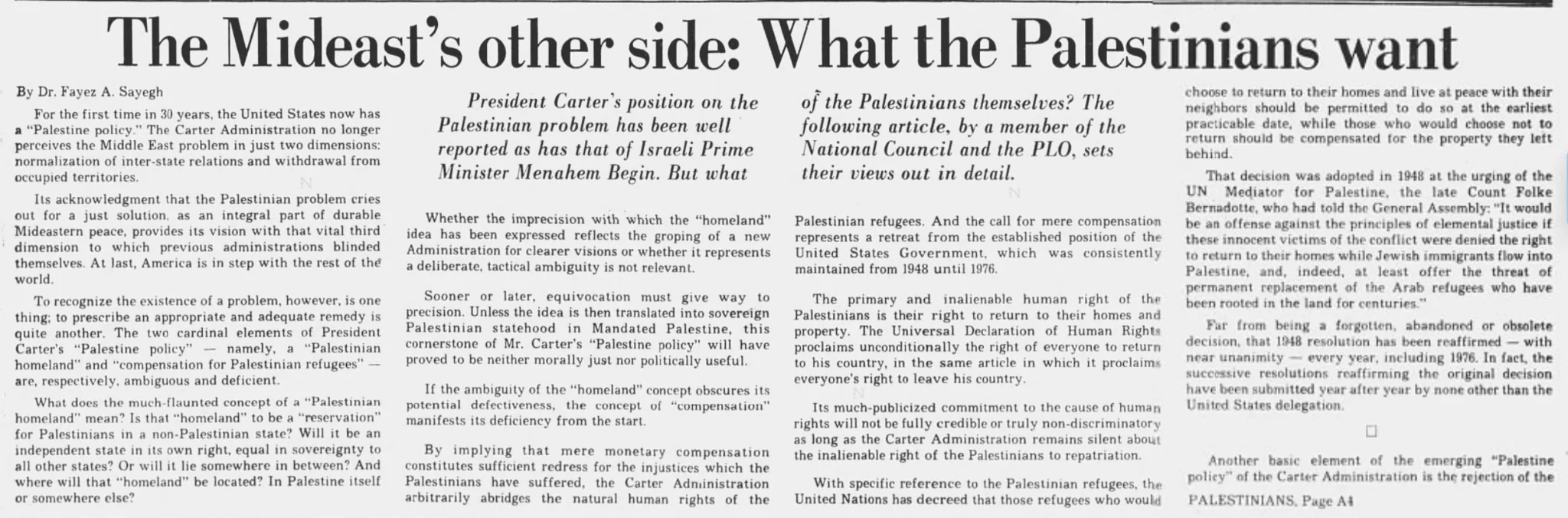
Transcribed from the clipping
The Mideast's other side: What the Palestinians want By Dr. Fayez A. Sayegh For the first time in 30 years, the United States now has a "Palestine policy." The Carter Administration no longer perceives the Middle East problem in just two dimensions: normalization of inter-state relations and withdrawal from occupied territories.
Its acknowledgment that the Palestinian problem cries out for a just solution, as an integral part of durable Mideastern peace, provides its vision with that vital third dimension to which previous administrations blinded themselves. At last, America is in step with the rest of the world.
To recognize the existence of a problem, however, is one thing: to prescribe an appropriate and adequate remedy is quite another. The two cardinal elements of President Carter's "Palestine policy" - namely, a "Palestinian homeland" and "compensation for Palestinian refugees" are, respectively, ambiguous and deficient.
What does the much-flaunted concept of a "Palestinian homeland" mean? Is that "homeland" to be a "reservation" for Palestinians in a non-Palestinian state? Will it be an independent state in its own right, equal in sovereignty to all other states? Or will it lie somewhere in between? And where will that "homeland" be located? In Palestine itself or somewhere else?
President Carter's position on the Palestinian problem has been well reported as has that of Israeli Prime Minister Menahem Begin. But what of the Palestinians themselves?
The choose to return to their homes and live at peace with their neighbors should be permitted to do so at the earliest following article, by a member of the practicable date, while those who would choose not to return should be compensated for the property they lett National Council and the PLO, sets behind. their views out in detail.
That decision was adopted in 1948 at the urging of the UN Mediator for Palestine, the late Count Folke Bernadotte, who had told the General Assembly: "It would Whether the imprecision with which the "homeland" idea has been expressed reflects the groping of a new Administration for clearer visions or whether it represents a deliberate, tactical ambiguity is not relevant.
Sooner or later, equivocation must give way to precision. Unless the idea is then translated into sovereign Palestinian statehood Mandated Palestine. cornerstone of Mr. Carter's "Palestine policy" will have proved to be neither morally just nor politically useful.
If the ambiguity of the "homeland" concept obscures its potential defectiveness, the concept of "compensation" manifests its deficiency from the start.
By implying that mere monetary compensation constitutes sufficient redress for the injustices which the Palestinians have suffered, the Carter Administration arbitrarily abridges the natural human rights of the Palestinian refugees.
And the call for mere compensation represents a retreat from the established position of the United maintained from 1948 until 1976. i Strom Government, which was c which was consistently The primary and inalienable human right of the Palestinians is their right to return to their homes and property.
The Universal Declaration of Human Rights proclaims unconditionally the right of everyone to return to his country, in the same article in which it proclaims everyone's right to leave his country. be an offense against the principles of elemental justice if these innocent victims of the conflict were denied the right to return to their homes while Jewish immigrants flow into Palestine, and, indeed, at least offer the threat of permanent replacement of the Arab refugees who have been rooted in the land for centuries." Far from being a forgotten, abandoned or obsolete decision, that 1948 resolution has been reaffirmed - with near unanimity — every year, including 1976.
In fact, the successive resolutions reaffirming the original decision have been submitted year after year by none other than the Its much-publicized commitment to the cause of human rights will not be fully credible or truly non-discriminatory as long as the Carter Administration remains silent about the inalienable right of the Palestinians to repatriation.
United States delegation. With specific reference to the Palestinian refugees, the United Nations has decreed that those refugees who would Another basic element of the emerging "Palestine poliey" of the Carter Administration is the rejection of the PALESTINIANS, Page At
Cite this item
"The Mideast's other side: What the Palestinians want," Boston Globe, 24 July 1977. Covering Palestine archive, CP-1977-015. https://coveringpalestine.org/archive/cp-1977-015
More from the 1970s
- Under friendly exterior—an ex-terroristChicago Tribune · 18 May 1977
- The PalestiniansThe Miami Herald · 29 May 1977
- The Fragile Right to Be IsraelNewsday · 6 June 1977
- Israeli Expansion Could Prove Too CostlySarasota Herald-Tribune · 6 June 1977
- Israel, PLO In TouchThe News and Advance · 6 June 1977
- West Bank Belongs To Jewish HomelandThe News and Advance · 6 June 1977
- All 129 clippings from the 1970s →
This record is part of Covering Palestine, an archive of American and Anglophone newspaper clippings about Palestinians, 1799 to 2023. Researched and assembled by Maria Robles.
The clipping belongs to the newspaper that printed it, or to the news agency that supplied the copy. It is reproduced here for research, criticism and commentary. The city is derived from the masthead, not read off the clipping.
Something wrong here, or something you know about this clipping? The archive is still being built and corrections are wanted: maria@rozumstudio.com, quoting CP-1977-015.
See it in the archive reel · Full text of every clipping · Dataset