The New York Times · New York, New York · 29 January 1977
CP-1977-029
Beersheba, Once Scorned by Israelis, Is Booming Amid the Desert
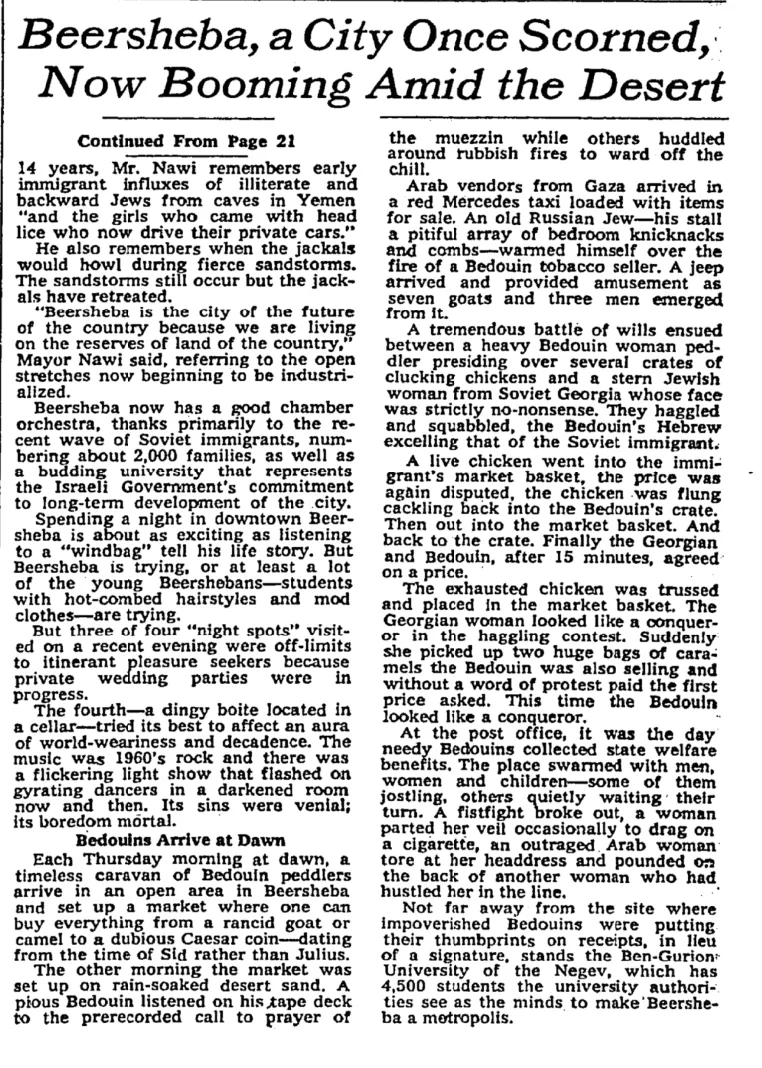
Transcribed from the clipping
Beersheba, Once Scorned by Israelis, Is Booming Amid the Desert By WILLIAM E. FARRELL Special to The New York Times BEERSHEBA, Israel, Jan. 25—Not so many years ago, urbane Israelis liked to put down this now booming town in the Negev Desert in much the way Manhattanites might make snide remarks about Brooklyn or the Bronx.
In those days, Beersheba was regarded as not much more than a sand-encrusted “burg” a traveler stopped in for gasoline or to pacify hunger pangs until he could be seated in a decent restaurant in Tel Aviv. But even then, Beersheba had come a long way from the 4,000-year-old water hole which tradition says was used by the Patriarch Abraham and his sheep.
Concrete was being poured, giant cranes were arching, houses were going up, water was being pumped into homes and kitchens and the city fathers talked ceaselessly of Beersheba as a major factor in the future of the state of Israel. But it was the kind of place some people found it necessary to live in, but hardly anyone wanted to visit.
Today, Beersheba is still not a city that will make esthetes purr with delight. But as a traveler drives along the endless wastes of the Negev it looms like an industrial Oz; it has grown from 1,800 Bedouins in 1947 to 104,000 inhabitants from a staggering number of places—Jews from India, America, Argentina, the Soviet Union, Morocco, Iraq and Egypt, to name just a few.
Varied People Reflect City’s Nature Rather than look at its architecture—it has a few distinguished or at least controversial buildings—a visitor can best understand Beersheba by looking at its varied inhabitants—Bedouins, North African Jews, recent Jewish immigrants from Soviet Georgia.
It is an array that in some way confirms what the city’s early boosters were saying about this vast, uncultivated and often inhospitable desert that holds a key to the country’s future.
“If the state does not put an end to the desert, the desert may put an end to the state,” David Ben-Gurion once said in one of his many exhortations to Israelis to settle the Negev. “It’s a city of newcomers,” said Mayor Eliyahu Nawi, a lawyer capable of making puns and telling jokes in Hebrew, Arabic and English.
“Here we have representatives of all the Jewish Diaspora.” Long a resident and Mayor for nearly Continued on Page 26, Column 5 [PHOTOGRAPH AND MAP CAPTIONS, five of them, set under the pictures across the top of the page, not body text] Booming Beersheba In the Negev [map credit] The New York Times/Jan.
29, 1977 A Soviet immigrant woman buys chicken from Bedouin in marketplace Concrete building of Ben-Gurion University of Negev is nearly completed Yitzhak Ephraim, immigrant from India, in hothouse where he grows roses [credit] The New York Times/Micha Bar-Am Needy Bedouins being assisted at Beersheba’s state welfare office … 14 years, Mr.
Nawi remembers early immigrant influxes of illiterate and backward Jews from caves in Yemen “and the girls who came with head lice who now drive their private cars.” He also remembers when the jackals would howl during fierce sandstorms. The sandstorms still occur but the jackals have retreated.
“Beersheba is the city of the future of the country because we are living on the reserves of land of the country,” Mayor Nawi said, referring to the open stretches now beginning to be industrialized.
Beersheba now has a good chamber orchestra, thanks primarily to the recent wave of Soviet immigrants, numbering about 2,000 families, as well as a budding university that represents the Israeli Government’s commitment to long-term development of the city. Spending a night in downtown Beersheba is about as exciting as listening to a “windbag” tell his life story.
But Beersheba is trying, or at least a lot of the young Beershebans—students with hot-combed hairstyles and mod clothes—are trying. But three of four “night spots” visited on a recent evening were off-limits to itinerant pleasure seekers because private wedding parties were in progress.
The fourth—a dingy boite located in a cellar—tried its best to affect an aura of world-weariness and decadence. The music was 1960’s rock and there was a flickering light show that flashed on gyrating dancers in a darkened room now and then. Its sins were venial; its boredom mortal.
Each Thursday morning at dawn, a timeless caravan of Bedouin peddlers arrive in an open area in Beersheba and set up a market where one can buy everything from a rancid goat or camel to a dubious Caesar coin—dating from the time of Sid rather than Julius.
How this transcription was made
Read from the scan by a machine looking at the image of the page, not by optical character recognition and not by a person. The clipping carries no masthead or date line, so its date and newspaper rest on the record it arrived with, not on anything visible in the scan. The other part of this article was added on 2 November 2026 from a second clipping (m015_1.png). Headline corrected on 2 November 2026 from the opening of the article, which the archive did not hold until now: the record read “Beersheba, a City Once Scorned, Now Booming Amid the Desert”, which is the jump slug, not the headline the paper set.
Context added by this archive
Date check: No masthead, folio line or page date is on this clipping. It is the jump leg of a story: the first line under the headline reads “Continued From Page 21”, and the body begins mid-sentence (“14 years, Mr. Nawi remembers…”).
Nothing on the scan dates it or names the paper, so 1977-01-29 and The New York Times cannot be confirmed from the image.
Cite this clipping
"Beersheba, Once Scorned by Israelis, Is Booming Amid the Desert," The New York Times, 29 January 1977. Covering Palestine archive, CP-1977-029. https://coveringpalestine.org/archive/cp-1977-029
More from The New York Times
- The Maine Colony in PalestineThe New York Times · 12 November 1866
- Jewish Colonization in PalestineThe New York Times · 9 December 1883
- Jewish State in Palestine OpposedThe New York Times · 9 July 1897
- ZIONIST CONGRESS IN BASELThe New York Times · 31 August 1897
- ROME FEARS THE ZIONISTSThe New York Times · 12 September 1897
- PROGRESS OF ZIONISMThe New York Times · 16 December 1901
- 852 more from this paper in the full text →
More from the 1970s
- Thousands Pay Respects To Palestinian LeaderThe New York Times · 9 February 1977
- U.N. Agency Says Israel Tortures and PillagesThe New York Times · 16 February 1977
- Carter Publicly Endorses Palestinian ‘Homeland’Poughkeepsie Journal · 18 March 1977
- Arafat Praises Carter's StandPress of Atlantic City · 18 March 1977
- Jimmy Carter shakes hands with a Palestinian andHouston Chronicle · 20 March 1977
- New Violence on the West Bank Is Feared as Arab-Israeli Tension RisesThe New York Times · 25 March 1977
- All 338 clippings from the 1970s →
Last updated 2 November 2026
This record is part of Covering Palestine, an archive of American newspaper clippings about Palestinians, 1724 to 2023. Researched and assembled by Maria Robles.
The clipping belongs to the newspaper that printed it, or to the news agency that supplied the copy. It is reproduced here for research, criticism and commentary. A city here is where the newspaper was published, not where the story came from, and on most records it was taken from the masthead.
Something wrong here, or something you know about this clipping? The archive is still being built and corrections are wanted: maria@rozumstudio.com, quoting CP-1977-029.
Everything printed in 1977 · Printed on this day · See it in the archive reel · Full text of every clipping · Dataset