The New York Times · 25 March 1977
CP-1977-035
New Violence on the West Bank Is Feared as Arab-Israeli Tension Rises
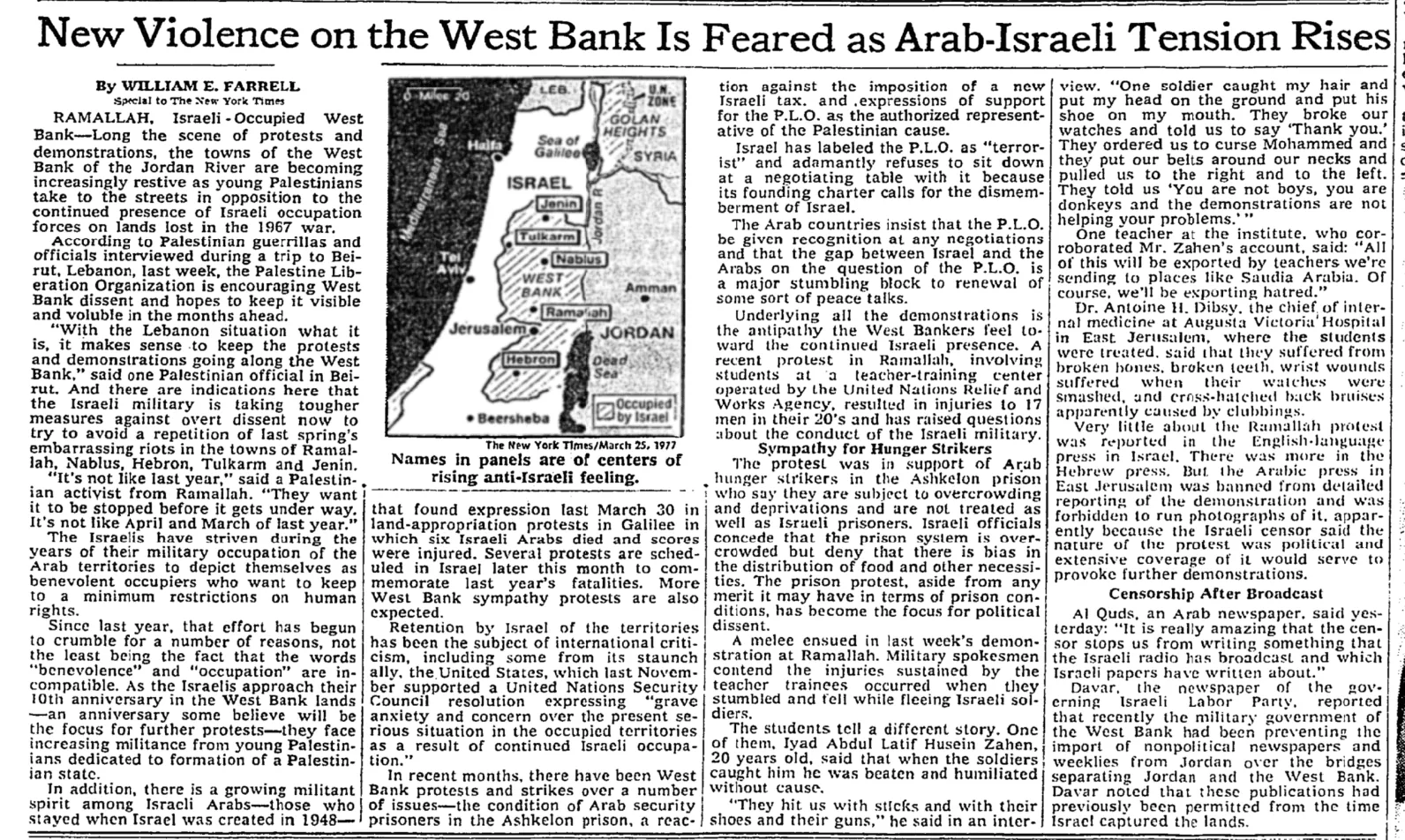
Transcribed from the clipping
RAMALLAH, Israeli-Occupied West Bank—Long the scene of protests and demonstrations, the towns of the West Bank of the Jordan River are becoming increasingly restive as young Palestinians take to the streets in opposition to the continued presence of Israeli occupation forces on lands lost in the 1967 war.
According to Palestinian guerrillas and officials interviewed during a trip to Beirut, Lebanon, last week, the Palestine Liberation Organization is encouraging West Bank dissent and hopes to keep it visible and voluble in the months ahead.
“With the Lebanon situation what it is, it makes sense to keep the protests and demonstrations going along the West Bank,” said one Palestinian official in Beirut.
And there are indications here that the Israeli military is taking tougher measures against overt dissent now to try to avoid a repetition of last spring's embarrassing riots in the towns of Ramallah, Nablus, Hebron, Tulkarm and Jenin. “It's not like last year,” said a Palestinian activist from Ramallah. “They want it to be stopped before it gets under way.
It's not like April and March of last year.” The Israelis have striven during the years of their military occupation of the Arab territories to depict themselves as benevolent occupiers who want to keep to a minimum restrictions on human rights.
Since last year, that effort has begun to crumble for a number of reasons, not the least being the fact that the words “benevolence” and “occupation” are incompatible.
As the Israelis approach their 10th anniversary in the West Bank lands—an anniversary some believe will be the focus for further protests—they face increasing militance from young Palestinians dedicated to formation of a Palestinian state.
In addition, there is a growing militant spirit among Israeli Arabs—those who stayed when Israel was created in 1948—that found expression last March 30 in land-appropriation protests in Galilee in which six Israeli Arabs died and scores were injured. Several protests are scheduled in Israel later this month to commemorate last year's fatalities.
More West Bank sympathy protests are also expected.
Retention by Israel of the territories has been the subject of international criticism, including some from its staunch ally, the United States, which last November supported a United Nations Security Council resolution expressing “grave anxiety and concern over the present serious situation in the occupied territories as a result of continued Israeli occupation.”
In recent months, there have been West Bank protests and strikes over a number of issues—the condition of Arab security prisoners in the Ashkelon prison, a reaction against the imposition of a new Israeli tax, and expressions of support for the P.L.O. as the authorized representative of the Palestinian cause.
Israel has labeled the P.L.O. as “terrorist” and adamantly refuses to sit down at a negotiating table with it because its founding charter calls for the dismemberment of Israel.
The Arab countries insist that the P.L.O. be given recognition at any negotiations and that the gap between Israel and the Arabs on the question of the P.L.O. is a major stumbling block to renewal of some sort of peace talks. Underlying all the demonstrations is the antipathy the West Bankers feel toward the continued Israeli presence.
A recent protest in Ramallah, involving students at a teacher-training center operated by the United Nations Relief and Works Agency, resulted in injuries to 17 men in their 20's and has raised questions about the conduct of the Israeli military.
Sympathy for Hunger Strikers The protest was in support of Arab hunger strikers in the Ashkelon prison who say they are subject to overcrowding and deprivations and are not treated as well as Israeli prisoners. Israeli officials concede that the prison system is overcrowded but deny that there is bias in the distribution of food and other necessities.
The prison protest, aside from any merit it may have in terms of prison conditions, has become the focus for political dissent. A melee ensued in last week's demonstration at Ramallah. Military spokesmen contend the injuries sustained by the teacher trainees occurred when they stumbled and fell while fleeing Israeli soldiers. The students tell a different story.
One of them, Iyad Abdul Latif Husein Zahen, 20 years old, said that when the soldiers caught him he was beaten and humiliated without cause. “They hit us with sticks and with their shoes and their guns,” he said in an interview. “One soldier caught my hair and put my head on the ground and put his shoe on my mouth. They broke our watches and told us to say ‘Thank you.’
They ordered us to curse Mohammed and they put our belts around our necks and pulled us to the right and to the left. They told us ‘You are not boys, you are donkeys and the demonstrations are not helping your problems.’” One teacher at the institute, who corroborated Mr.
Zahen's account, said: “All of this will be exported by teachers we're sending to places like Saudia Arabia. Of course, we'll be exporting hatred.” Dr. Antoine H.
Dibsy, the chief of internal medicine at Augusta Victoria Hospital in East Jerusalem, where the students were treated, said that they suffered from broken bones, broken teeth, wrist wounds suffered when their watches were smashed, and cross-hatched back bruises apparently caused by clubbings.
Very little about the Ramallah protest was reported in the English-language press in Israel. There was more in the Hebrew press.
But the Arabic press in East Jerusalem was banned from detailed reporting of the demonstration and was forbidden to run photographs of it, apparently because the Israeli censor said the nature of the protest was political and extensive coverage of it would serve to provoke further demonstrations.
Censorship After Broadcast Al Quds, an Arab newspaper, said yesterday: “It is really amazing that the censor stops us from writing something that the Israeli radio has broadcast and which Israeli papers have written about.”
Davar, the newspaper of the governing Israeli Labor Party, reported that recently the military government of the West Bank had been preventing the import of nonpolitical newspapers and weeklies from Jordan over the bridges separating Jordan and the West Bank. Davar noted that these publications had previously been permitted from the time Israel captured the lands.
How this transcription was made
Confirmed twice on the page: the credit line under the byline reads "Special to The New York Times", and the map credit reads "The New York Times/March 25, 1977". Definite article in both. — CONFIRMED FROM THE PAGE. The map's credit line prints "The New York Times/March 25, 1977" in full, giving day, month and year. This is the only clipping in batch E whose date I could read off the paper itself rather than infer. It matches Maria's label exactly. — Transcribed from magnified crops of all four columns. Printed as set: "Saudia Arabia" inside the teacher's quotation; "militance" and "militant" in adjacent paragraphs; "17 men in their 20's" with the apostrophe as printed; "labeled". Single quotation marks inside Mr. Zahen's quotation are as printed. — No deck. "Sympathy for Hunger Strikers" and "Censorship After Broadcast" are bold subheads inside the columns.
Cite this clipping
"New Violence on the West Bank Is Feared as Arab-Israeli Tension Rises," The New York Times, 25 March 1977. Covering Palestine archive, CP-1977-035. https://coveringpalestine.org/archive/cp-1977-035
More from The New York Times
- The Maine Colony in PalestineThe New York Times · 12 November 1866
- Jewish Colonization in PalestineThe New York Times · 9 December 1883
- Jewish State in Palestine OpposedThe New York Times · 9 July 1897
- ZIONIST CONGRESS IN BASELThe New York Times · 31 August 1897
- ROME FEARS THE ZIONISTSThe New York Times · 12 September 1897
- PROGRESS OF ZIONISMThe New York Times · 16 December 1901
- 852 more from this paper in the full text →
More from the 1970s
- Beersheba, Once Scorned by Israelis, Is Booming Amid the DesertThe New York Times · 29 January 1977
- Thousands Pay Respects To Palestinian LeaderThe New York Times · 9 February 1977
- U.N. Agency Says Israel Tortures and PillagesThe New York Times · 16 February 1977
- Carter Publicly Endorses Palestinian ‘Homeland’Poughkeepsie Journal · 18 March 1977
- Arafat Praises Carter's StandPress of Atlantic City · 18 March 1977
- Jimmy Carter shakes hands with a Palestinian andHouston Chronicle · 20 March 1977
- All 338 clippings from the 1970s →
Last updated 2 November 2026
This record is part of Covering Palestine, an archive of American newspaper clippings about Palestinians, 1724 to 2023. Researched and assembled by Maria Robles.
The clipping belongs to the newspaper that printed it, or to the news agency that supplied the copy. It is reproduced here for research, criticism and commentary. A city here is where the newspaper was published, not where the story came from, and on most records it was taken from the masthead.
Something wrong here, or something you know about this clipping? The archive is still being built and corrections are wanted: maria@rozumstudio.com, quoting CP-1977-035.
Everything printed in 1977 · Printed on this day · See it in the archive reel · Full text of every clipping · Dataset