 When American papers started saying PalestinianThe word in a headline, 1924 · 1890 to 2010
A word for the people
When American papers started saying Palestinian
The colonization chart tracks a word for the land. This one tracks the word for the people, and it moves the other way: absent for decades, then standard.
In the 1930s these papers covered Palestine constantly. Sixteen of the thirty-seven clippings from that decade put Arab in the headline. None puts Palestinian. The lines cross between the 1970s and the 1980s, and after 2000 the older word nearly disappears: three headlines out of one hundred and eighty.
The chart for this section is drawn on the site →
Share of each decade’s clippings whose headline or subheading uses the word. Before about 1930, “Palestinian” in these papers usually just meant of Palestine and was applied to Jewish residents too, so the left end of the blue line is not national identity.
Before 1964, in their own sentences
The Palestine Liberation Organization was founded in 1964, which is the date usually given for when the word acquired its present meaning. This archive holds seventy clippings older than that which use it. Seven of them say plainly who is meant.
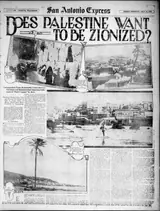
“Before the ‘menace’ of Zionism, Moslems and Christians alike are united… They are no longer enemies. They are Palestinians.”
San Antonio Express, under the headline Does Palestine Want To Be Zionized? The correspondent, Clair Price, does not use the word loosely: he defines it in the sentence before. The same dispatch ran in the Deseret News the previous morning and in the Buffalo Courier Express the same day, so the two entries below are the same piece of writing arriving in three cities.
 CP-1919-010
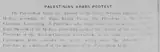
“Resentment of Jewish Colonization by Natives Whose Demand Is ‘Palestine For Palestinians’ — Moslems and Christians For Once United.”
Deseret News, Salt Lake City. The subheading names the people, their demand and the two faiths making it together. The same dispatch: “None knows this better than the Palestinians themselves.”
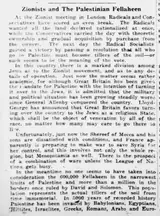
“Zionists and the Palestinian Fellaheen.”
The Philadelphia Inquirer, in a headline. Fellaheen is the Arabic for peasant farmers, so the phrase cannot be describing Jewish residents.
 CP-1920-002
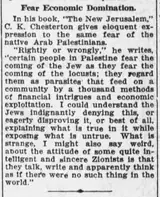
“the same fear of the native Arab Palestinians”
Brooklyn Eagle, on Chesterton. Three words doing the work of a definition.
 CP-1926-001
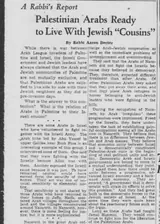
“Palestinian Arabs Ready to Live With Jewish ‘Cousins’.”
Boston Evening Globe, reporting a rabbi’s account. The compound distinguishes them from the other people in the sentence.
 CP-1948-044
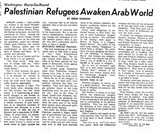
“Palestinian Refugees Awaken Arab World.”
Freeport Journal-Standard, Illinois, carrying the Washington Merry-Go-Round column. Seven years before the PLO, in a small Midwestern daily, as ordinary syndicated copy.
 CP-1957-009
“Plight Of The Palestinian.”
Odessa American, Texas. The definite article and the singular: a kind of person, assumed known to the reader.
 CP-1959-002
Checked against the Library of Congress
Everything above is a count of the clippings collected here, which were found by searching, which means they can only show what searching found. So the same question was put to Chronicling America, the Library of Congress’s collection of scanned American newspapers: millions of pages, assembled by librarians for no purpose connected to this.
Counting only pages that also mention Palestine.
| Phrase | Pages | Heaviest decade |
|---|---|---|
| “Palestinian Jews” | 272 | 1940s |
| “Palestinian Arabs” | 78 | 1950s |
| “Palestine for the Palestinians” | 31 | 1920s |
| “Jewish Palestinians” | 26 | 1920s |
| “Palestinian citizenship” | 25 | 1920s |
| “Palestine Arab delegation” | 22 | 1920s |
| “Palestine Arab Congress” | 16 | 1920s |
| “Palestinian people” | 14 | 1920s |
American papers used this word for Jewish residents more often than for Arab ones, by roughly three and a half to one. That is the opposite of a convenient finding and it is the main thing that collection says.
What it also says is that the Arab-referent use is not a late arrival. Palestine for the Palestinians is a political slogan about Arab self-rule, and twenty-four of its thirty-one pages fall in the 1910s and 1920s. The Palestine Arab Congress, a body that first met in 1919, is named on sixteen pages. So is a Palestine Arab delegation. So is the Palestinian people, ten times in the 1920s alone.
Both meanings were in circulation for decades, and the one that survived was not the more common one. The claim this actually settles is narrow: the word was in American newspapers, attached to Arab political demands, forty years before the Palestine Liberation Organization was founded in 1964.
And the ones that do not count. Several early uses here are the plain geographic sense and are no evidence of anything: a 1902 New York Times reference to the Palestinian Kingdom means the ancient one; a 1920 American Israelite headline about Palestinian Restoration means the Zionist project; a 1946 New Jersey paper calls a Jewish resident of Mandate Palestine a Former Palestinian Native.
The same pattern, in the Library of Congress’s own newspaper collection
The same shape appears in the Library of Congress
Chronicling America holds millions of American newspaper pages, digitized by librarians for reasons unconnected to any of this. Searched for “Jewish colony” and “Jewish settlement” on pages that also mention Palestine, per 10,000 such pages:
| decade | “Jewish colony” | “Jewish settlement” |
|---|---|---|
| 1890s | 9.5 | 5.5 |
| 1900s | 21.8 | 11.1 |
| 1910s | 22.2 | 20.4 |
| 1920s | 44.2 | 61.4 |
| 1930s | 21.5 | 51.3 |
| 1940s | 17.9 | 130.2 |
| 1950s | 1.7 | 31.5 |
Colony leads two to one in the 1900s. They run level in the 1910s. Settlement passes it in the 1920s and by the 1940s wins seven to one.
Across 263,128 pages mentioning Palestine between 1890 and 1959, Arab outruns Palestinian in every decade: fourteen to one in the 1930s, thirty-four to one in the 1950s.
Chronicling America stops around 1963, so it cannot test what came after.
A people can be written about for forty years without being named as themselves. That is what the left half of this chart is. The right half is not a correction anyone apologized for; the word simply became usable, around the time there was a political movement making it impossible to avoid.