The Santa Fe New Mexican · Santa Fe, New Mexico · 10 September 2023
CP-2023-074
Palestinian threads of identity
Recognized by UNESCO in 2021, culture’s traditional embroidery, a symbol of national pride, faces challenges in a modern world
Raja Abdulrahim, The New York Times, Birzeit
Transcribed from the clipping
“BIRZEIT, West Bank — In every stitch, there is a story. Like layers of history, the hand-stitched Palestinian embroidery known as tatreez, traditionally used to ornament Palestinian dress, tells of towns and villages lost, old customs abandoned, past lives and survival. The stitched designs and symbols once functioned almost as an identification card. The rooster, an old Christian symbol, indicated the wearer’s faith. A red bird on a blue-threaded robe worn by widows meant the woman was ready to remarry. An image of a particular plant or fruit suggested the garment’s origin, such as orange blossoms adorning robes from Jaffa or cypress trees on those from Hebron. ‘Every town’s embroidery has a special characteristic,’ said Baha Jubeh, collections and conservation manager at the Palestinian Museum in Birzeit, as he stood among a long row of these dresses, known as thobes, some dating back decades and others more than a century. ‘But all of them together combine to create a historical Palestinian identity.’ The craft ‘is a central part of the Palestinian heritage,’ he added. In 2021, UNESCO added Palestinian embroidery to its list of Intangible Cultural Heritage of Humanity, recognizing it as ‘a widespread social and intergenerational practice in Palestine,’ a symbol of national pride and a way in which women supplement family income.… Those efforts include plans to reintroduce embroidery in curriculums in Palestinian schools, to include it as part of school uniforms and to open an academy in the Israeli-occupied West Bank dedicated to the handicraft… In July, the museum inaugurated a Textile Conservation Studio to preserve Palestinian thobes and other heritage fabrics… ‘We need to practice our heritage so we don’t lose it,’ said Maha Saca, founder and director of the Palestinian Heritage Center in Bethlehem, who helped submit the UNESCO application and is now working on opening the academy.… Women’s tradition of embroidering their own thobes became widespread across the Middle East starting in the ninth century, said Hanan Munayyer, a Palestinian American who wrote the book Traditional Palestinian Costume: Origins and Evolution… Decades ago, the thobe was an everyday item worn and embroidered mostly by rural Palestinian women. Its colors and designs were drawn from the flowers, plants and animals around them. Some were worn throughout a lifetime, with fabric added to mark a marriage and seams expanded to allow for pregnancy and breast feeding. Since the 1970s, most Palestinian women have abandoned the thobe in favor of Western clothes or the generic Islamic styles worn across the Middle East… Saca said images on traditional thobes that came from different towns and cities in present-day Israel told a political story. ‘We prove our presence here for thousands of years through our heritage,’ she said. ‘How do we have a Jaffa thobe and an Akka thobe and a Beersheba thobe if we were not there? The biggest evidence of our presence in these areas is our thobe.’”
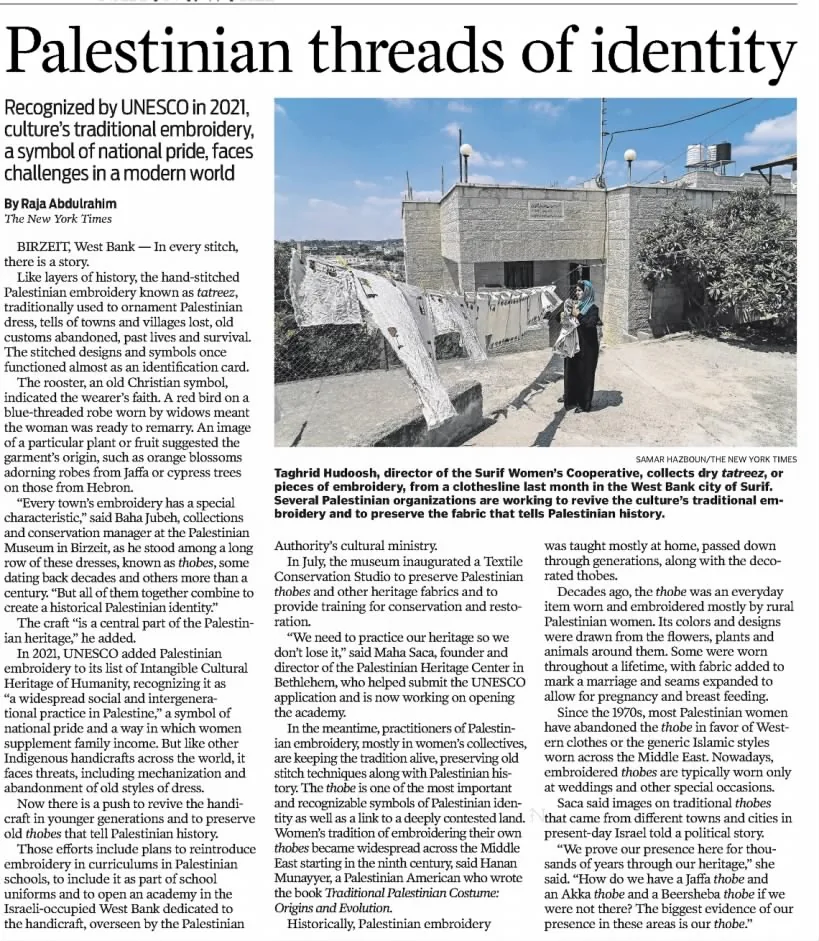
Photograph caption
“Taghrid Hudoosh, director of the Surif Women’s Cooperative, collects dry tatreez, or pieces of embroidery, from a clothesline last month in the West Bank city of Surif. Several Palestinian organizations are working to revive the culture’s traditional embroidery and to preserve the fabric that tells Palestinian history.” · Samar Hazboun / The New York Times
Context added by this archive
Printed twenty-six days before the line this archive stops at. Four Palestinians are named, three of them women, and the argument one of them makes is the whole presence case put through needlework: how do we have a Jaffa thobe and an Akka thobe and a Beersheba thobe if we were not there. The detail that stays with you is the dress worn for a lifetime, with fabric added at a marriage and the seams let out for pregnancy and feeding. Written by a Palestinian reporter and photographed by a Palestinian photographer, in the same West Bank town whose empty museum this archive holds from 2016.
Cite this item
"Palestinian threads of identity," The Santa Fe New Mexican, 10 September 2023. Covering Palestine archive, CP-2023-074. https://coveringpalestine.org/archive/cp-2023-074
Elsewhere in the archive
- Gaza Strip: Hardship falls below ‘emergency’ threshold, but blockade shutters factories and clinics, and leaves everyone relying on aidThe Santa Fe New Mexican · 14 June 2010 · the same newspaper
- Israeli minister defies leadership with visit to Jerusalem flash pointThe Philadelphia Inquirer · 4 January 2023 · the same year
- Visit to Jerusalem holy site stokes angerLos Angeles Times · 4 January 2023 · the same year
- Israel official’s site visit assailedNew Jersey Herald · 4 January 2023 · the same year
This record is part of Covering Palestine, an archive of American and Anglophone newspaper clippings about Palestinians, 1812 to 2022. Researched and assembled by Maria Robles.
The clipping belongs to the newspaper that printed it, or to the wire service that supplied the copy. It is reproduced here for research, criticism and commentary. The city is derived from the masthead, not read off the clipping.
Something wrong here, or something you know about this clipping? The archive is still being built and corrections are wanted: maria@rozumstudio.com, quoting CP-2023-074.
See it in the archive reel · Full text of every clipping · Dataset