The Arizona Republic · Phoenix, Arizona · 28 April 2021
CP-2021-007
Phoenix family shares recipe for rice dish
Priscilla Totiyapungprasert, Arizona Republic / USA Today Network
Transcribed from the clipping
“Ramadan looks different during a pandemic, but Salmah Monsour feels determined to make the most of it. While there are no festive gatherings at her local mosque in Laveen, Monsour still tries to get her children excited by making Palestinian sweets together and decorating their house with ornaments, paper lanterns and strings of lights. And instead of helping herself to catering from the mosque, she’s preparing homecooked meals every day of the holy month. Recently, she made one of her favorites, maqluba. Maqluba, which means ‘upside down’ in Arabic, is a popular dish that Palestinian families like to make during Ramadan, she said. The layered dish is cooked in one pot. Meat such as lamb or chicken is stewed on the bottom with vegetables such as cauliflower and eggplant, then rice is poured on top and everything is cooked together. Right before serving, the pot is flipped upside down on a plate. It can be served with salad and yogurt on the side. ‘We’re always debating what we should make the first week of Ramadan and anytime I talk to anyone from the Levant, Jordanians, Palestinians, they say maqluba. It dates back hundreds and hundreds of years in our history,’ Monsour said… Growing up in California, her family usually celebrated at home with a feast and lots of sweets. Monsour said her favorite activity as a child was rolling the grape leaves and stuffing the squash and eggplant — though she was slow to roll, unlike her mother, who could swiftly roll the leaves between the palms of her hands… ‘I know a lot of households are probably sick of being around each other and want to get out, but I see the opposite here,’ Monsour said. ‘We actually sit down and take the time to talk, not in a hurry to go anywhere or be anywhere. There’s a different closeness I observed, and the time we’ve taken to talk about things that are important to us and family values.’ Maqluba. As told by Salmah Monsour. The reason why we make maqluba is because it’s one of the oldest dishes in Palestinian history. I always end up cooking for an army, so there’s always leftovers. Serves: 6-8 people… About 2 lbs of lamb pieces, bone in, cut 4” by 4”… 4 cups of basmati rice… Handful of browned vermicelli noodles… Toasted almonds and chopped parsley, to garnish… Place the pot on medium-high heat and let it bubble. Then cover the pot and reduce heat to low and let cook for about 50 minutes… Once ready to serve, use a large tray or plate with raised edges to place on top of the pot. Swiftly flip the pot over… allowing gravity to pull the maqluba down. Carefully lift the pot up to keep the maqluba intact.”
Photograph caption
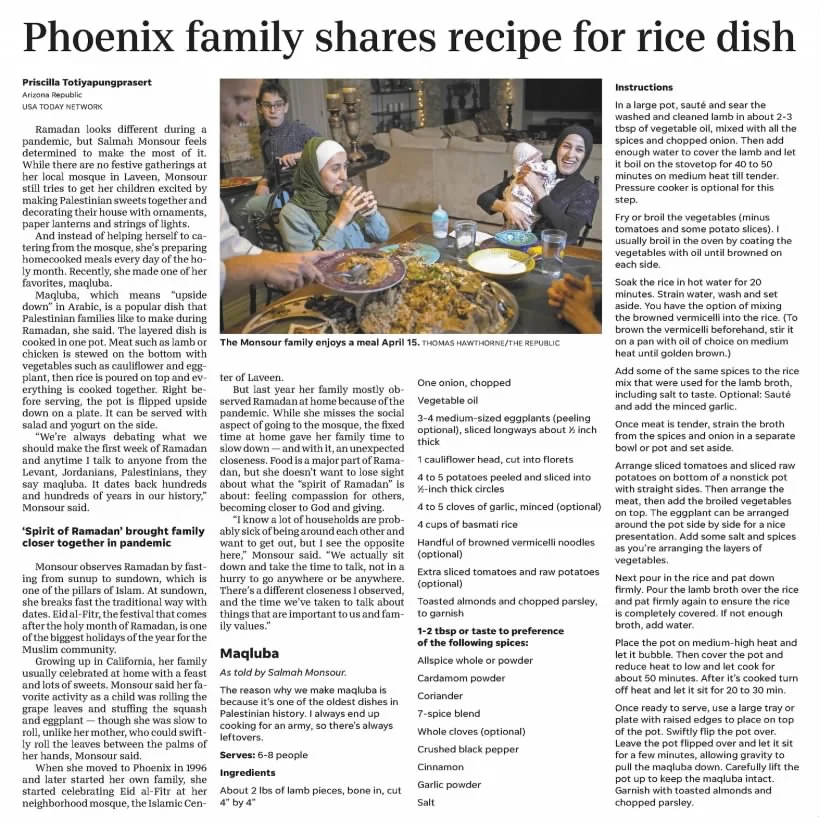
“The Monsour family enjoys a meal April 15.” · Thomas Hawthorne / The Republic
Context added by this archive
A recipe. Weights, timings, a note that she always cooks for an army. The photograph shows the family at the table, laughing. Nothing in it is about the war, and the only reason this is unusual is the rest of this archive.
Cite this item
"Phoenix family shares recipe for rice dish," The Arizona Republic, 28 April 2021. Covering Palestine archive, CP-2021-007. https://coveringpalestine.org/archive/cp-2021-007
Elsewhere in the archive
- Palestinian artists protestThe Arizona Republic · 1 November 2002 · the same newspaper
- Palestinians remember ‘Nakba’The Arizona Republic · 6 July 1998 · the same newspaper
- Netanyahu’s 450 ‘security reasons’The Arizona Republic · 11 October 1996 · the same newspaper
- Cooking TogetherChicago Tribune · 7 May 2021 · the same year
- If we’re against genocide we should look at PalestineThe Capital Times · 19 May 2021 · the same year
- Damage is inspected at a house in Deir el-Balah in the central Gaza StripHerald News · 20 May 2021 · the same year
This record is part of Covering Palestine, an archive of American and Anglophone newspaper clippings about Palestinians, 1812 to 2022. Researched and assembled by Maria Robles.
The clipping belongs to the newspaper that printed it, or to the wire service that supplied the copy. It is reproduced here for research, criticism and commentary. The city is derived from the masthead, not read off the clipping.
Something wrong here, or something you know about this clipping? The archive is still being built and corrections are wanted: maria@rozumstudio.com, quoting CP-2021-007.
See it in the archive reel · Full text of every clipping · Dataset