St. Louis Jewish Light · St. Louis, Missouri · 24 February 2021
CP-2021-010
Joe and Bibi talked, but what's it mean? Biden and Israel, the scorecard.
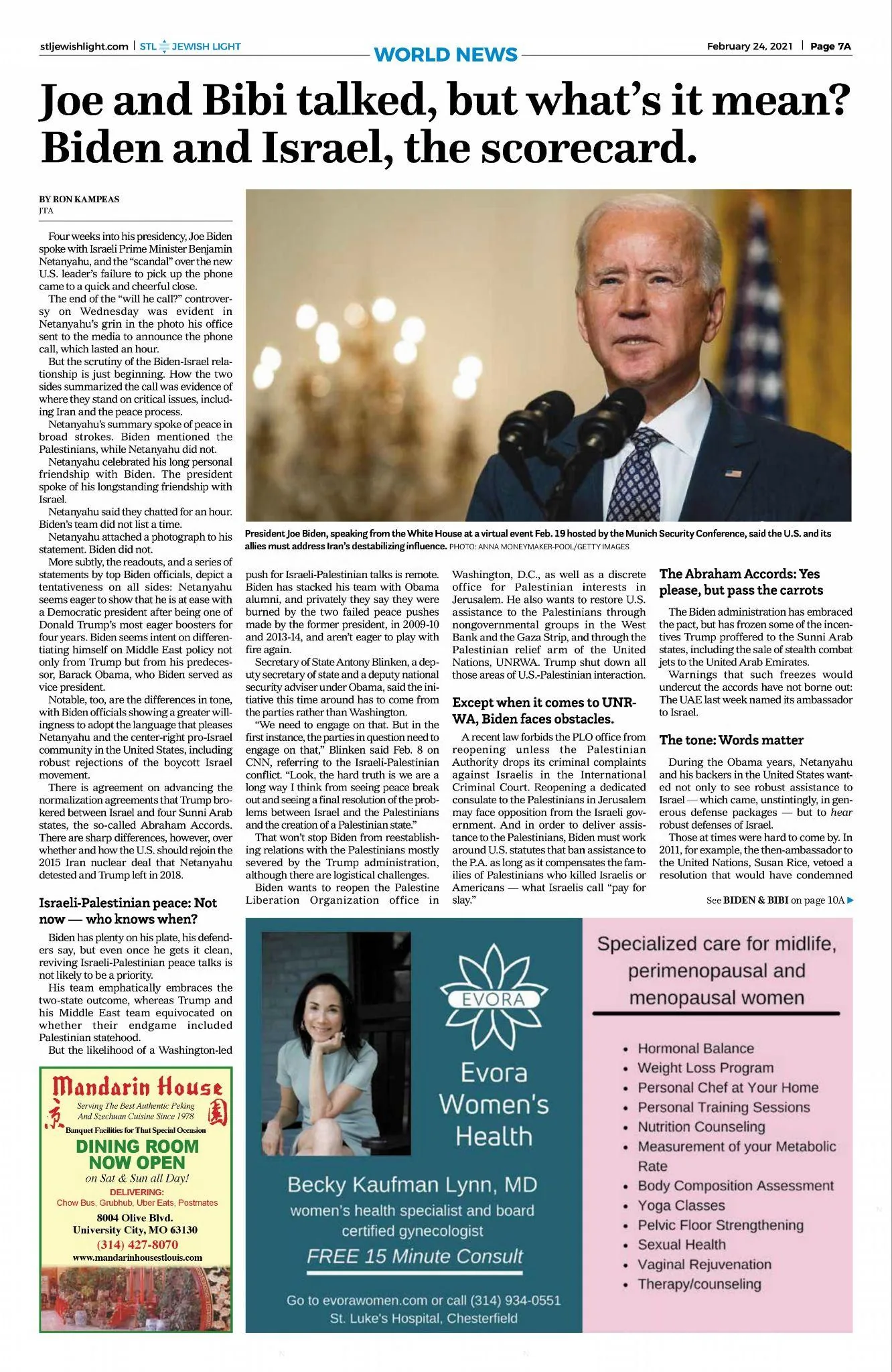
Transcribed from the clipping
Four weeks into his presidency, Joe Biden spoke with Israeli Prime Minister Benjamin Netanyahu, and the “scandal” over the new U.S. leader’s failure to pick up the phone came to a quick and cheerful close.
The end of the “will he call?” controversy on Wednesday was evident in Netanyahu’s grin in the photo his office sent to the media to announce the phone call, which lasted an hour. But the scrutiny of the Biden-Israel relationship is just beginning.
How the two sides summarized the call was evidence of where they stand on critical issues, including Iran and the peace process. Netanyahu’s summary spoke of peace in broad strokes. Biden mentioned the Palestinians, while Netanyahu did not. Netanyahu celebrated his long personal friendship with Biden. The president spoke of his longstanding friendship with Israel.
Netanyahu said they chatted for an hour. Biden’s team did not list a time. Netanyahu attached a photograph to his statement. Biden did not.
More subtly, the readouts, and a series of statements by top Biden officials, depict a tentativeness on all sides: Netanyahu seems eager to show that he is at ease with a Democratic president after being one of Donald Trump’s most eager boosters for four years.
Biden seems intent on differentiating himself on Middle East policy not only from Trump but from his predecessor, Barack Obama, who Biden served as vice president.
Notable, too, are the differences in tone, with Biden officials showing a greater willingness to adopt the language that pleases Netanyahu and the center-right pro-Israel community in the United States, including robust rejections of the boycott Israel movement.
There is agreement on advancing the normalization agreements that Trump brokered between Israel and four Sunni Arab states, the so-called Abraham Accords. There are sharp differences, however, over whether and how the U.S. should rejoin the 2015 Iran nuclear deal that Netanyahu detested and Trump left in 2018. Israeli-Palestinian peace: Not now — who knows when?
Biden has plenty on his plate, his defenders say, but even once he gets it clean, reviving Israeli-Palestinian peace talks is not likely to be a priority. His team emphatically embraces the two-state outcome, whereas Trump and his Middle East team equivocated on whether their endgame included Palestinian statehood.
But the likelihood of a Washington-led push for Israeli-Palestinian talks is remote. Biden has stacked his team with Obama alumni, and privately they say they were burned by the two failed peace pushes made by the former president, in 2009-10 and 2013-14, and aren’t eager to play with fire again.
Secretary of State Antony Blinken, a deputy secretary of state and a deputy national security adviser under Obama, said the initiative this time around has to come from the parties rather than Washington. “We need to engage on that. But in the first instance, the parties in question need to engage on that,” Blinken said Feb.
8 on CNN, referring to the Israeli-Palestinian conflict. “Look, the hard truth is we are a long way I think from seeing peace break out and seeing a final resolution of the problems between Israel and the Palestinians and the creation of a Palestinian state.”
That won’t stop Biden from reestablishing relations with the Palestinians mostly severed by the Trump administration, although there are logistical challenges. Biden wants to reopen the Palestine Liberation Organization office in Washington, D.C., as well as a discrete office for Palestinian interests in Jerusalem.
He also wants to restore U.S. assistance to the Palestinians through nongovernmental groups in the West Bank and the Gaza Strip, and through the Palestinian relief arm of the United Nations, UNRWA. Trump shut down all those areas of U.S.-Palestinian interaction. Except when it comes to UNRWA, Biden faces obstacles.
A recent law forbids the PLO office from reopening unless the Palestinian Authority drops its criminal complaints against Israelis in the International Criminal Court. Reopening a dedicated consulate to the Palestinians in Jerusalem may face opposition from the Israeli government.
And in order to deliver assistance to the Palestinians, Biden must work around U.S. statutes that ban assistance to the P.A. as long as it compensates the families of Palestinians who killed Israelis or Americans — what Israelis call “pay for slay.”
The Abraham Accords: Yes please, but pass the carrots The Biden administration has embraced the pact, but has frozen some of the incentives Trump proffered to the Sunni Arab states, including the sale of stealth combat jets to the United Arab Emirates. Warnings that such freezes would undercut the accords have not borne out: The UAE last week named its ambassador to Israel.
The tone: Words matter During the Obama years, Netanyahu and his backers in the United States wanted not only to see robust assistance to Israel — which came, unstintingly, in generous defense packages — but to hear robust defenses of Israel.
How this transcription was made
Transcribed by optical character recognition and read back against the scan by hand.
Cite this clipping
"Joe and Bibi talked, but what's it mean? Biden and Israel, the scorecard.," St. Louis Jewish Light, 24 February 2021. Covering Palestine archive, CP-2021-010. https://coveringpalestine.org/archive/cp-2021-010
More from St. Louis Jewish Light
- The Truth Behind Those HeadlinesSt. Louis Jewish Light · 6 March 1947
- Arab Propaganda Takes New PathSt. Louis Jewish Light · 13 August 1969
- E. Jerusalem Guides Probed For PLO PropagandaSt. Louis Jewish Light · 30 August 1978
- PLO Propaganda Offensive Becomes Intense in ArgentinaSt. Louis Jewish Light · 17 April 1985
- The Palestinian Arabs: It’s Time to Demythologize HistorySt. Louis Jewish Light · 5 March 1986
- Netanyahu resigns as U.N. envoy; protests Shultz-PLO meetingSt. Louis Jewish Light · 6 April 1988
- 28 more from this paper in the full text →
More from the 2020s
- UCLA able to shield identities of 64 activistsLos Angeles Times · 17 March 2021
- Phoenix family shares recipe for rice dishThe Arizona Republic · 28 April 2021
- Cooking TogetherChicago Tribune · 7 May 2021
- Palestinians fear loss of homes as evictions loomThe Palm Beach Post · 11 May 2021
- Beset by virus, Gaza’s hospitals now struggle with woundedKentucky New Era · 15 May 2021
- Biden supports cease-fireDaily Citizen · 18 May 2021
- All 206 clippings from the 2020s →
Last updated 17 November 2026
This record is part of Covering Palestine, an archive of American newspaper clippings about Palestinians, 1724 to 2023. Researched and assembled by Maria Robles.
The clipping belongs to the newspaper that printed it, or to the news agency that supplied the copy. It is reproduced here for research, criticism and commentary. A city here is where the newspaper was published, not where the story came from, and on most records it was taken from the masthead.
Something wrong here, or something you know about this clipping? The archive is still being built and corrections are wanted: maria@rozumstudio.com, quoting CP-2021-010.
Everything printed in 2021 · Printed on this day · See it in the archive reel · Full text of every clipping · Dataset