Chicago Tribune · Chicago, Illinois · 7 May 2021
CP-2021-008
Cooking Together
The iftar meal looks different during a pandemic Ramadan, but Chicago-area Muslims are finding solace in traditional, tenderly made dishes
Zareen Syed, Chicago Tribune
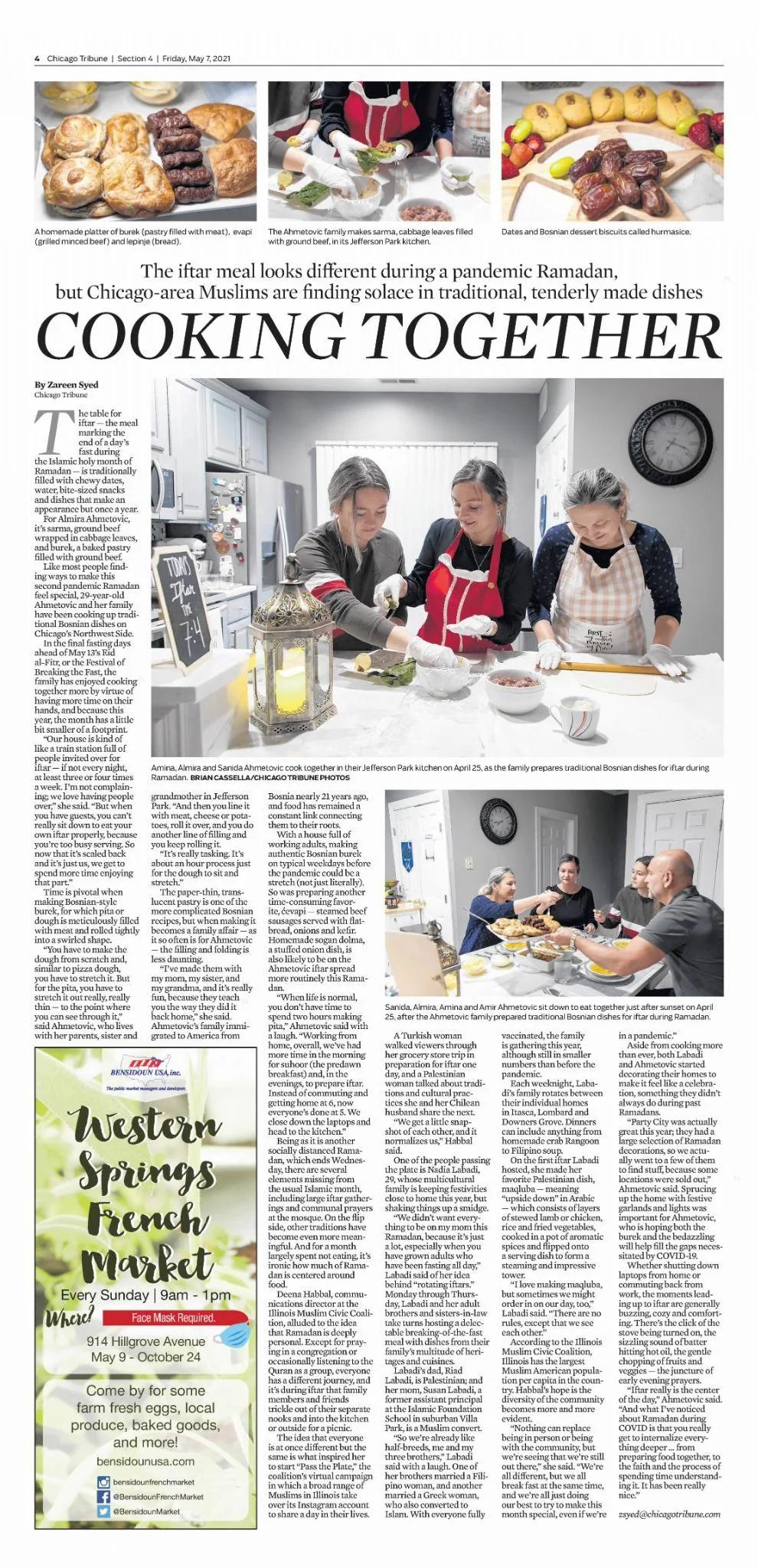
Transcribed from the clipping
“The table for iftar — the meal marking the end of a day’s fast during the Islamic holy month of Ramadan — is traditionally filled with chewy dates, water, bite-sized snacks and dishes that make an appearance but once a year… A Turkish woman walked viewers through her grocery store trip in preparation for iftar one day, and a Palestinian woman talked about traditions and cultural practices she and her Chilean husband share the next. ‘We get a little snapshot of each other, and it normalizes us,’ Habbal said. One of the people passing the plate is Nadia Labadi, 29, whose multicultural family is keeping festivities close to home this year, but shaking things up a smidge. ‘We didn’t want everything to be on my mom this Ramadan, because it’s just a lot, especially when you have grown adults who have been fasting all day,’ Labadi said of her idea behind ‘rotating iftars.’ Monday through Thursday, Labadi and her adult brothers and sisters-in-law take turns hosting a delectable breaking-of-the-fast meal with dishes from their family’s multitude of heritages and cuisines. Labadi’s dad, Riad Labadi, is Palestinian; and her mom, Susan Labadi, a former assistant principal at the Islamic Foundation School in suburban Villa Park, is a Muslim convert. ‘So we’re already like half-breeds, me and my three brothers,’ Labadi said with a laugh. One of her brothers married a Filipino woman, and another married a Greek woman, who also converted to Islam. With everyone fully vaccinated, the family is gathering this year, although still in smaller numbers than before the pandemic… On the first iftar Labadi hosted, she made her favorite Palestinian dish, maqluba — meaning ‘upside down’ in Arabic — which consists of layers of stewed lamb or chicken, rice and fried vegetables, cooked in a pot of aromatic spices and flipped onto a serving dish to form a steaming and impressive tower. ‘I love making maqluba, but sometimes we might order in on our day, too,’ Labadi said. ‘There are no rules, except that we see each other.’ According to the Illinois Muslim Civic Coalition, Illinois has the largest Muslim American population per capita in the country… ‘Nothing can replace being in person or being with the community, but we’re seeing that we’re still out there,’ she said.”
Context added by this archive
Not a Palestinian story: the family at the centre of it is Bosnian, and the page is about how Chicago Muslims kept Ramadan during a pandemic. Nadia Labadi gets a few paragraphs, and what she chooses to cook for the first iftar she hosts is maqluba. It is the sixth printing of that dish in this archive and the second in 2021 alone, the other being a Ramadan feature in Phoenix eleven days earlier.
Cite this item
"Cooking Together," Chicago Tribune, 7 May 2021. Covering Palestine archive, CP-2021-008. https://coveringpalestine.org/archive/cp-2021-008
Elsewhere in the archive
- Israel to release 1st group of Palestinian prisonersChicago Tribune · 13 August 2013 · the same newspaper
- Use of human shields complicates Israel’s approachChicago Tribune · 27 November 2006 · the same newspaper
- Newly freed Palestinians bittersweetChicago Tribune · 10 September 1999 · the same newspaper
- Phoenix family shares recipe for rice dishThe Arizona Republic · 28 April 2021 · the same year
- If we’re against genocide we should look at PalestineThe Capital Times · 19 May 2021 · the same year
- Damage is inspected at a house in Deir el-Balah in the central Gaza StripHerald News · 20 May 2021 · the same year
This record is part of Covering Palestine, an archive of American and Anglophone newspaper clippings about Palestinians, 1812 to 2022. Researched and assembled by Maria Robles.
The clipping belongs to the newspaper that printed it, or to the wire service that supplied the copy. It is reproduced here for research, criticism and commentary. The city is derived from the masthead, not read off the clipping.
Something wrong here, or something you know about this clipping? The archive is still being built and corrections are wanted: maria@rozumstudio.com, quoting CP-2021-008.
See it in the archive reel · Full text of every clipping · Dataset