The New York Times · New York, New York · 10 July 2002
CP-2002-088
A History of the Mideast In the Humble Chickpea
A common food like falafel can unite or divide.
By JODI KANTOR
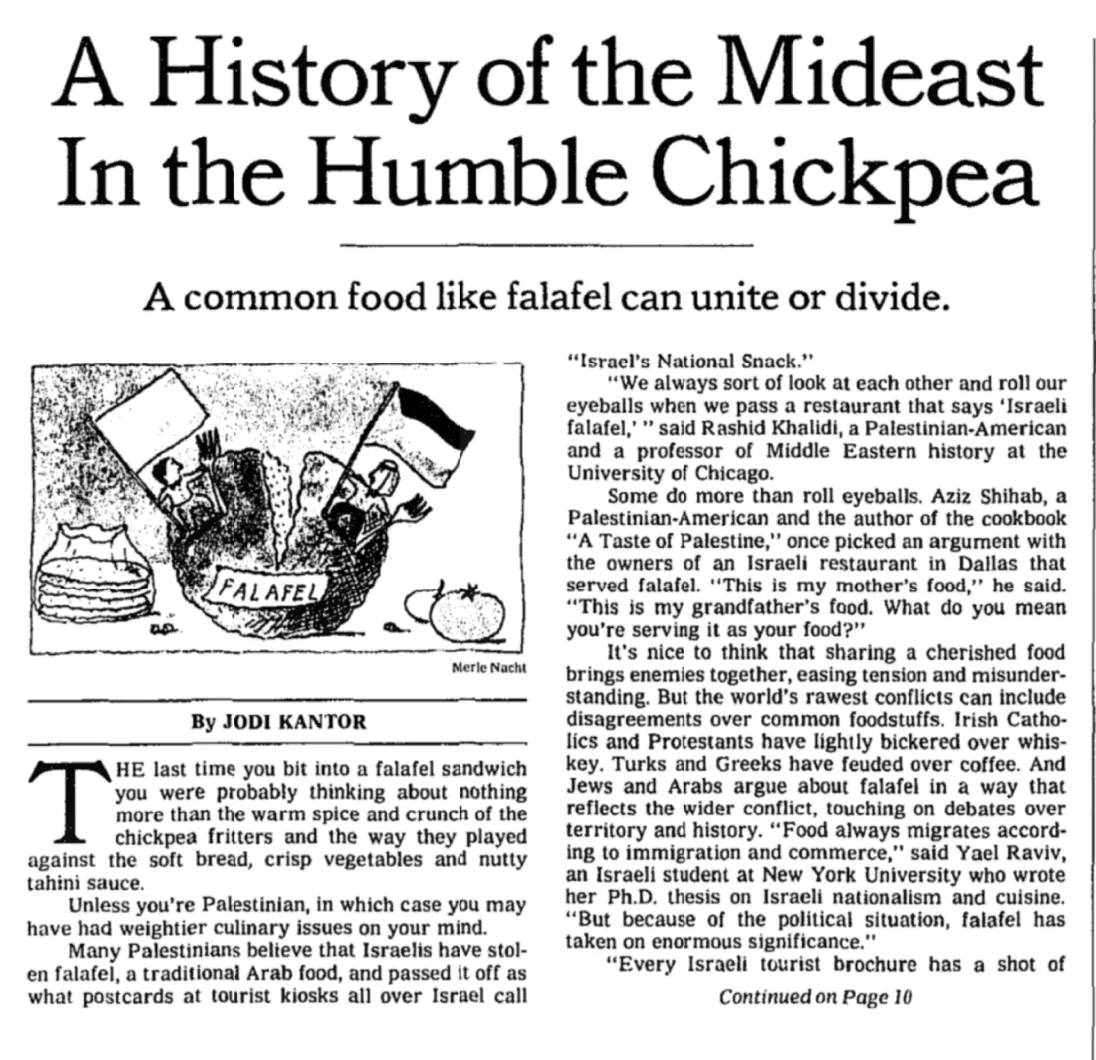
Transcribed from the clipping
THE last time you bit into a falafel sandwich you were probably thinking about nothing more than the warm spice and crunch of the chickpea fritters and the way they played against the soft bread, crisp vegetables and nutty tahini sauce. Unless you’re Palestinian, in which case you may have had weightier culinary issues on your mind.
Many Palestinians believe that Israelis have stolen falafel, a traditional Arab food, and passed it off as what postcards at tourist kiosks all over Israel call “Israel’s National Snack.”
“We always sort of look at each other and roll our eyeballs when we pass a restaurant that says ‘Israeli falafel,’” said Rashid Khalidi, a Palestinian-American and a professor of Middle Eastern history at the University of Chicago. Some do more than roll eyeballs.
Aziz Shihab, a Palestinian-American and the author of the cookbook “A Taste of Palestine,” once picked an argument with the owners of an Israeli restaurant in Dallas that served falafel. “This is my mother’s food,” he said. “This is my grandfather’s food. What do you mean you’re serving it as your food?”
It’s nice to think that sharing a cherished food brings enemies together, easing tension and misunderstanding. But the world’s rawest conflicts can include disagreements over common foodstuffs. Irish Catholics and Protestants have lightly bickered over whiskey. Turks and Greeks have feuded over coffee.
And Jews and Arabs argue about falafel in a way that reflects the wider conflict, touching on debates over territory and history. “Food always migrates according to immigration and commerce,” said Yael Raviv, an Israeli student at New York University who wrote her Ph.D. thesis on Israeli nationalism and cuisine.
“But because of the political situation, falafel has taken on enormous significance.”
How this transcription was made
Read from the scan by a machine looking at the image of the page, not by optical character recognition and not by a person. The clipping carries no masthead and no dated folio line, so the date recorded here could not be checked against anything printed on the page. Nothing on the page contradicts it.
Cite this clipping
"A History of the Mideast In the Humble Chickpea," The New York Times, 10 July 2002. Covering Palestine archive, CP-2002-088. https://coveringpalestine.org/archive/cp-2002-088
This clipping is read closely in the section below
More from The New York Times
- The Maine Colony in PalestineThe New York Times · 12 November 1866
- Jewish Colonization in PalestineThe New York Times · 9 December 1883
- Jewish State in Palestine OpposedThe New York Times · 9 July 1897
- ZIONIST CONGRESS IN BASELThe New York Times · 31 August 1897
- ROME FEARS THE ZIONISTSThe New York Times · 12 September 1897
- PROGRESS OF ZIONISMThe New York Times · 16 December 1901
- 852 more from this paper in the full text →
More from the 2000s
- Don’t forget it’s an Israeli occupationThe Daily Press · 1 January 2002
- Soothing Israel’s FearsThe New York Times · 7 January 2002
- Israel, in Reprisal for Killings, Razes Gaza Refugee HomesThe New York Times · 11 January 2002
- Refugees and Reparations in the MideastThe New York Times · 13 January 2002
- Israeli missiles strike naval baseThe Greenville News · 13 January 2002
- Friendship of Palestinian, architect defies oddsThe Bismarck Tribune · 17 January 2002
- All 516 clippings from the 2000s →
Last updated 2 November 2026
This record is part of Covering Palestine, an archive of American newspaper clippings about Palestinians, 1724 to 2023. Researched and assembled by Maria Robles.
The clipping belongs to the newspaper that printed it, or to the news agency that supplied the copy. It is reproduced here for research, criticism and commentary. A city here is where the newspaper was published, not where the story came from, and on most records it was taken from the masthead.
Something wrong here, or something you know about this clipping? The archive is still being built and corrections are wanted: maria@rozumstudio.com, quoting CP-2002-088.
Read in: The dish, the thread, the wood
Everything printed in 2002 · Printed on this day · See it in the archive reel · Full text of every clipping · Dataset