Corpus Christi Caller · Corpus Christi, Texas · 29 July 1973
CP-1973-006
Palestinian food, music survive
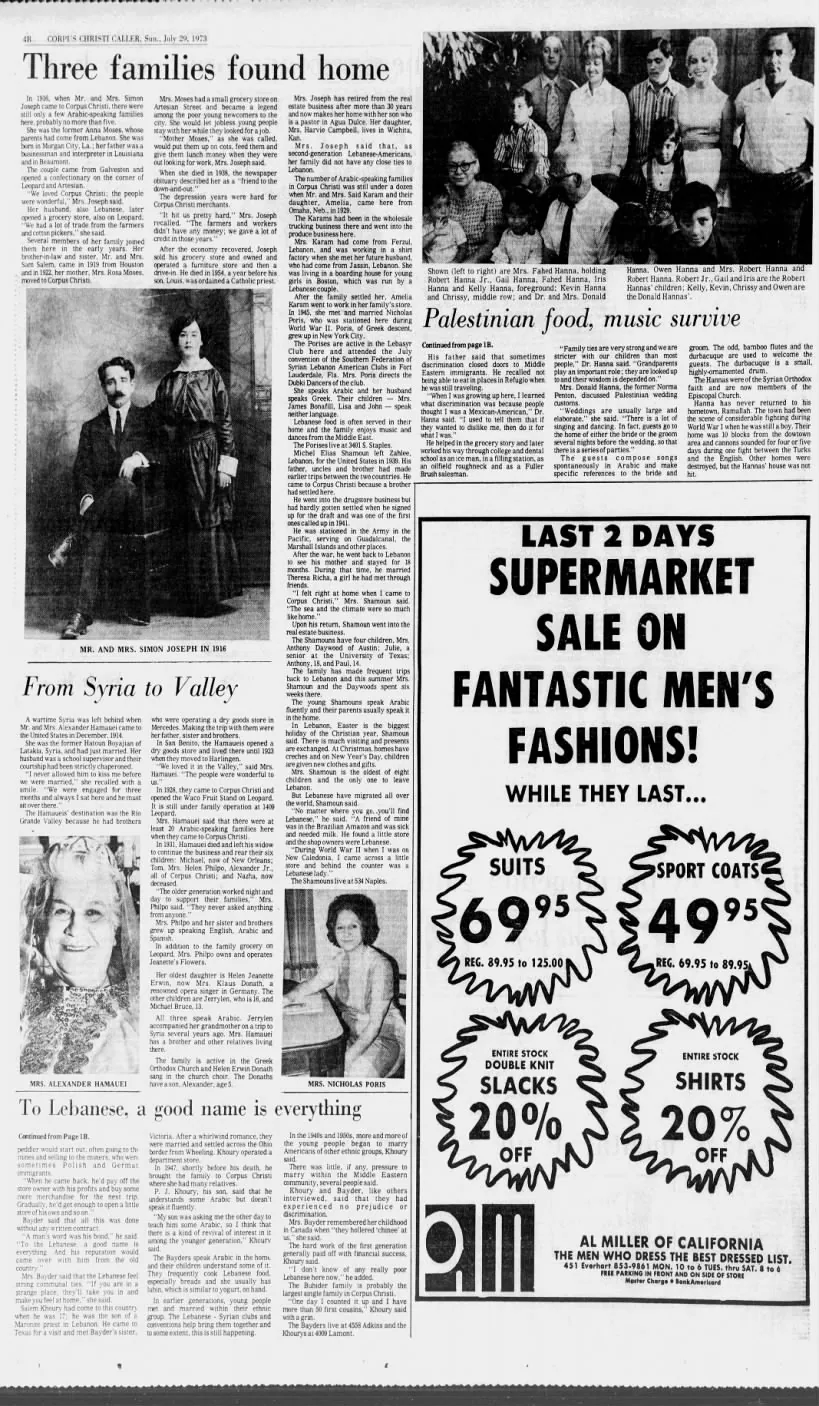
Transcribed from the clipping
“Mrs. Donald Hanna, the former Norma Pennon, discussed Palestinian wedding customs. ‘Weddings are usually large and elaborate,’ she said. ‘There is a lot of singing and dancing. In fact, guests go to the home of either the bride or the groom several nights before the wedding, so that there is a series of parties.’
The guests compose songs spontaneously in Arabic and make specific references to the bride and groom. The odd, bamboo flutes and the durbaeque are used to welcome the guests. The durbaeque is a small, highly-ornamented drum. The Hannas were of the Syrian Orthodox faith and are now members of the Episcopal Church. Hanna has never returned to his hometown, Ramallah.
The town had been the scene of considerable fighting during World War I when he was still a boy. Their home was 10 blocks from the downtown area and cannons sounded for four or five days during one fight between the Turks and the English.
Other homes were destroyed, but the Hannas’ house was not hit.… ‘Family ties are very strong and we are stricter with our children than most people,’ Dr. Hanna said.
‘Grandparents play an important role; they are looked up to and their wisdom is depended on.’… ‘When I was growing up here, I learned what discrimination was because people thought I was a Mexican-American,’ Dr. Hanna said.
‘I used to tell them that if they wanted to dislike me, then do it for what I was.’ He helped in the grocery story and later worked his way through college and dental school as an ice man, in a filling station, as an oilfield roughneck and as a Fuller Brush salesman… His father said that sometimes discrimination closed doors to Middle Eastern immigrants.
He recalled not being able to eat in places in Refugio when he was still traveling… The number of Arabic-speaking families in Corpus Christi was still under a dozen when Mr. and Mrs. Said Karam and their daughter, Amelia, came here from Omaha, Neb., in 1929.”
Context added by this archive
A Sunday feature on the Arabic-speaking families of Corpus Christi, in which the Palestinian one gets its own standing head: Palestinian food, music survive. What survives is a wedding — nights of parties before the day, songs composed on the spot in Arabic naming the bride and groom, bamboo flutes and a small ornamented drum the paper spells durbaeque.
A dentist who worked oilfields and sold Fuller brushes says the discrimination he grew up with was for being taken for Mexican-American. Thirteen members of the family are named in the photograph caption.
Cite this clipping
"Palestinian food, music survive," Corpus Christi Caller, 29 July 1973, p. 1. Covering Palestine archive, CP-1973-006. https://coveringpalestine.org/archive/cp-1973-006
This clipping is read closely in the section below
More from the 1970s
- French Plan Protection For Israeli(newspaper unidentified) · 10 January 1973
- Paris Police Plan Special Security Measures for Meir(newspaper unidentified) · 10 January 1973
- Mrs. Meir's Safety StudiedLos Angeles Times · 11 January 1973
- Cases of senseless murder and wanton destructionWisconsin Jewish Chronicle · 19 January 1973
- Palestinian Runs : Arab Newspaper In E. JerusalemDuluth News-Tribune · 4 February 1973
- Israeli Arabs and Jews unite for right of villagers to returnDaily World · 23 February 1973
- All 353 clippings from the 1970s →
In these collections
Last updated 17 November 2026
This record is part of Covering Palestine, an archive of American newspaper clippings about Palestinians, 1724 to 2023. Researched and assembled by Maria Robles.
The clipping belongs to the newspaper that printed it, or to the news agency that supplied the copy. It is reproduced here for research, criticism and commentary. A city here is where the newspaper was published, not where the story came from, and on most records it was taken from the masthead.
Something wrong here, or something you know about this clipping? The archive is still being built and corrections are wanted: maria@rozumstudio.com, quoting CP-1973-006.
Read in: The dish, the thread, the wood
Everything printed in 1973 · Printed on this day · See it in the archive reel · Full text of every clipping · Dataset