Los Angeles Times · Los Angeles, California · 25 October 2017
CP-2017-017
Quiet power of embroidery hits eloquently
By Leah Ollman
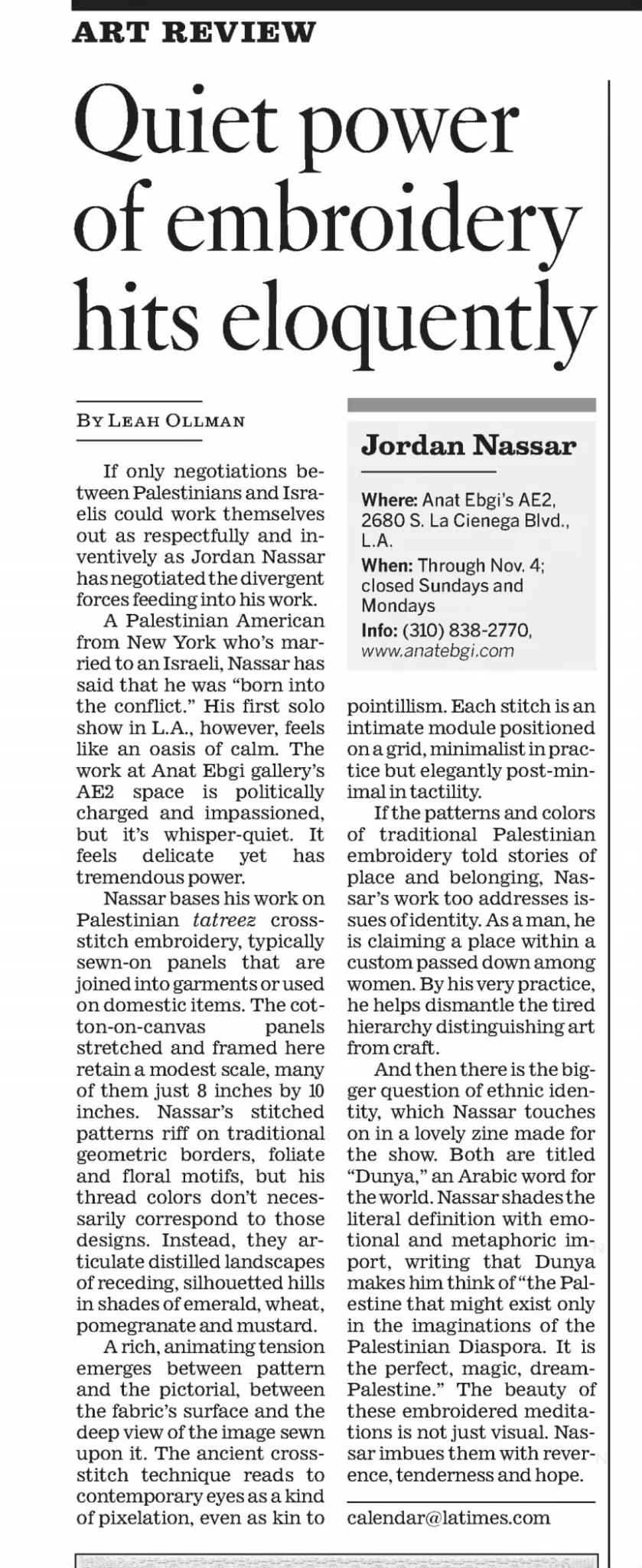
Transcribed from the clipping
If only negotiations between Palestinians and Israelis could work themselves out as respectfully and inventively as Jordan Nassar has negotiated the divergent forces feeding into his work. A Palestinian American from New York who’s married to an Israeli, Nassar has said that he was “born into the conflict.” His first solo show in L.A., however, feels like an oasis of calm.
The work at Anat Ebgi gallery’s AE2 space is politically charged and impassioned, but it’s whisper-quiet. It feels delicate yet has tremendous power. Nassar bases his work on Palestinian tatreez cross-stitch embroidery, typically sewn-on panels that are joined into garments or used on domestic items.
The cotton-on-canvas panels stretched and framed here retain a modest scale, many of them just 8 inches by 10 inches. Nassar’s stitched patterns riff on traditional geometric borders, foliate and floral motifs, but his thread colors don’t necessarily correspond to those designs.
Instead, they articulate distilled landscapes of receding, silhouetted hills in shades of emerald, wheat, pomegranate and mustard. A rich, animating tension emerges between pattern and the pictorial, between the fabric’s surface and the deep view of the image sewn upon it.
The ancient cross-stitch technique reads to contemporary eyes as a kind of pixelation, even as kin to pointillism. Each stitch is an intimate module positioned on a grid, minimalist in practice but elegantly post-minimal in tactility.
If the patterns and colors of traditional Palestinian embroidery told stories of place and belonging, Nassar’s work too addresses issues of identity. As a man, he is claiming a place within a custom passed down among women. By his very practice, he helps dismantle the tired hierarchy distinguishing art from craft.
And then there is the bigger question of ethnic identity, which Nassar touches on in a lovely zine made for the show. Both are titled “Dunya,” an Arabic word for the world. Nassar shades the literal definition with emotional and metaphoric import, writing that Dunya makes him think of “the Palestine that might exist only in the imaginations of the Palestinian Diaspora.
It is the perfect, magic, dream-Palestine.” The beauty of these embroidered meditations is not just visual. Nassar imbues them with reverence, tenderness and hope.
How this transcription was made
Read from the scan by a machine looking at the image of the page, not by optical character recognition and not by a person. The clipping carries no masthead and no dated folio line, so the date recorded here could not be checked against anything printed on the page. Nothing on the page contradicts it.
Cite this clipping
"Quiet power of embroidery hits eloquently," Los Angeles Times, 25 October 2017. Covering Palestine archive, CP-2017-017. https://coveringpalestine.org/archive/cp-2017-017
This clipping is read closely in the section below
More from Los Angeles Times
- The Palestinians’ EvolutionLos Angeles Times · 21 March 1969
- Bomb Victim Had Expected DeathLos Angeles Times · 10 July 1972
- Mrs. Meir's Safety StudiedLos Angeles Times · 11 January 1973
- Show of Artists from PalestineLos Angeles Times · 24 June 1977
- UCLA Jewish Groups Ask Palestinian BanLos Angeles Times · 21 October 1984
- UCLA Renews Rival Groups' StatusLos Angeles Times · 1 November 1984
- 60 more from this paper in the full text →
More from the 2010s
- A two-faced policy cooked up with just one of the sidesJackson Citizen Patriot · 3 January 2017
- A two-state solution is the only oneTelegram & Gazette · 3 January 2017
- Keep Mideast peace option aliveClarion Ledger · 5 January 2017
- How about sticking with ally Israel?Omaha World-Herald · 5 January 2017
- Israeli military at odds with political classThe Register-Guard · 7 January 2017
- A Palestinian lightning rodLos Angeles Times · 11 January 2017
- All 343 clippings from the 2010s →
Last updated 17 November 2026
This record is part of Covering Palestine, an archive of American newspaper clippings about Palestinians, 1724 to 2023. Researched and assembled by Maria Robles.
The clipping belongs to the newspaper that printed it, or to the news agency that supplied the copy. It is reproduced here for research, criticism and commentary. A city here is where the newspaper was published, not where the story came from, and on most records it was taken from the masthead.
Something wrong here, or something you know about this clipping? The archive is still being built and corrections are wanted: maria@rozumstudio.com, quoting CP-2017-017.
Read in: The dish, the thread, the wood
Everything printed in 2017 · Printed on this day · See it in the archive reel · Full text of every clipping · Dataset